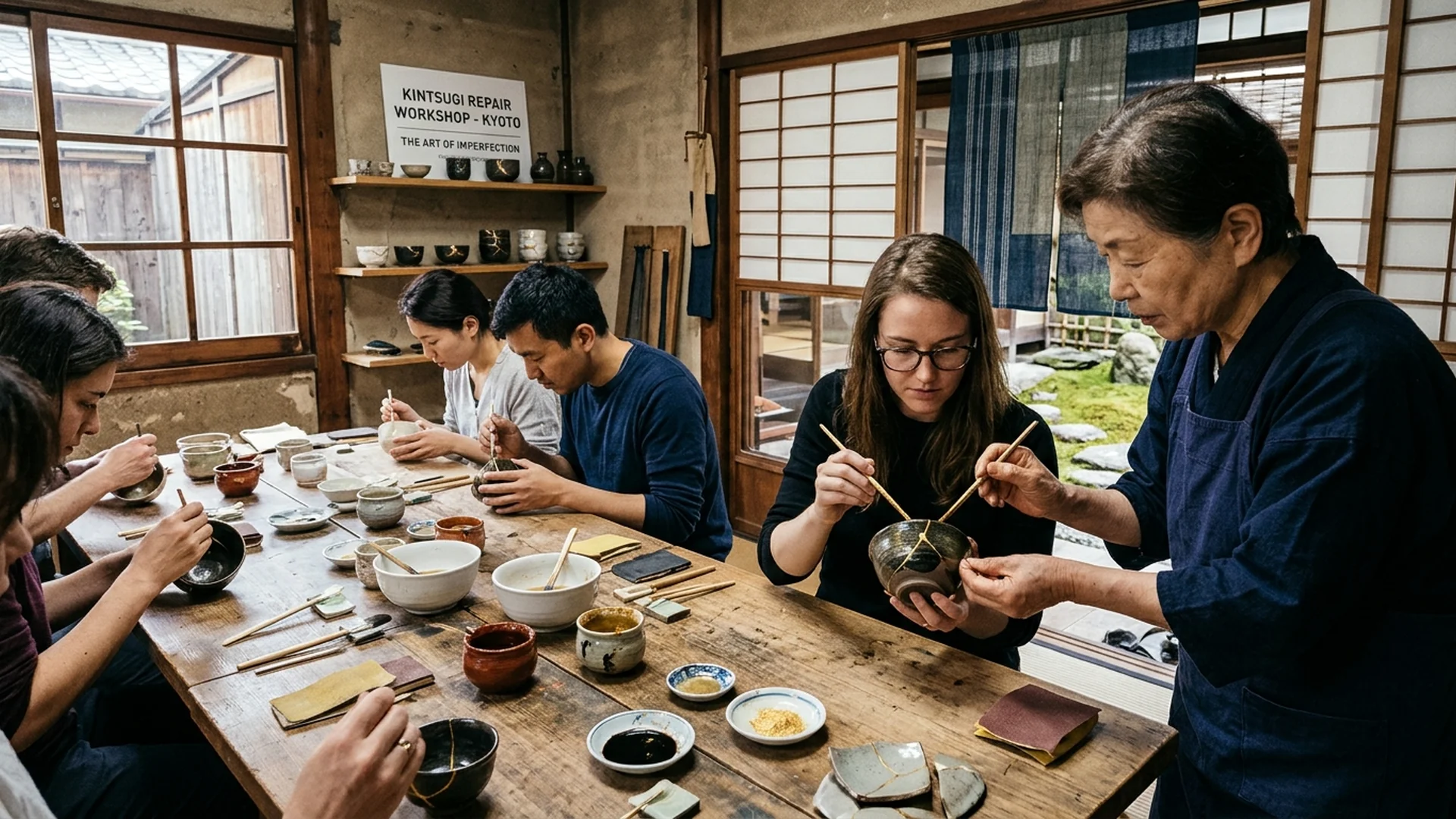
Amidst the quiet stillness of a suburban Kyoto studio, the gentle chime of artisan tools mingles with the faint, earthy aroma of natural tree sap, anchoring the mind entirely upon the delicate fragment of pottery held within one’s palms. Upon the matte wooden table lies a jagged fracture that was once viewed merely as damage. Yet under the ancient lens of Kintsugi, those perceived flaws are not an ending, but rather the beginning of a renaissance illuminated in brilliant gold—a meticulous ritual that not only restores the vessel to functional grace, but mends the spirit of its creator, imparting a profound appreciation for imperfection.
In an era driven by relentless velocity, this venerable art of repair has emerged as a vital pilgrimage for cultured travelers and seekers of inner tranquility. Participating in Kintsugi workshops across Tokyo and Kyoto transcends the acquisition of a mere handicraft to take home; it is an inward expedition into the heart of Wabi-Sabi, honoring the unvarnished truths of impermanence, the passage of time, and the exquisite beauty hidden quietly within our scars.
The Roots of Time: When Fractures Become Beauty in Wabi-Sabi Philosophy
Kintsugi (金継ぎ), occasionally referred to as Kintsukuroi (金繕い), traces its origins to the 15th century during the golden age of the Japanese tea ceremony. Legend recounts that Shogun Ashikaga Yoshimasa dispatched a damaged imported tea bowl back to China for restoration, only to receive it returned fastened with unsightly metal staples entirely discordant with the bowl’s aesthetic harmony. He promptly challenged domestic artisans to conceive a repair method that would not disguise the damage, but rather elevate its fractured contours into a celebrated feature. Thus was born an art form that transforms structural failure into a sculptural masterpiece. The underlying philosophy is rooted in Wabi-Sabi, teaching us to embrace impermanence. The golden seams tracing each fracture do not attempt to erase a broken past; instead, they narrate the passage of time with consummate elegance.
Preserving Craftsmanship: The Divergence of Traditional and Modern Techniques
Upon stepping into a Kintsugi workshop, your introduction begins with the fundamental dichotomy of the craft. Traditional Kintsugi employs raw Urushi lacquer harvested from Japanese lacquer trees, a meticulous process demanding weeks or months of curing time alongside precise humidity control. However, for international travelers navigating tighter schedules, the majority of studios in Tokyo and Kyoto have thoughtfully curated Modern Kintsugi curricula. These utilize safe synthetic resins or epoxy adhesives paired with genuine gold powder or high-grade brass, empowering participants to complete their bespoke pieces and carry them home within a mere two to three hours while preserving the quintessential aesthetic of glowing golden lines.
The Guided Brushstroke: Crafting Your Masterpiece by Hand
The tactile engagement commences with the selection of a favored ceramic vessel provided by the studio, though discerning guests occasionally bring along cherished heirloom fragments from home. The initial phase involves gentle cleansing and the precise compounding of specialized adhesives to unite the fractured segments with absolute stability. Once the bonding agent sets, the meticulous application of colored lacquer or resin along the fissure precedes the delicate brushing of pure gold powder. During these quiet moments, ambient sounds seem to recede, leaving only the cadence of measured breaths and the gentle sweep of gold adhering to dark seams—a meditative prayer manifested through exquisite craftsmanship.