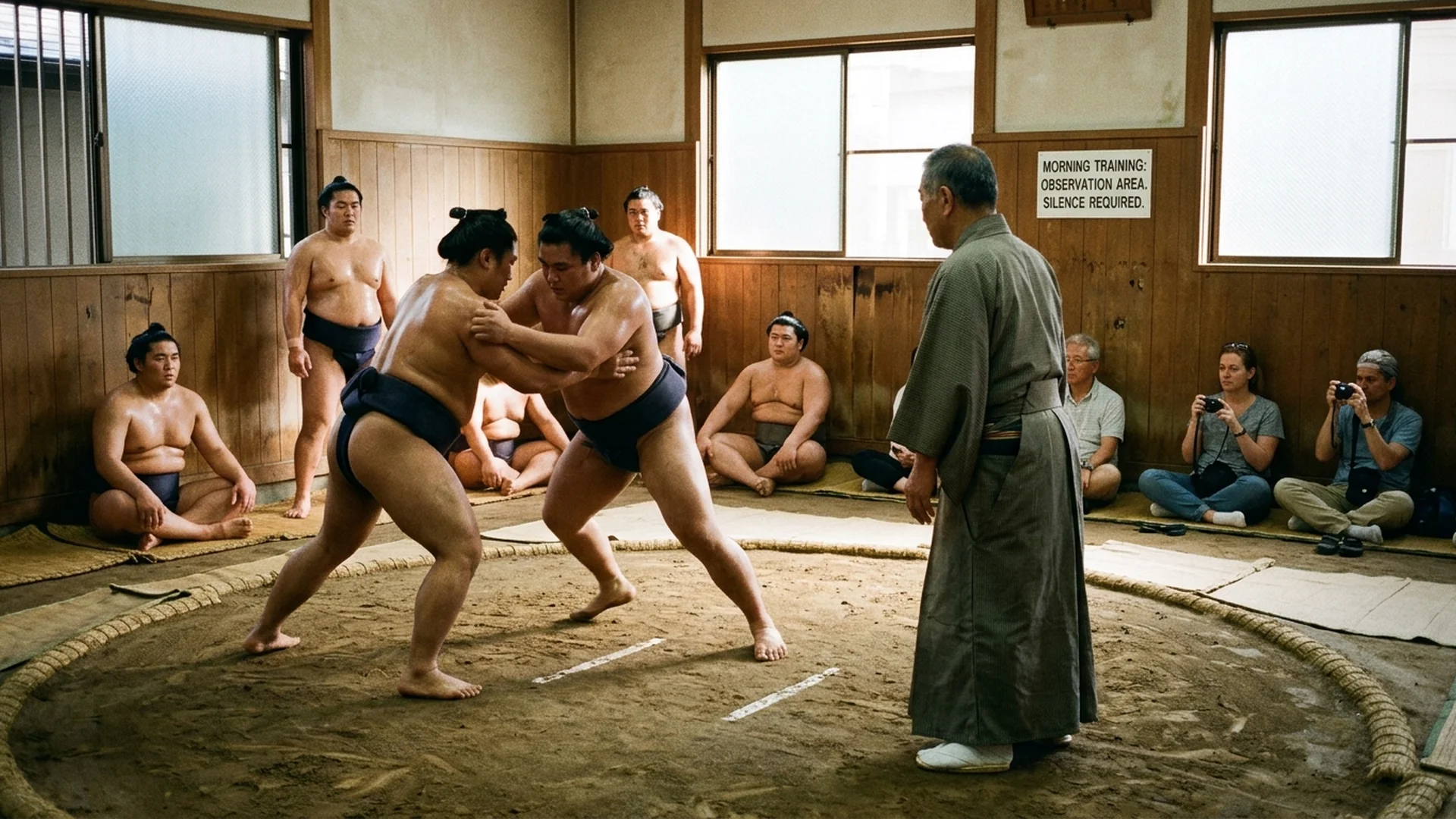
Before the first dawn light brushes the tiled rooftops of Tokyo’s historic Ryogoku district, the heavy thud of human mass and powerful footfalls upon packed clay has already begun behind the paper sliding doors of the sumo stable, or heya. This is far more than a mere athletic training ground; it is a sanctified space where discipline, history, and the enduring spirit of bushido have been preserved for centuries. To step inside and witness the morning training ritual known as Asageiko is to cross the threshold into another dimension of Japanese culture—one where profound silence, deep low-pitched roars, and sweat mingling with the chill of early morning coalesce into a powerful, living poetry of endurance.
For the discerning traveler seeking depth far beyond superficial entertainment, observing morning sumo training in Tokyo stands as one of the most elusive and treasured cultural privileges. Yet gaining entry into this hidden world is never a matter of simply purchasing a standard ticket. It demands a sophisticated understanding of sumo’s intricate social architecture, unwavering humility, and strict adherence to codified rules established to protect the honor of Japan’s national sport.
Architecture of Discipline: The Structure and Spirit Within the Heya
Upon crossing the threshold of a traditional sumo stable, the senses are immediately greeted by a distinct olfactory tapestry: the earthy scent of clay, the traditional bintsuke oil used to groom the wrestlers’ topknots, and the heavy musk of exertion. At the heart of the heya lies the dohyo, the sacred ring meticulously constructed and maintained by hand. Every element within the stable is strictly governed by the banzuke, the rigid hierarchy of seniority. Junior wrestlers, known as tsukebito, awaken well before dawn to prepare communal meals and meticulously sweep the training courtyard long before their seniors and the elite sekitori step onto the sacred earth to commence Asageiko. Observing this training at close quarters reveals the human narrative behind the tournament spectacles—faint scars, fleeting frustrations, and the subtle, hard-won nods of mutual understanding passing between the oyakata (stable master) and his disciples.
The Asageiko Ritual: Beyond Athletics into a Trial of the Spirit
Morning practice is never treated merely as physical conditioning to build muscle; it is a profound Zen-infused process of spiritual polishing. Training typically commences with shiko, the rhythmic leg-stamping exercise designed to drive away malevolent spirits and forge absolute core stability. This flows seamlessly into rigorous bouts of mosuke, where wrestlers engage in intense, uninterrupted sparring pairs. The concussive thud of colliding bodies and echoing ancestral roars reverberate through the aging timber hall. Beneath the immense psychological pressure, however, lies an undercurrent of deep compassion. The stable master watches closely, offering corrections in a voice that is simultaneously gentle and unyielding, sculpting each novice into a warrior complete in both body and mind.
Heart of the Historic Districts: Ryogoku and the Sumo Landscape
Encountering the world of sumo in Tokyo is inextricably bound to exploring Ryogoku, the sacred enclave along the Sumida River imbued with the atmospheric ghost of the Edo period. Beyond the towering Ryogoku Kokugikan arena, numerous quiet alleyways shelter secluded stables, while adjacent neighborhoods like Kiyosumi-shirakawa preserve a serene, unhurried rhythm of traditional life. Strolling through these neighborhoods in the quiet hours before the metropolis awakens provides essential context, deepening the appreciation for Asageiko much like turning the living pages of an illustrated historical manuscript.