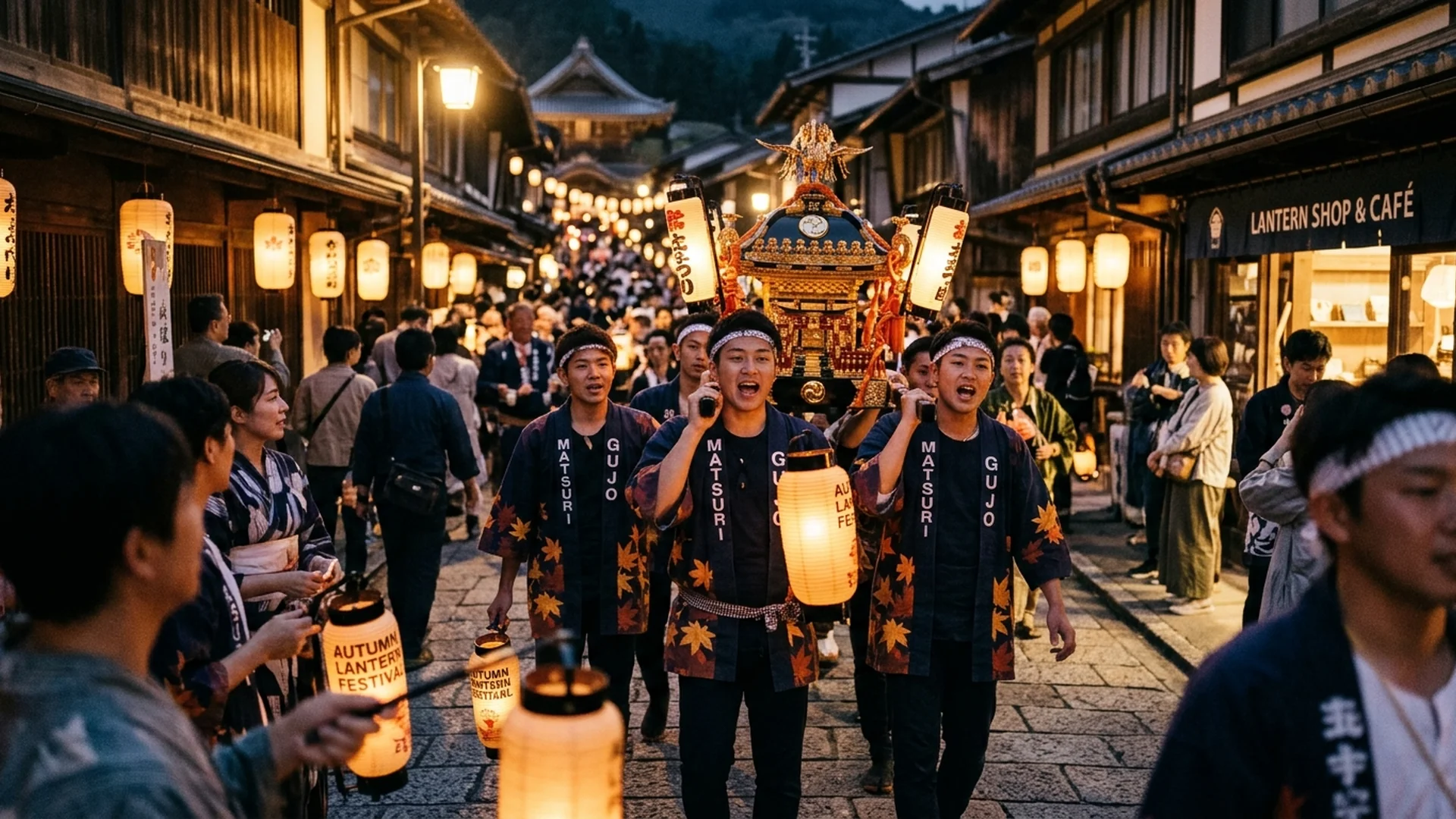
When stillness and crisp autumn breezes descend upon Japan, ancient forests and historic architecture gently transition into a realm of nocturnal wonder. Yet, this season’s arresting beauty extends far beyond the brilliant crimson and amber of daytime maple leaves. As twilight surrenders to darkness, Japan’s evenings awaken with blazing fires and the soft, pulsing glow of thousands of paper lanterns swaying to the rhythmic beat of taiko drums and the resonant cheers of ceremonial processions.
This is a sacred domain where centuries-old heritage converges seamlessly with the contemporary mastery of illumination, offering a profound reflection of the Japanese spiritual aesthetic. Autumn lantern and fire festivals transcend mere sightseeing; they are vital cultural touchstones that invite discerning travelers and photographers to venture into the dark, witnessing how living light tells timeless stories of devotion, history, and exquisite craftsmanship.
The Heart of Fukushima: Three Centuries of Grace at Nihonmatsu Chochin Matsuri
When considering the grandest autumn illumination traditions in Japan, the paramount destination is undoubtedly the Nihonmatsu Chochin Matsuri in Fukushima Prefecture. Widely celebrated as one of the nation’s three premier lantern festivals, its origins trace back to 1664 during the Edo period, established under the visionary patronage of the Niwa clan to unify the citizenry through sacred ritual.
The most breathtaking spectacle unfolds on the festival’s inaugural evening (Yoi-matsuri), when seven colossal float structures (Taikodai), representing individual districts of the city, gather at the Shintenten Shrine to receive the sacred flame. This pristine ember is meticulously used to ignite more than 300 spherical red paper lanterns adorning each float—surpassing 3,000 glowing vessels blazing against the velvety night sky. The reverberating thunder of community-specific taiko drumming, spirited chanting, and the procession of eleven-meter-tall illuminated floats gliding through historic streets forge an atmosphere of raw, devout energy rarely encountered in the modern era.
The Aesthetics of Light and Foliage: The Confluence of Fire and Momiji
Beyond monumental lantern processions, the Japanese autumn invites contemplative evening illuminations (Light-up) across historic temples and traditional gardens, deliberately designed to accentuate the ethereal beauty of changing leaves. This sophisticated manipulation of natural shadow and light differs profoundly from urban neon.
Illumination designers frequently employ warm amber palettes to accentuate ancient maples and weathered pines within Zen precincts. When these golden beams strike vibrant scarlet leaves and cast reflections upon the still waters of a traditional strolling garden (Chisen-kaiyushiki), a deeply meditative, dreamlike dimension emerges. Strolling along mossy stone pathways beneath the soft glow of weathered stone lanterns (Toro) transports the traveler backward into an unhurried epoch of profound inner tranquility.
Mastering Nighttime Lantern Photography: Capturing Luminous Splendor
Preserving the delicate radiance of festival lanterns amid profound darkness presents an intricate challenge, demanding both technical precision and a sensitive eye for ambient light.
For photographers utilizing DSLR or mirrorless systems, prime lenses featuring wide maximum apertures—such as f/1.4 or f/1.8—are indispensable for capturing natural luminescence while rendering distant light sources into soft, shimmering bokeh. Maintain a moderate-to-high ISO setting optimized for exceptional noise control, and deploy a sturdy tripod wherever permitted to utilize slower shutter speeds without compromising background sharpness.
When shooting with contemporary smartphones, engage the automatic Night Mode while manually tapping the screen to lock exposure directly onto the brightest lantern surfaces, preventing blown-out highlights that erase delicate paper textures. Seek out reflective surfaces dampened by evening mists or standing water to double the visual symmetry and poetic resonance of your compositions.