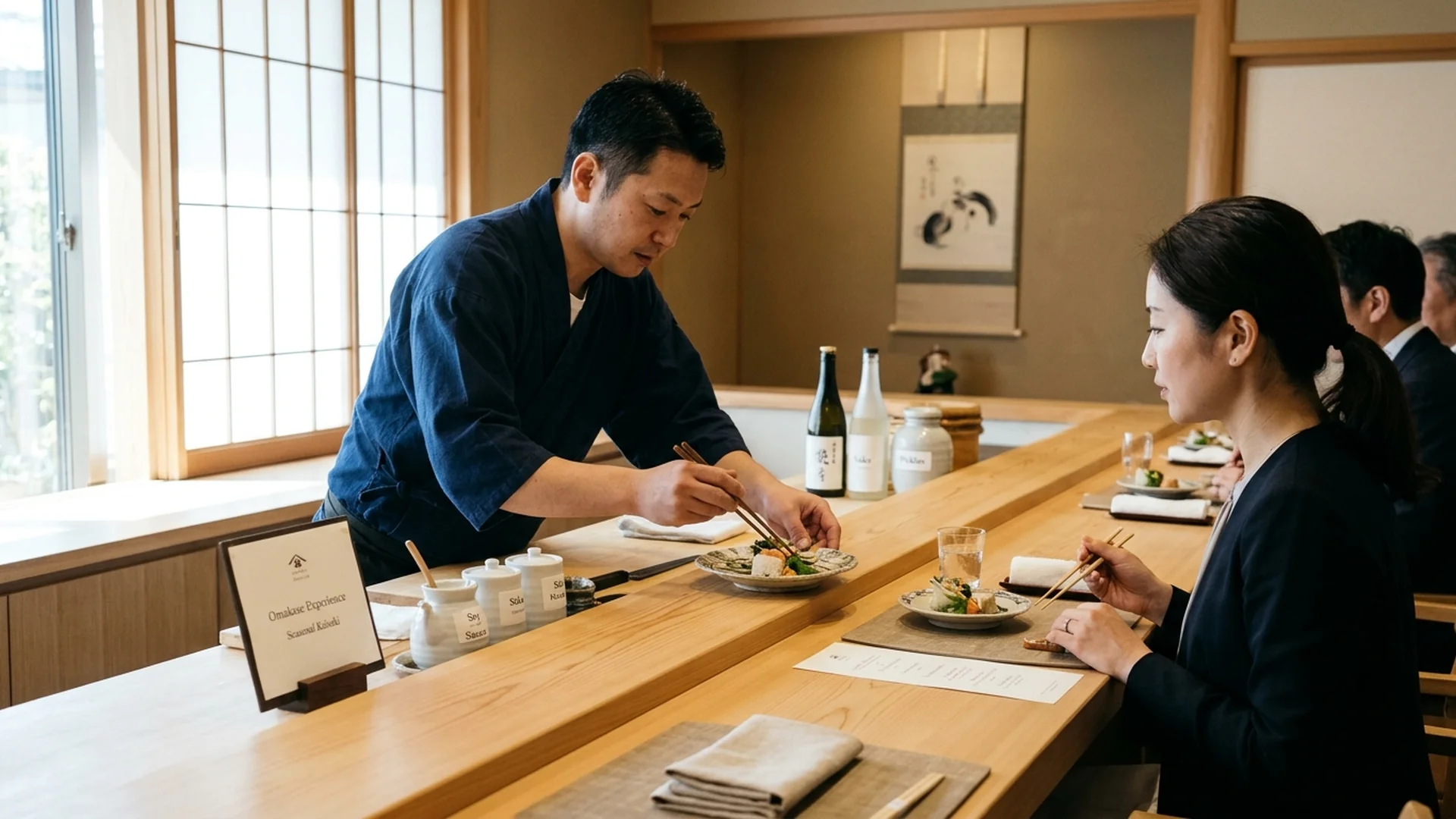
When the heavy cypress-wood door slides shut, the restless hum of the outer world instantly dissolves, leaving only the faint, calming fragrance of hinoki wood and the gentle glow of charcoal glowing within a ceramic hearth. Entering the upper echelons of Japanese fine dining—whether through the meditative progression of a traditional kaiseki or the intense, focused choreography of an omakase sushi counter—is never merely about satisfying hunger. It is an immersive communion with the philosophy of the four seasons, expressed through flavor, texture, and silence.
Yet, in a culture that holds harmony and reverence as its highest ideals, every subtle gesture—from the angle of your bow upon entering and the delicate placement of your chopsticks to the unspoken eye contact with the itamae (master chef)—carries a profound cultural vocabulary. A lack of familiarity with these delicate conventions can inadvertently transform a sacred culinary encounter into a moment of unease. This manual invites discerning travelers deep into the aesthetic core of Japanese dining, ensuring that every morsel savored becomes an authentic bridge between mind, palate, and tradition.
The Architecture of Taste: Decoding the Kaiseki Sequence
Kaiseki (会席) stands as the crown jewel of Japanese gastronomy, tracing its philosophical lineage back to the austere traditions of the tea ceremony before evolving into an exquisite seasonal art form. The meal is anchored by the concept of ‘Shun’ (旬)—the fleeting, perfect zenith of an ingredient’s season. The journey begins with the Sakizuke, a delicate appetizer served in a miniature ceramic vessel designed to gently awaken the palate. This is followed by the Hassun, the poetic heart of the meal, where a harmonious composition of seasonal delicacies from both mountain and sea is arranged to evoke a living landscape.
As the meal progresses into its middle chapters, guests encounter the Mukozuke—an sashimi course that showcases the master’s peerless knife skills—and the Yakimono, featuring premium seasonal fish grilled over binchotan charcoal. The true enjoyment of a kaiseki lies not merely in consumption, but in deep appreciation of the handcrafted vessels curated specifically to complement each dish. Every element invites the diner to engage all five senses in a quiet meditation on time and nature.
Ironclad Rules of the Counter: Communication and Decorum in Omakase
Omakase (おまかせ), translating loosely to ‘I leave it to you,’ represents the ultimate expression of trust between diner and master chef (Itamae). At a hinoki-wood counter, the single most critical rule is absolute punctuality. The shari (seasoned sushi rice) is held at body temperature and hand-pressed to order, served at precise intervals calculated down to the minute. Arriving late not only compromises the delicate temperature and texture of the rice, but also disrupts the rhythm of the artisan and fellow guests.
Furthermore, consuming nigiri with clean fingers rather than chopsticks is entirely acceptable and demonstrates cultural fluency. When using your fingers, gently grasp the piece with your thumb and middle finger, tilt it slightly, and touch only the fish—never the rice—to the soy sauce. Diners must also refrain from wearing heavy perfumes or scented lotions, as premier sushi sanctuaries rely heavily on the natural aromas of pristine fish and freshly grated Shizuoka wasabi.
Secret Codes of the Chopsticks and Ancient Vessel Etiquette
Chopsticks (Hashi) carry far more symbolic weight in Japan than in many neighboring culinary cultures. A cardinal sin is sticking them vertically upright into a bowl of rice (Watashibashi or Tate-bashi), as this mirrors funeral rites. When resting your chopsticks, always place them neatly upon their designated ceramic rest (Hashi-oki), and never pass food directly from your chopsticks to another person’s.
Regarding tableware, lifting smaller soup bowls directly to your lips with both hands is considered entirely proper and polite. Conversely, the common habit of cupping a hand underneath food to catch stray drops (Te-bari) is discouraged in formal settings. If a portion is too large to consume in a single bite, use your chopsticks to gently divide it in half rather than biting into it and returning the remainder to your plate.