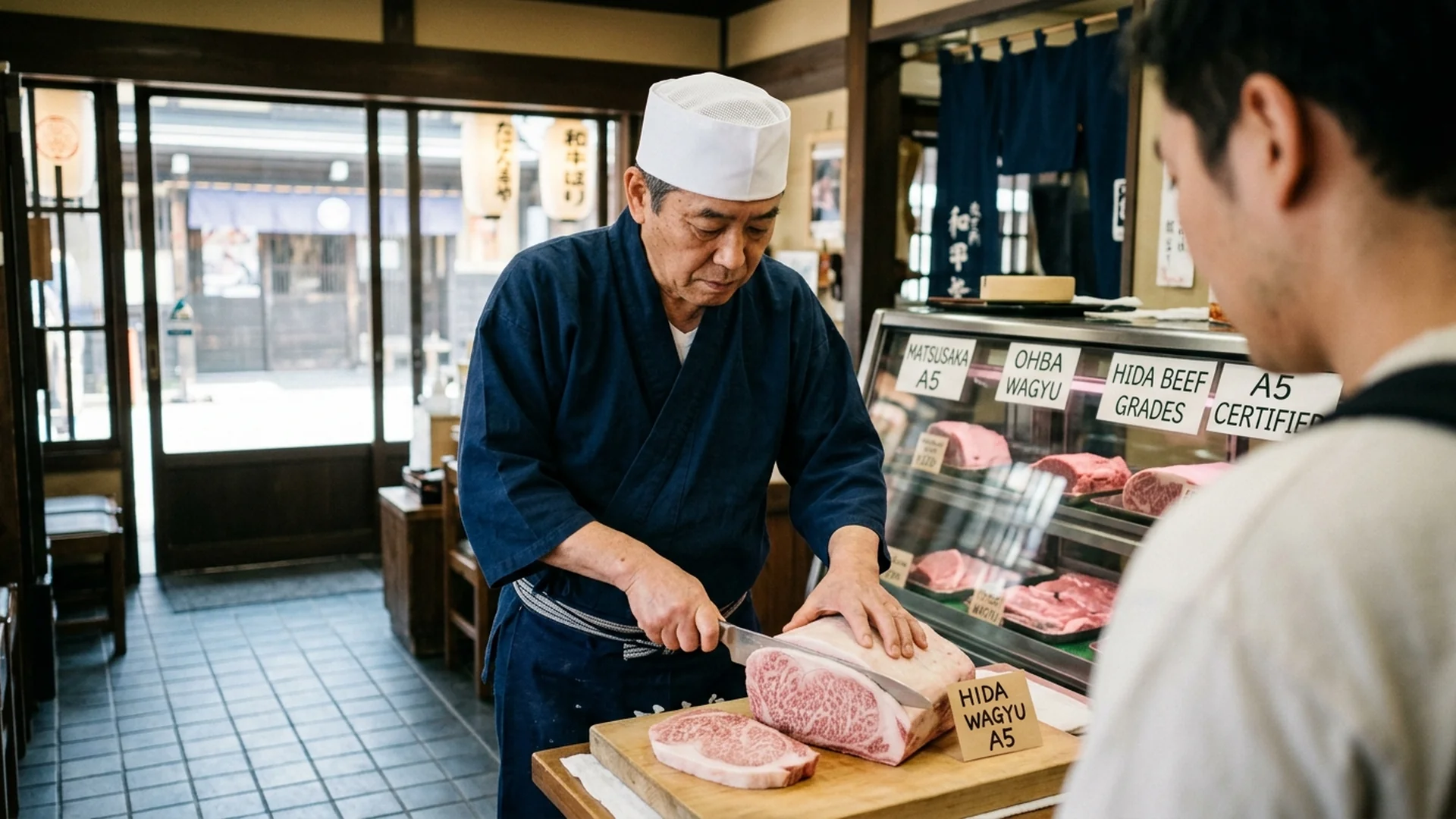
When a delicate, marble-veined ribbon of Wagyu beef meets the searing heat of a teppanyaki iron griddle, the quiet, melodic sizzle accompanied by a sweet, buttery aroma signals the entry into a revered culinary realm. Yet behind this melt-in-the-mouth tenderness lies a profound philosophy of craftsmanship, stretching from precise alphanumeric indices to the crisp mountain breezes and pristine pastures of rural Japan.
For the discerning global traveler and gastronome, decoding the world of Wagyu transcends the simple pursuit of a fine dining table. It is an exploration of cultural dedication—the culmination of years of patient stewardship by Japanese farmers. This definitive guide decodes the enigma behind the coveted A5 rating and introduces five legendary regional Wagyu brands that captivate epicureans across the globe.
Decoding A5 and the BMS Score: What the Indices Reveal
Upon encountering a high-end menu, designations such as ‘A5’ immediately command attention. These symbols, however, are far from arbitrary marketing flourishes; they are the result of rigorous evaluation by the Japan Meat Grading Association (JMGA).
The assessment system is bifurcated. The first component is the Yield Grade, designated by letters A (above average), B (standard), and C (below average), which quantifies the proportion of usable meat harvested from the carcass. An ‘A’ rating denotes the highest yield of prime red cuts. The second component is the Quality Grade, scored from 1 to 5 across four strict criteria: the Beef Marbling Score (BMS), the luster and brightness of the meat, firmness and texture, and the color, gloss, and quality of the fat.
Consequently, the ‘A5’ distinction stands as the pinnacle of perfection, guaranteeing both maximum yield and elite marbling scores. The BMS index, in particular, reaches heights of 8 to 12 in A5 cuts, representing a microscopic web of pure white fat interspersed evenly throughout the lean muscle tissue, reminiscent of fine Italian marble. Composed largely of oleic acid, this fat boasts a melting point lower than human body temperature, explaining precisely why premium Wagyu dissolves effortlessly upon contact with the warmth of the palate.
Five Legendary Regional Brands: A Heritage of Flavor Across the Japanese Archipelago
While the A5 standard defines overarching quality, the nuanced aromas and individual flavor profiles of Wagyu are dictated by regional microclimates and specific bovine lineages. Japan’s five legendary regional brands each tell a distinct story:
-
Kobe Beef (Hyogo Prefecture): Widely regarded as the global monarch of Wagyu. Sourced from pure Tajima-gyu cattle raised amidst pristine landscapes and crystal-clear waters, Kobe beef is celebrated for its spiderweb marbling, ethereal aroma, and texture so tender it defies the need for a knife.
-
Matsusaka Beef (Mie Prefecture): Revered as the ‘art of beef.’ Virgin female cattle are tended to with extraordinary devotion, resting in tranquil environments that encourage optimal development. Matsusaka fat features an exceptionally low melting point, yielding a decadent, deeply lingering sweetness.
-
Ohmi Beef (Shiga Prefecture): Boasting a heritage spanning over four centuries, Ohmi is Japan’s oldest recognized Wagyu brand. Grazed near the vast expanse of Lake Biwa, the pristine waters and air impart a mellow, silky elegance that never overwhelms the senses.
-
Hida Beef (Gifu Prefecture): The crowning jewel of the Japanese Alps. Sheltered by soaring peaks and crisp, clean air, Hida cattle develop delicate pink marbling accompanied by a robust, deeply savory profile unique to the Chubu region.
-
Yonezawa Beef (Yamagata Prefecture): Nurtured through the heavy snows of the Tohoku region, Yonezawa cattle mature in serene isolation on superior feed. The fat possesses a fine consistency akin to fresh snowflakes, creating an aromatic, dreamlike finish upon cooking.
The Culinary Arts: Harmonizing Cooking Methods with Wagyu Architecture
The splendor of elite Wagyu relies as much on culinary technique as it does on raw provenance, with each preparation method designed to complement the unique internal architecture of the fat:
- Teppanyaki Steak: Ideal for dense A5 cuts with high marbling density. Searing the beef briefly on a flat iron griddle at high heat locks in the internal juices while rendering excess surface fat into a crisp, golden crust, preserving a velvety, succulent center.
- Sukiyaki and Shabu-Shabu: Submerging paper-thin slices into gently simmering warishita (a sweet-savory soy broth) or kombu dashi for mere seconds melts the low-temperature fats, harmonizing the richness of the meat with the broth for a balanced, harmonious profile.
- Yakiniku: Grilling over clean charcoal embers imparts a delicate smokiness that cuts cleanly through the richness of the Wagyu. Connoisseurs recommend grilling single slices at a time, seasoned simply with pure sea salt or fresh wasabi to honor the natural integrity of the beef.