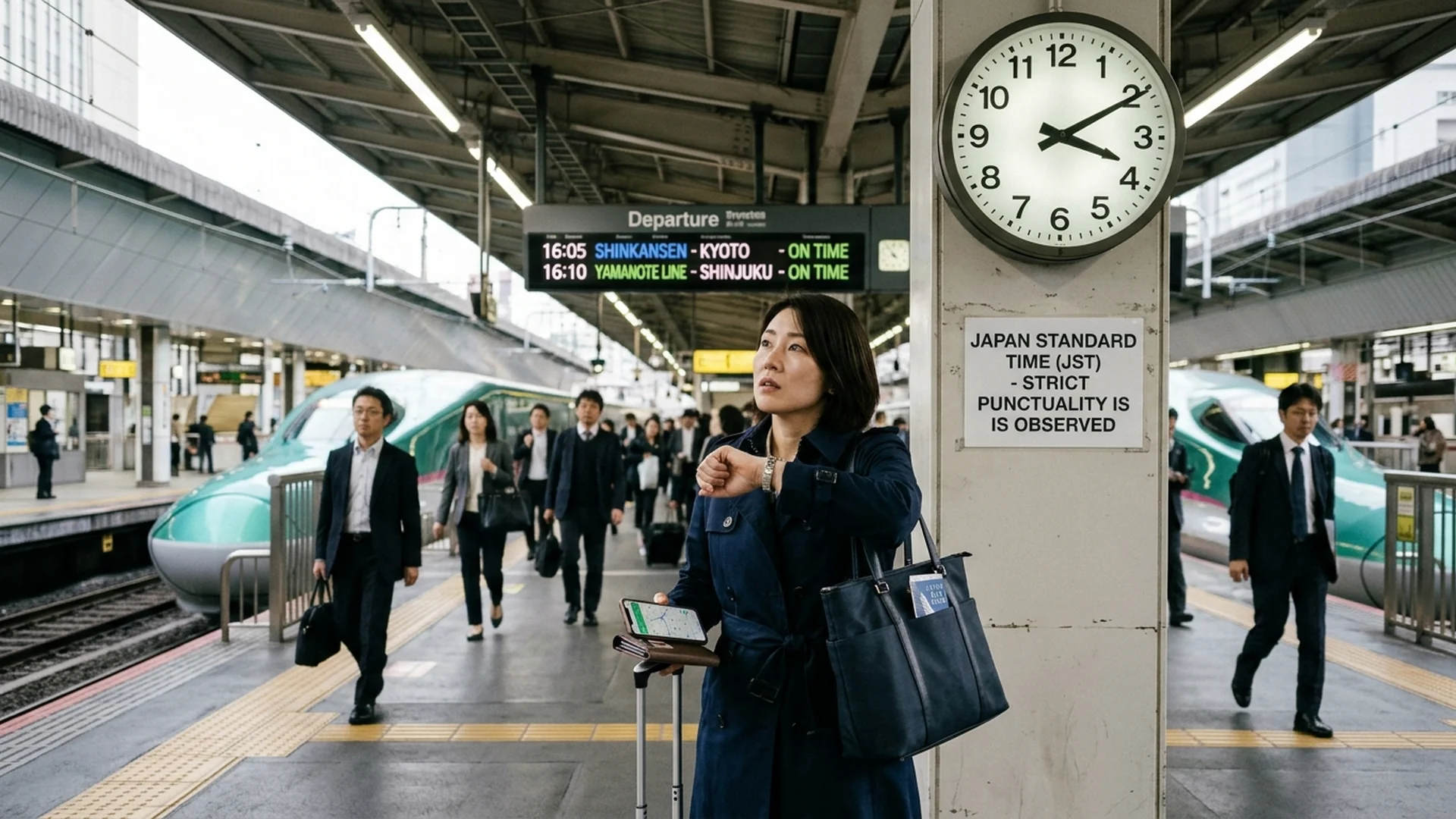
When the second hand on a Tokyo station platform ticks down to the exact second a Shinkansen glides to a halt, the quiet, orderly atmosphere is heightened by an almost supernatural precision. This is far beyond efficient transit; it is a manifestation of a national soul and philosophical reverence for time that defines punctuality as something infinitely deeper than merely avoiding lateness.
For the international traveler accustomed to a more flexible cadence, entering the Land of the Rising Sun demands a gentle recalibration of rhythm. Japan Standard Time (JST), running two hours ahead of Indochina Time, is merely the physical baseline. The true horizon—and the most rewarding to comprehend—is the pervasive cultural ethos of Jikan o Mamoru (protecting time), an intricate choreography woven seamlessly into mutual respect, personal dignity, and an uncompromising pursuit of grace in daily life.
The Dimension of Time: Understanding JST and the Internal Metronome
Japan resides strictly within the UTC+9 time zone, operating under the unchanging banner of Japan Standard Time (JST). Unencumbered by the seasonal fluctuations of Daylight Saving Time, their temporal ledger remains utterly unmoving across all 365 days of the year. For the visitor, synchronization requires little more than advancing watches or digital devices by two hours. Yet, the genuine trial lies in attuning one’s internal biological clock to a society that moves with hushed, relentless velocity.
Upon arrival, one notices that summer mornings break with startling swiftness, while winter dusk descends rapidly. To harmonize with this environment requires embracing the crispness of early mornings—perhaps at a quiet neighborhood park or an awakening market—rather than resisting the temporal shift. Aligning with JST is the foundational step toward moving through the country with effortless equilibrium.
The Philosophy of the Five-Minute Rule and the Weight of Minutes
In many Western and cosmopolitan contexts, arriving on the exact stroke of an hour is deemed acceptable. Within the refined social structures of Japan, however, arriving at the absolute final second is often perceived as an imposition—a silent pressure placed upon the host. The unwritten convention of the ‘five-minute early rule’ governs everything from high-level corporate engagements to quiet social rendezvous and transit boardings.
Arriving ahead of schedule grants the traveler a rare luxury: a moment to center the mind, absorb the ambient atmosphere, and step into an experience with profound composure. To disregard this in transit—such as missing a Shinkansen or Limited Express by a mere sixty seconds—is to forfeit a reserved seat instantly, as ticket parameters invalidate the moment the train clears the platform. This rigorous standard is not punitive; it is the lubricating oil that allows a densely populated archipelago to function with frictionless elegance.
Gastronomic Etiquette and the Inviolable No-Show Policy
Nowhere is Japan’s temporal sensitivity more exquisitely pronounced than in its culinary landscape, particularly within rarefied omakase counters or traditional kaiseki sanctuaries. Here, master chefs curate seasonality and sequence ingredients to be served to an intimate gathering at an exact, synchronized moment.
To arrive even fifteen minutes tardy without prior communication disrupts the delicate orchestration of flavors and the chef’s intentional pacing. Consequently, numerous establishments enforce stringent no-show or late-cancellation policies, sometimes retaining the full cost of the seating. This philosophy teaches a timeless truth: another person’s time possesses the exact same sanctity as our own. Advanced digital communication or a polite phone call in the face of unforeseen delay is the universal hallmark of an astute, respectful global traveler.