Amidst the hushed, impeccable order of a Shinkansen bullet train or the intuitive attentiveness of an innkeeper at a countryside ryokan, one cannot help but wonder: what invisible architecture shapes a society so thoroughly infused with grace, respect, and meticulous care? The answer does not lie merely in codified rules, but in a wellspring of traditional philosophies passed down through generations.
To journey through Japan is to experience far more than seasonal landscapes or celebrated gastronomy. By opening our hearts to four guiding paradigms—Meiwaku, Omotenashi, Mottainai, and Ikigai—the veil of unfamiliarity dissolves. We transition from passing tourists into culturally fluent travelers who engage with foreign soil not as spectators, but as reverent guests.
1. Meiwaku (迷惑): The Art of Non-Interference and Shared Harmony
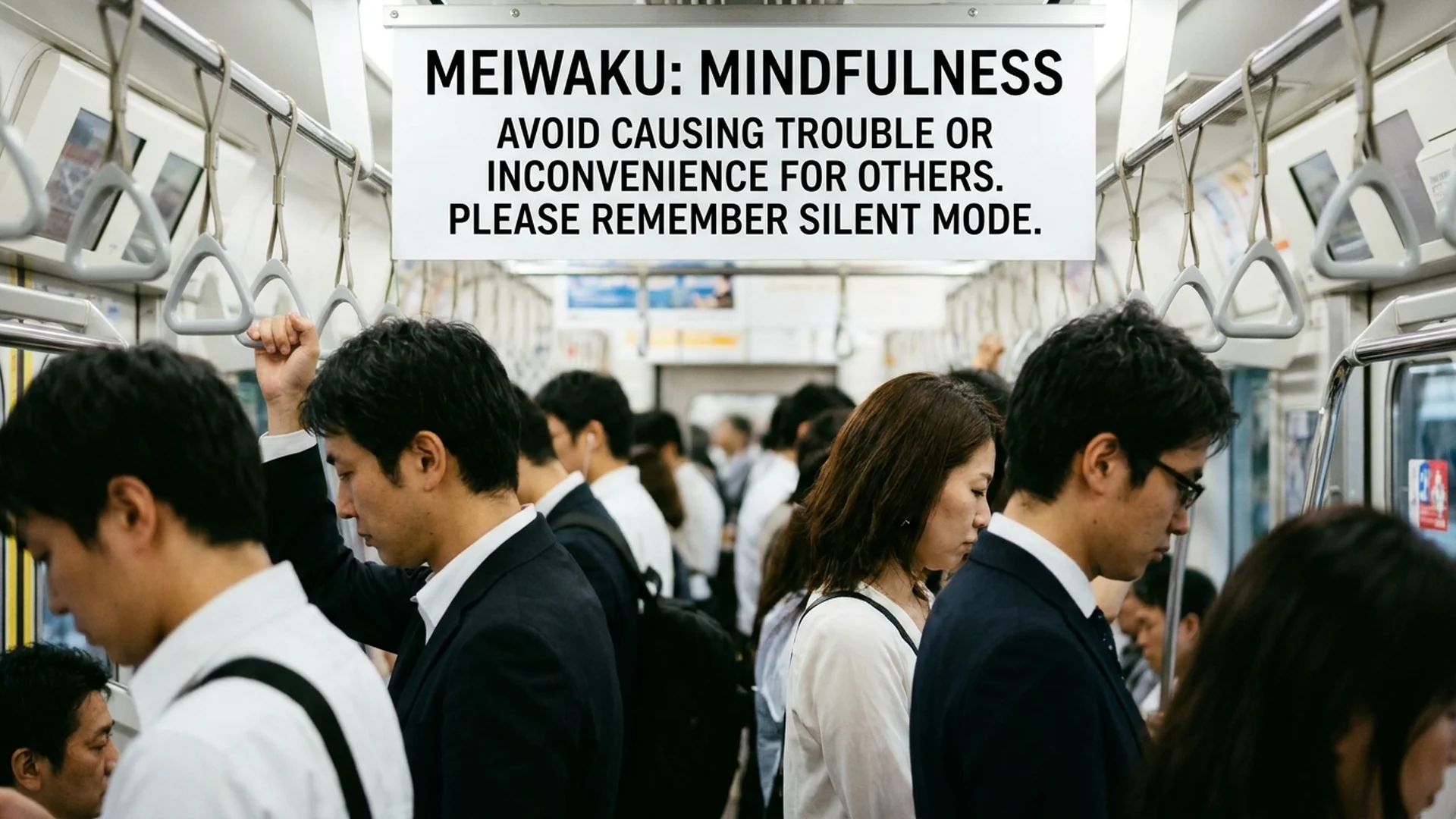
To understand why city streets, railway platforms, and neighborhood sanctuaries in Japan maintain such profound serenity and pristine order, one must first grasp the concept of Meiwaku—the principle of avoiding inconvenience, annoyance, or burden to others. This philosophy is rarely enforced by legislation; rather, it is an internalized social consciousness nurtured from early childhood. Aboard a high-speed train or underground metro, conversations remain muted, and mobile phones are kept silent, because citizens recognize that personal comfort must never infringe upon the mental sanctuary of others.
For the international traveler, understanding Meiwaku is the key to seamless cultural integration. Simple acts—such as silencing electronic devices, refraining from consuming pungent foods in confined spaces, or ensuring luggage does not obstruct pathways—become acts of silent diplomacy. These small gestures of mindfulness build an unspoken bridge of mutual respect between the traveler and the local community.
2. Omotenashi (おもてなし): The Spirit of Unconditional Hospitality
Hospitality in Japan transcends mere transactional exchange. Grounded in Omotenashi, it represents a pure, uncalculated desire to welcome and care for a guest without expectation of praise or reward. Omotenashi hides in the minutiae: a warm, welcoming bow infused with genuine eye contact, tea served at a temperature perfectly matched to the weather outside, or a host who instinctively remembers a guest’s preferences.
The core of Omotenashi is anticipation—acting with care before the traveler even articulates a need. When we recognize this philosophy, receiving service in Japan ceases to be a commercial transaction and transforms into a profound human exchange defined by deep mutual respect and attentiveness.
3. Mottainai (勿体ない): A Reverence for Resources and Impermanence
In an era dominated by global consumerism, the philosophy of Mottainai serves as a poignant, grounding reminder of value. Translated loosely as a sense of regret over waste, it stems from the worldview that objects and resources possess inherent dignity rather than being mere disposable commodities. This ethos manifests in the world’s most intricate waste-sorting systems, the cultural imperative to finish every grain of rice on one’s plate (Shokuji no Sankaku), and Kintsugi—the art of repairing fractured ceramics with gold, celebrating scars rather than concealing them.
Mottainai invites the modern traveler to reflect upon sustainable living, teaching us to honor resources and discover profound beauty in simplicity.
4. Ikigai (生き甲斐): The Reason for Being and the Soul of Craftsmanship
Behind the exacting precision of a sword-smith, a ceramic artist, or a third-generation ramen artisan in a quiet alleyway lies a driving force known as Ikigai—the reason for waking up each morning. Ikigai is the harmonious intersection of what you love, what you are good at, what the world needs, and what can sustain you. This philosophy inspires artisans to dedicate their entire lives to perfecting their craft, embodying the Shokunin spirit.
When we converse with elder masters in ancient towns or observe the quiet pride in a shopkeeper’s eyes, we begin to understand that success in the Japanese consciousness is measured not by speed or wealth, but by the depth of meaning poured into one’s vocation.