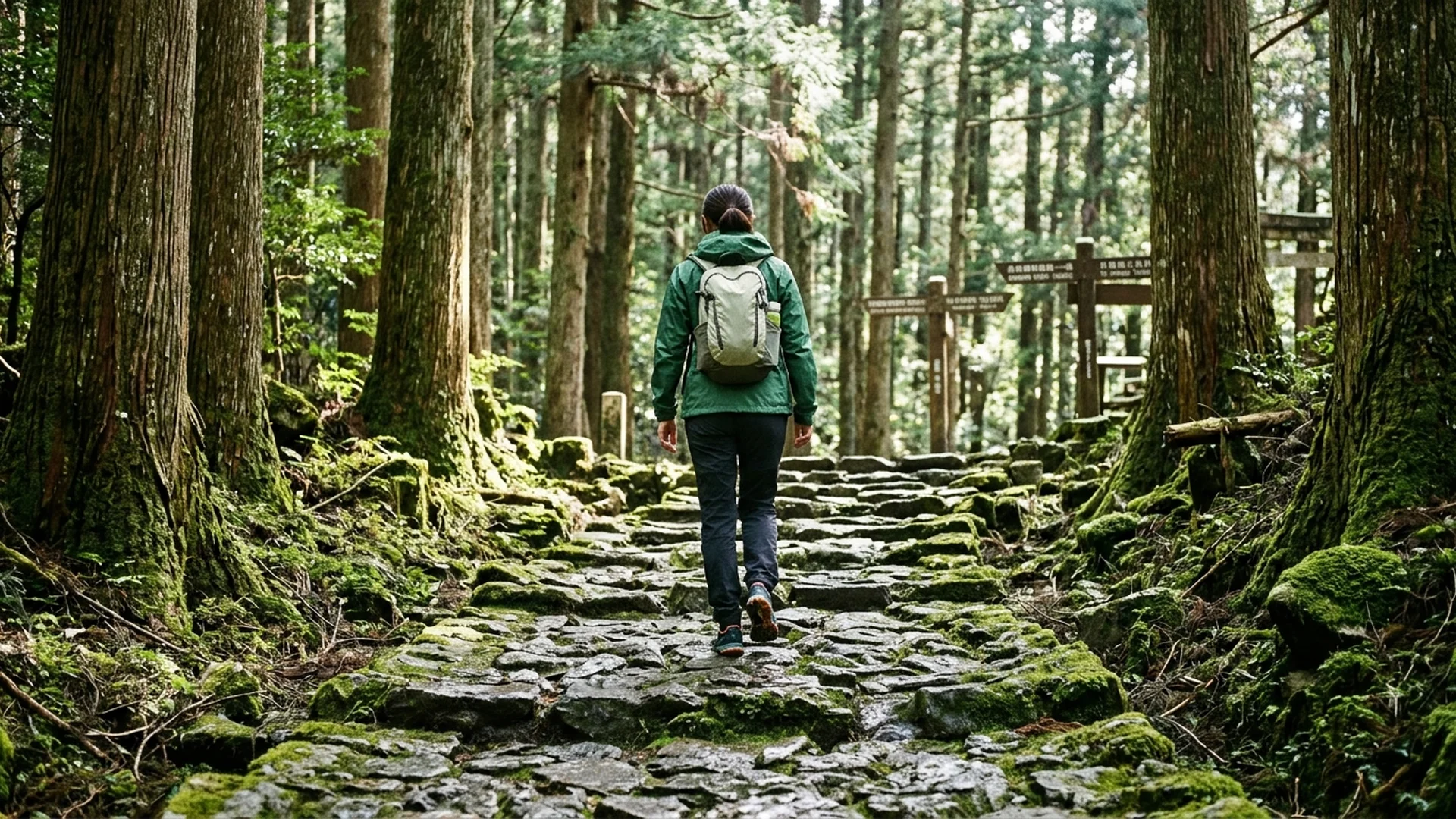
When the morning mist drifts softly through centuries-old giant cedar forests, the rhythmic crunch of footfalls on ancient stone pavements evokes a profound sense of suspended time. The Kumano Kodo pilgrimage route, nestled within the sacred forested mountains of the Kii Peninsula in Wakayama Prefecture, does not require a week-long expedition to reveal its spiritual essence. For discerning travelers with limited time who wish to experience a seamless day hike, this historic trail welcomes you with carefully curated pathways tailored perfectly for first-time visitors.
Stepping onto this World Heritage path—honored alongside Spain’s legendary Camino de Santiago—is an intentional journey backward into an era when Japanese emperors and aristocrats undertook arduous spiritual pilgrimages seeking inner purification. Here, pristine nature and ancient esoteric Buddhism merge into a singular, breathtaking landscape. This editorial guide explores the art of planning a flawless one-day Kumano Kodo trek, balancing historical insight, route selection, meticulous bus logistics, and the quiet satisfaction of collecting traditional stamp impressions along the way.
Deciphering World Heritage: Why Daimon-zaka is the Ideal Gateway
For those contemplating a day hike along the Kumano Kodo, the Nakahechi Route segment surrounding Daimon-zaka offers the quintessential visual narrative immortalized in classical Japanese landscape photography. This monumental stone-paved staircase winds upward beneath a vaulted canopy of towering cedars and Hinoki cypress trees centuries in the making. The enveloping silence is broken only by the murmur of rushing mountain streams and native birdsong. Spanning roughly six hundred meters in length, the ascent features steady inclines and over two hundred weathered stone steps, offering an invigorating challenge that awakens both body and spirit.
Climbing these moss-draped steps leads directly to the sacred precincts of Kumano Nachi Taisha and the magnificent Nachi Falls, Japan’s tallest single-drop waterfall. Condensing these profound spiritual landmarks into an accessible distance allows travelers unaccustomed to strenuous mountaineering to fully absorb the ancient atmosphere within a few hours, completely bypassing the need for heavy packs or backcountry camping.
Expansive Rural Vistas: From Hosshinmon-oji to Hongu Taisha
For travelers desiring an immersive landscape with a slightly extended walking duration, the seven-kilometer trail stretching from Hosshinmon-oji to Kumano Hongu Taisha presents an exceptional day hike alternative. Requiring approximately two and a half to three hours, this route meanders across soft earth paths traversing traditional farming hamlets, terraced agricultural fields, and sunlit pine woodlands.
The defining charm of this path lies in its passage through numerous ‘Oji’—subordinate subsidiary shrines scattered throughout the ancient Kumano belief network. Walking this trail feels akin to strolling through an open-air living museum where rural villagers coexist harmoniously with a protected natural sanctuary. Culminating at Kumano Hongu Taisha, famously marked by the colossal Oyu-no-hara torii gate, visitors instantly comprehend why these mist-shrouded mountains are revered as dwelling places of the ancient deities.
Navigating Logistics: Mastering Bus Timetables for Seamless Travel
The single most critical element in executing a successful Kumano Kodo day hike is not raw physical endurance, but rather the mastery of bus schedules operated by Kumano Kotsu and Ryujin Bus. Because public transport linking major rail hubs such as Kii-Katsuura or Kii-Tanabe to remote mountain trailheads operates on limited daily departures, meticulous advance planning is paramount.
For instance, tackling the Daimon-zaka route requires boarding an early morning bus from Kii-Katsuura station to the Daimon-zaka parking area, traversing the trail upward to Nachi Falls, and securing an afternoon return transport back to the railway terminal. Factoring in generous time margins for afternoon bus connections ensures travelers never find themselves stranded in alpine dusk, as darkness descends swiftly within forested mountain valleys.