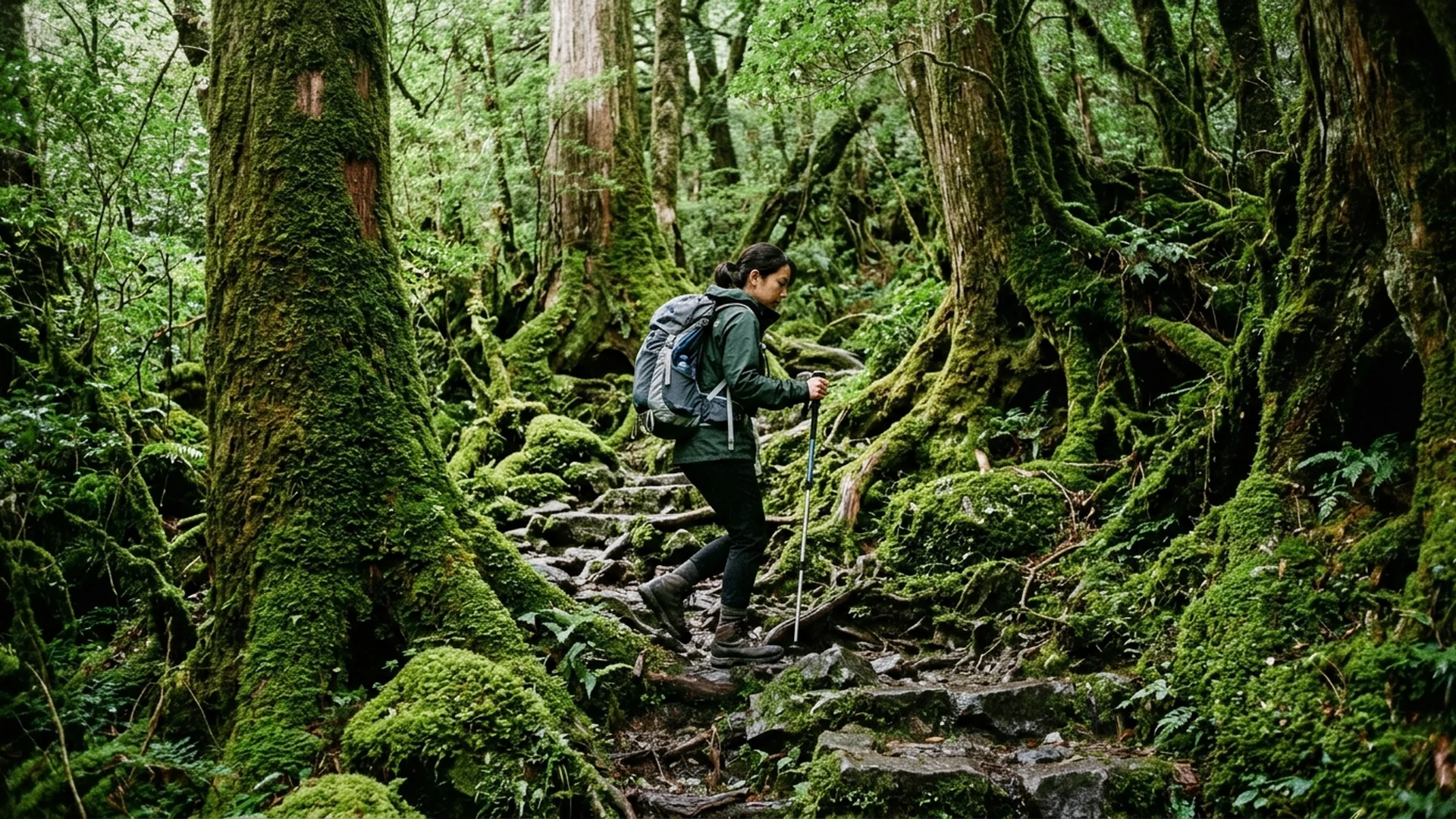
When a fine, ethereal mist clings to the ancient canopies of a southern Japanese island sanctuary, the timeless whispers of a primeval forest begin to awaken. Yakushima is far more than a conventional destination; it is an unhurried natural cathedral where time itself slows down. The damp earth is laid with a thick carpet of emerald-green moss, recalling the legendary cinematic landscapes of Hayao Miyazaki, while epic physical trials await those wishing to test their devotion to the pristine wilderness.
Venturing into the heart of Yakushima is an exercise in aligning your journey with your inner spirit. You must choose between Shiratani Unsuikyo, a dreamlike foray through moss-draped glades lasting mere hours, and Jomon Sugi, an arduous half-day pilgrimage to pay homage to a titanic botanical elder that has weathered millennia. Grasping trail topologies, preparing for frequent mountain squalls, and mastering dawn logistics are the vital keys to transforming a standard walk in the woods into a profound internal pilgrimage.
Shiratani Unsuikyo: The Moss Realm and Ghibli’s Living Muse
For travelers seeking to commune with Yakushima’s primeval spirit without enduring punishing physical strain, Shiratani Unsuikyo stands as the consummate sanctuary. Situated at roughly 800 meters above sea level, this nature study path winds among ancient yakusugi cedars that have endured for centuries, if not millennia.
The defining highlight is a contemplative stroll along crystal-clear streams leading deep into the Moss Forest, where jade-hued vegetation glows softly beneath drifting mountain mists. The surrounding tranquility is absolute, broken only by the delicate percussion of falling droplets and rushing currents. This very topography served as the primary visual muse for Hayao Miyazaki and his animation studio when crafting the mysterious woodlands of Princess Mononoke. Ascending further to the granite precipice of Taikoiwa rewards the intrepid with sweeping panoramic vistas across the island’s interior ranges. Requiring only three to four hours round-trip, it is an exquisite half-day immersion in aesthetic wonder.
Jomon Sugi Day Trek: An Epic Trial to an Ancient Witness
If Shiratani Unsuikyo is an effortless pastoral verse, the trek to Jomon Sugi is an epic saga that beckons dedicated hikers from across the globe. Spanning a demanding 22 kilometers round-trip and requiring between 10 and 11 hours of continuous exertion, visiting this venerable cedar—estimated to be anywhere from two to several thousand years old—is less a casual excursion and more a test of stamina and quiet resolve.
The initial leg of the route traces a historic logging railway, carrying wanderers across timber trestles suspended above fern-choked ravines before transitioning into steeper ascents and elevated wooden boardwalks. Along the way, pilgrims encounter Wilson’s Stump, the hollowed remnant of a colossal ancient tree whose interior frames a perfect natural heart shape when viewed from below. The journey culminates at the Jomon Sugi viewing platform, where the gnarled, tremendously powerful silhouette of the tree stands as an eloquent testament to nature’s fierce endurance.
Wilderness Logistics: Conservation Buses and Methodical Preparation
The true challenge of Yakushima extends beyond mere distance and elevation gain, encompassing a strict environmental management system designed to protect fragile ecosystems. During high seasons, private vehicular traffic is prohibited past the Arakawa Trailhead, the primary starting point for Jomon Sugi. All visitors must utilize the Arakawa Mountain Bus network, with departures beginning around 5:00 AM. Acquiring bus vouchers and settling conservation contributions beforehand is an indispensable administrative ritual.
Regarding gear, Yakushima is renowned for its persistent precipitation—jokingly referred to as raining thirty-five days a month—rendering standard cotton garments a dangerous liability. Visitors are strongly advised to utilize professional gear rental houses in Miyanoura or Anbo to secure high-tier Gore-Tex shells, waterproof trekking boots, and headlamps for pre-dawn starts. Diligent preparation prevents the onset of hypothermia and ensures you can surrender entirely to the island’s haunting beauty.