Among the historical tapestries woven across Japan, no era profoundly shaped the nation’s spiritual aesthetic, artistic grace, and cultural identity quite like the Heian period (794–1185 CE). Commencing when Emperor Kanmu established his new capital at Heian-kyo—modern-day Kyoto—this epoch ignited an urban and spiritual center of gravity that endured for over a millennium.
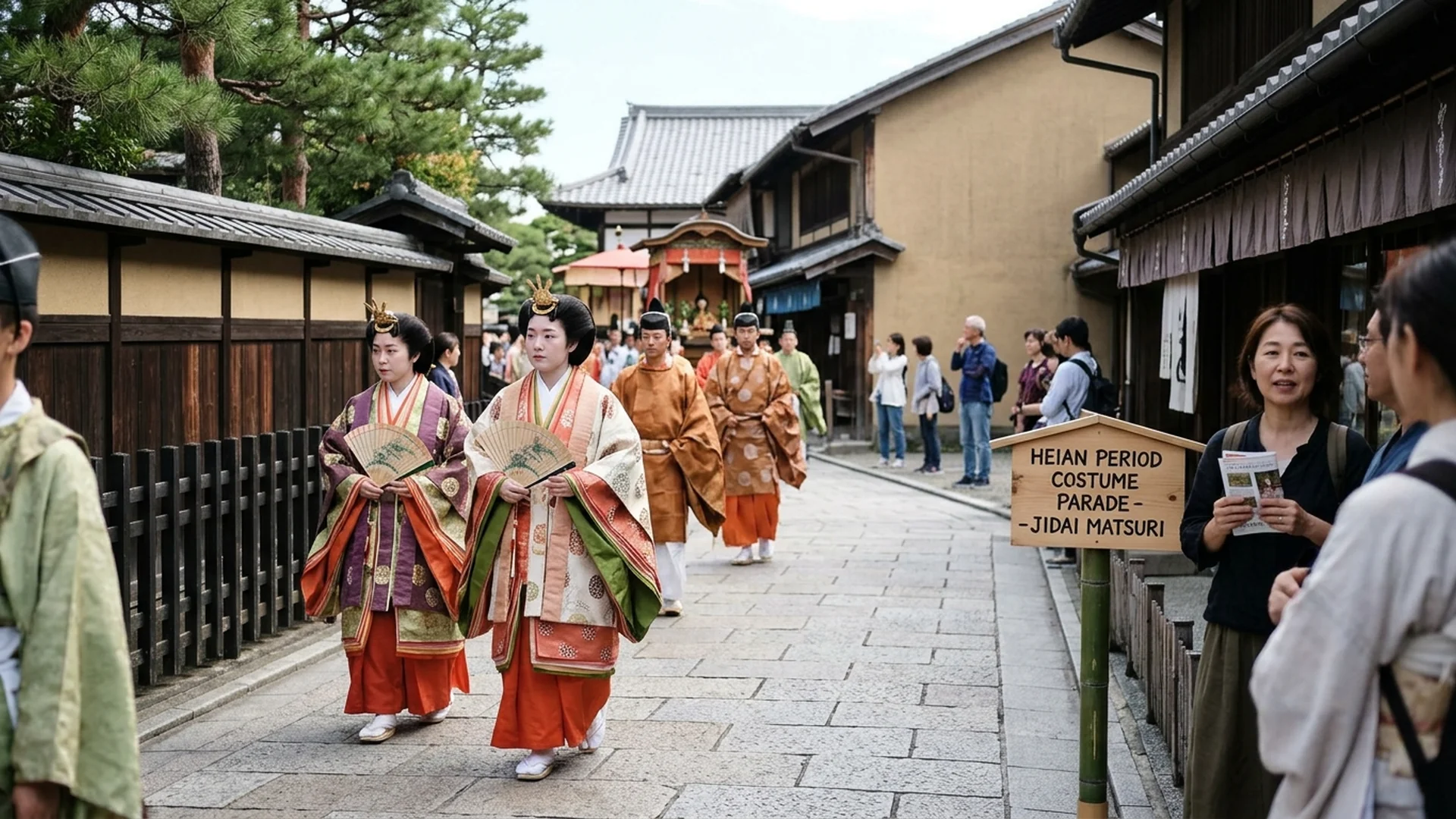
Amidst shifting seasonal winds and falling cherry blossoms, the imperial court gradually untethered itself from the monumental embrace of Tang Dynasty China. It birthed Kokufusa culture, an indigenous aesthetic blossoming from authentic Japanese sensibilities. This golden age gave rise to hiragana script, liberating court women to express innermost sentiments on delicate paper, alongside sumptuous twelve-layer silk kimono known as junihitoe and airy shinden-zukuri residential architecture woven seamlessly into natural gardens.
Journeying backward into the Heian realm is far more than a mere academic survey of antiquity; it is an intimate decoding of aristocratic Kuge lifestyles and imperial sovereignty. Here, transcendent beauty and the poignant impermanence of existence were understood as one, framed by the philosophy of mono no aware—a sensitive heart’s resonance with things, whose gentle pulse still beats quietly within the breath of contemporary Kyoto.
From Heian-kyo to the Millennial Metropolis: Forging an Imperial and Aesthetic Center
Relocating the imperial capital from Nara and Nagaoka-kyo to the northern expanses of the Yamashiro basin in 794 CE, under Emperor Kanmu’s visionary decree, fundamentally transformed Japanese history. Named Heian-kyo—meaning the capital of peace and tranquility—the urban grid was meticulously mapped using traditional geomancy and ancient military strategy. Adapting the grid layout of China’s Chang’an, architects tailored the design to harmonize seamlessly with the three mountain ranges embracing Kyoto.
During the early decades, the imperial institution sought deliberate distance from the political interference of powerful Buddhist monasteries in Nara. In time, towering aristocratic houses, most notably the Fujiwara clan, ascended to supreme political dominance via regency roles such as Sessho and Kampaku. By strategically placing daughters as imperial consorts, the court environment evolved into an exquisitely refined, intensely intricate web of patronage and intrigue.
When official missions to China, known as Kento-shi, were formally suspended in the late ninth century, foreign cultural influences dissolved organically into local preferences, crystallizing the Kokufusa culture. Consequently, the Heian epoch elevated arts, architecture, and aristocratic existence to unprecedented peaks of nuanced sophistication.
The Literary Power of Hiragana and ‘The Tale of Genji’: Echoes of Court Women
Perhaps the most enduring cultural innovation of the Heian period was the development of hiragana. Adapted from complex Chinese kanji characters into fluid, cursive, and accessible strokes, this script contrasted sharply with kanji, which remained the formal domain of men and official governance. Consequently, hiragana was affectionately termed onnade, or women’s hand, becoming an essential instrument empowering court ladies to freely articulate philosophies, emotions, and exquisite waka poetry.
Within this poetry-infused atmosphere, Murasaki Shikibu—a lady-in-waiting and imperial court poet—composed the monumental epic The Tale of Genji in the early eleventh century. Celebrated globally by literary scholars as the world’s first true novel, the chronicles of Prince Hikaru Genji not only dissected political maneuvers and amorous affairs within the palace walls, but also documented intimate details of daily ritual, attire, and domestic spatial design.
During the same era, Sei Shonagon penned The Pillow Book, capturing observations of nature and courtly life with sharp, discerning wit. Together, these literary masterworks immortalized mono no aware, a contemplative aesthetic philosophy acknowledging the bittersweet beauty of transience, deep emotional resonance, and the melancholy grace inherent in all passing things.
Shinden-zukuri and Junihitoe: Airy Architecture and Twelve-Layered Aristocratic Garments
The physical splendor of the Heian period is brilliantly mirrored in shinden-zukuri domestic architecture, the palatial style favored by the aristocratic Kuge class. Characterized by a central main pavilion, or shinden, flanked by subsidiary residential wings linked via long covered corridors known as watadono, these buildings featured open layouts devoid of heavy permanent walls. Spatial divisions were fluidly managed using folding screen partitions and bamboo blinds, integrating the structure completely with courtyard ponds and meandering streams in accordance with teioku ichinyo—the harmonious unity of dwelling and garden.
Stepping inside these open pavilions revealed high-born noblewomen attired in junihitoe, ceremonial silk robes consisting of twelve or more layered garments that could weigh up to twenty kilograms. Dressing in this era was far from a simple sartorial choice; it was an intricate art of color coordination known as kasane no irome. Visible collar gradations were carefully curated to reflect shifting seasons, weather patterns, and blooming flora—such as plum blossoms, wisteria, or autumn leaves—demonstrating a profound, highly cultivated literacy in the natural world.
Traces of the Heian Era in Modern Kyoto: A Legacy That Still Breathes
While the original wooden imperial palaces and aristocratic mansions of the Heian period have long since succumbed to fire and civil conflict, the spirit and architectural echoes of the era remain remarkably vivid across contemporary Kyoto. An essential point of reflection is Heian Jingu, a majestic shrine erected in 1895 to commemorate the 1,100th anniversary of the founding of Heian-kyo, featuring a two-thirds scale replica of the original Daigokuden imperial hall.
Further south in the city of Uji stands Byodoin Temple. Its Amida Hall, widely known as the Phoenix Hall, was constructed in 1053 by Fujiwara no Yorimichi and remains one of the rare surviving wooden structures from the Heian era to escape the ravages of war. The temple’s reflection shimmering across the waters of the surrounding pond evokes the celestial Pure Land Buddhism envisioned by Heian aristocrats.
Additionally, ancient traditions such as the Aoi Matsuri festival, held annually on May 15th, faithfully reenact the regal processions of nobles and court ladies arrayed in full junihitoe regalia. Traveling from the Kyoto Imperial Palace to the Kamo Shrines, they offer traditional tributes in a ritual unbroken for over a thousand years.