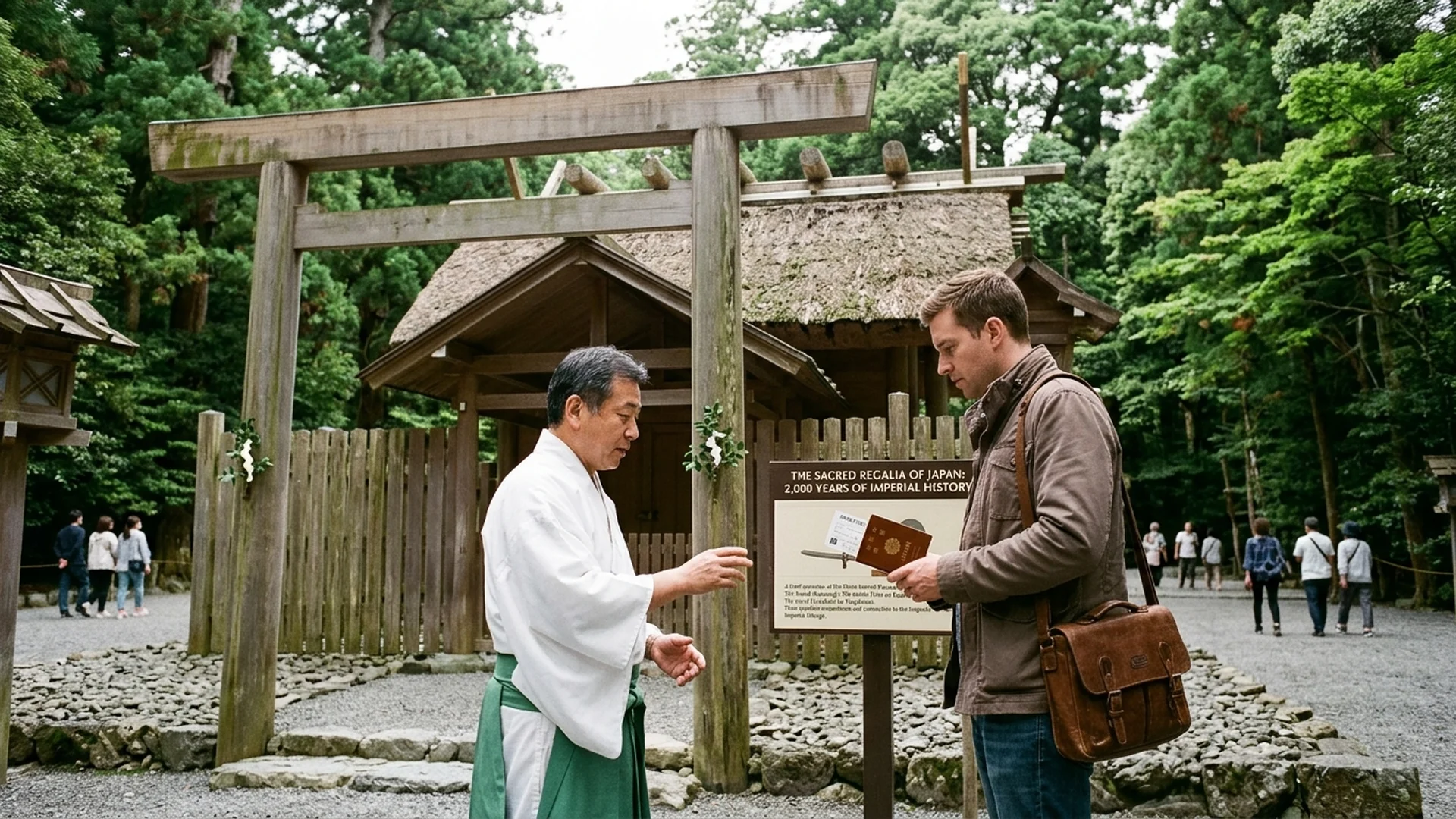
Amid the sacred stillness of the Tokyo Imperial Palace during an imperial accession ceremony, an ancient wooden chest wrapped in dark silk is carried with utmost care before the new sovereign. Remarkably, even the emperor who nominally owns these treasures has never been permitted to unwrap them or gaze upon their forms with mortal eyes. This is the profound enigma of the Sanshu no Jingi, or the Three Sacred Treasures of Japan—objects of immense temporal authority and spiritual resonance that have transcended time for more than two thousand years.
While numerous dynasties across the globe have fallen or dissolved through shifting tides of history, the Japanese imperial institution endures as the longest unbroken hereditary monarchy in the world, sustained by the ancient principle known as Bansei Ikkei, an unbroken lineage from antiquity. What fortifies this enduring legitimacy is neither military might nor territorial expanse, but rather three venerable artifacts: the Yata no Kagami mirror, the Kusanagi no Tsurugi sword, and the Yasakani no Magatama jewel.
These sacred regalia are not merely historical relics; they are deeply woven into the tapestry of Shinto mythology, believed to have been bestowed by the Sun Goddess, Amaterasu-Omikami, to her divine grandson upon his descent to rule the Land of the Rising Sun. A journey to trace their history and make pilgrimage to the grand sanctuaries housing these treasures opens a doorway to the most profound spiritual depths of Japanese civilization.
1. Artifacts of Antiquity: From Shinto Myth to the Triad of Wisdom, Truth, and Valor
According to the ancient chronicles Kojiki and Nihon Shoki, the genesis of the Three Sacred Treasures is inextricably bound to Shinto mythology. The first artifact, the Yata no Kagami mirror, was forged to reflect light and entice the Sun Goddess Amaterasu out of the Heavenly Rock Cave, Ame-no-Iwato, when the world had plunged into perpetual darkness. This mirror embodies supreme wisdom and untblemished truth, and it is presently enshrined as a sacred vessel of the divine, or Shintai, at Ise Jingu, the preeminent Shinto sanctuary in Japan.
The second artifact, the Kusanagi no Tsurugi sword—originally named Ame-no-Murakumo-no-Tsurugi, or the Heaven-Gathering Cloud Sword—was discovered by the storm god Susanoo within the tail of the eight-headed serpent Yamata no Orochi. It was later bestowed upon Prince Yamato Takeru, who harnessed its miraculous energies to cut away tall grass and escape a ring of fire set by his enemies, earning it the moniker ‘Grass-Cutter Sword.’ Symbolizing unyielding valor and decisive action, the blade is enshrined at Atsuta Shrine in Nagoya.
The final artifact is the Yasakani no Magatama, a curved comma-shaped bead of polished stone that represents boundless benevolence and prosperity. This jewel is uniquely kept within the Tokyo Imperial Palace itself, resting alongside replicas of the mirror and sword to serve in paramount court rituals.
2. Bansei Ikkei and Political Philosophy: How the Sacred Regalia Sustained Emperors Above Shogunates
Throughout Japanese history, the political role of the emperor ebbed and flowed. During the Kamakura, Muromachi, and Edo periods, actual governance and military dominance rested firmly in the hands of military shoguns and the samurai class. Yet, why did powerful shoguns never attempt to overthrow the imperial institution or declare themselves emperor?
The answer lies within the concept of Bansei Ikkei, the enduring belief that the emperor descends directly from Amaterasu in an unbroken line, and that a true sovereign must be the sole custodian of the Sanshu no Jingi. While shoguns could manage the administration of the realm, supreme spiritual legitimacy invariably remained with the imperial throne.
The critical gravity of the regalia is vividly illustrated by the naval Battle of Dan-no-ura in 1185. When the Taira clan faced defeat and the young Emperor Antoku plunged into the sea alongside the sacred treasures, the recovery of the jewel and mirror became a national imperative. Although the original sword was lost to the depths, the imperial court commissioned a faithful replacement through meticulous Shinto rites to ensure the unbroken continuity of the succession. This profound mystery shielded the imperial line from political turmoil for over a millennium.
3. Sokui no Rei: Ancient Rites Beneath the Veil of Secrecy
The beating heart of imperial succession in Japan is the enthronement ceremony known as Sokui no Rei, paired with the presentation of the sacred regalia during the Kenso-doku-shoto-no-rei. During these rites, the caskets containing the sacred jewel and sword are placed beside the new monarch as tangible proof that the transfer of the throne has been consummated.
The mesmerizing allure of Shinto philosophy lies in the premise that supreme power resides in the invisible. Unlike the glittering crowns and scepters of European monarchies displayed openly to the public, the sacred treasures of Japan are venerated as Shintai—physical dwelling places of the kami. To expose them to human gaze would profane their immaculate purity. The profound veil of secrecy surrounding these objects represents the ultimate reverence humanity holds for nature and the divine.
4. Pilgrimage to the Great Sanctuaries: Breathing the Mists of Ise Jingu and Atsuta Shrine
For the culturally attuned traveler, even without gazing upon the physical treasures themselves, making a pilgrimage to their sanctuaries offers an incomparable spiritual immersion.
The primary destination is Ise Jingu in Mie Prefecture, the spiritual epicenter of Shinto. Walking through centuries-old cedar groves and across the pristine Uji Bridge over the Isuzu River leads one to the Inner Shrine, or Naiku, where the Yata no Kagami is spiritually stationed. The architecture of pure Hinoki cypress in the Shinmei-zukuri style, coupled with the tradition of rebuilding the shrines every twenty years known as Shikinen Sengu, speaks eloquently to eternal renewal and unblemished purity.
The second destination is Atsuta Shrine, nestled within a tranquil forest in the heart of Nagoya, Aichi Prefecture. Established over nineteen centuries ago specifically to enshrine the Kusanagi sword, the shrine grounds exude quiet serenity, anchored by a thousand-year-old sacred camphor tree. The sanctuary also features the Kusanagi-kan museum, where exceptional historic samurai blades evoke the legacy of fine craftsmanship inspired by the legendary sword.