In the blistering summer of 1853, when four formidable black steam warships commanded by Commodore Matthew C. Perry dropped anchor in Uraga Bay, the heavy plumes of dark smoke billowing across the water served as an awakening bell for the Japanese archipelago. For more than two centuries and a half, the nation had slumbered beneath the strict isolationist policy of Sakoku enforced by the Tokugawa shogunate. Now, it was jolted into the realization that the wider world was surging forward on the unstoppable momentum of the Industrial Revolution, while the enduring legacy of the samurai teetered on the precipice of obsolescence.
The Meiji Restoration, which officially commenced in 1868, was far more than a mere repatriation of sovereign authority from the shogunate to the imperial throne, or the relocation of the capital from Kyoto to Tokyo. It was a complete dismantling of feudal structures and the most profound ideological revolution in Asian history. Samurai swords were permanently laid aside, rigid class hierarchies were dissolved, and the Japanese populace embraced Western scientific inquiry, advanced technology, and modern governance with breathless velocity, guided by the national ethos of Fukoku Kyohei—enrich the country, strengthen the armed forces.
Today, the footprints of this meteoric rise to modernity are not confined to dusty history texts. They are palpably preserved across the UNESCO Sites of Japan’s Meiji Industrial Revolution, encompassing pioneering silk mills, ancient iron blast furnaces, remote offshore coal mines, and breathtaking hybrid architectural marvels where traditional samurai carpentry seamlessly fuses with classical Gothic arches. These hallowed sites stand as tangible testaments to an astonishing chapter of contemporary human history.
From Black Ships to the Fall of the Samurai: The Pivot from Edo to Tokyo
The appearance of Western black ships did more than simply pry open trade routes; it ignited severe internal security crises and intense political pressures. Factions favoring the shogunate clashed bitterly with loyalist reformers, plunging the country into the Boshin War. This conflict culminated in the triumph of the modernizers, who formally restored governing authority to the young Emperor Meiji in 1868.
Sustained for centuries, the privileged existence of the samurai dissolved almost overnight. The promulgation of the Haitorei edict banned the public carrying of swords, and class distinctions were systematically abolished to transition every citizen into an active participant of a modern nation-state. The center of gravity shifted decisively from the ancient capital of Kyoto to Edo, which was rechristened as Tokyo, meaning the Eastern Capital.
The dispatch of the Iwakura Mission in 1871, led by top-tier architects of the Meiji government, sent diplomats touring across Europe and North America to meticulously examine legal frameworks, educational institutions, and heavy industrial plants. Their observations served as the blueprint for rebuilding the nation upon an elevated, self-determined foundation.
UNESCO Industrial Relics: Iron Cogs and the Mist of Modernization
Japan’s Meiji-era industrial revolution stands as an unprecedented historical phenomenon outside the Western hemisphere. The nation’s successful leap from an agrarian society to an industrial superpower within a matter of decades prompted UNESCO to designate the Sites of Japan’s Meiji Industrial Revolution as a World Heritage cultural property spanning twenty-three distinct locations.
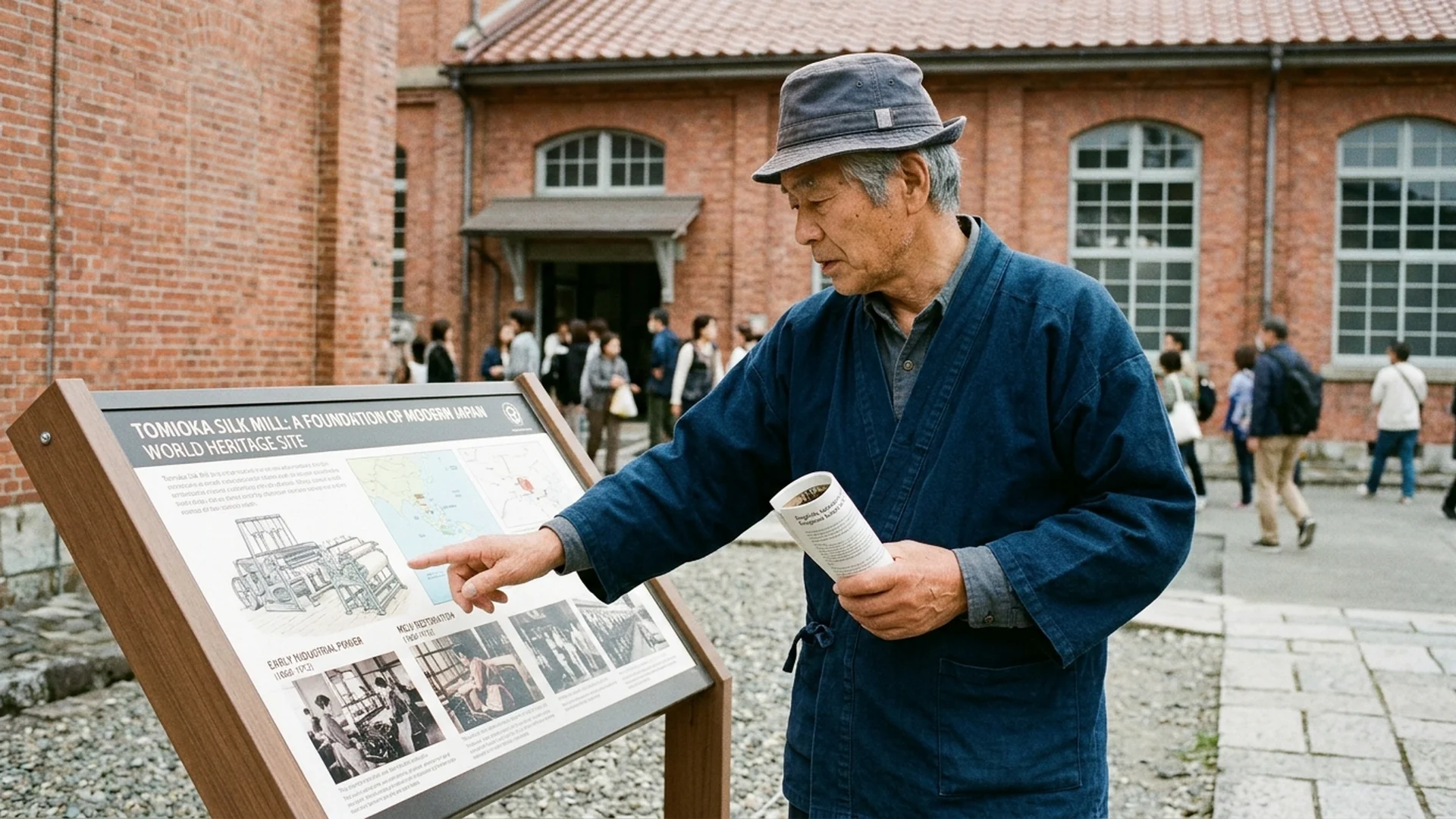
Among the most remarkable monuments is the Tomioka Silk Mill in Gunma Prefecture, established in 1872. Featuring French-inspired red-brick masonry harmonized with traditional Japanese tile roofing, the facility served as both a powerhouse for high-grade silk exportation and an institutional academy training female artisans to disseminate weaving technology nationwide.
Meanwhile, in the prefectures of Kyushu and Yamaguchi, Hagi preserves its primitive reverberatory furnaces and the Ebisukahana shipyard, marking the nascent stages of Japanese metallurgy. Furthermore, Hashima Island, commonly known as Gunkanjima (Battleship Island) off the coast of Nagasaki, stands defiant as an iconic deep-sea coal mining complex that once fueled the Yahata Steel Works to drive the nation’s heavy industrial engine.
Giyofu Architecture: When Samurai Woodworkers Recreated the West
Perhaps the most charming physical heritage of the early Meiji period is Giyofu Kenchiku, or Pseudo-Western Architecture. This aesthetic movement arose from a fascinating logistical challenge: the government urgently required public schools, banks, and municipal offices designed in Western styles, yet domestic architects and carpenters had received no formal training in European structural engineering.
Traditional craftsmen resolved this conundrum by meticulously studying blueprints, imported scale models, and foreign photographs, subsequently translating them through indigenous woodworking and joinery techniques. The result was a stunning hybrid—buildings boasting classical European stone facades, Roman columns, and arched porticos on the exterior, while utilizing traditional timber framing, authentic Japanese roofing tiles, and intricate wood carvings in place of Western stucco on the inside.
Quintessential exemplars include the Former Kaichi School in Nagano Prefecture and the Mita Enzetsukan in Tokyo. This evolutionary bridge ultimately paved the way for fully realized classic red-brick architecture championed by British architect Josiah Conder and his visionary Japanese disciple, Tatsuno Kingo, designer of the legendary Tokyo Station.