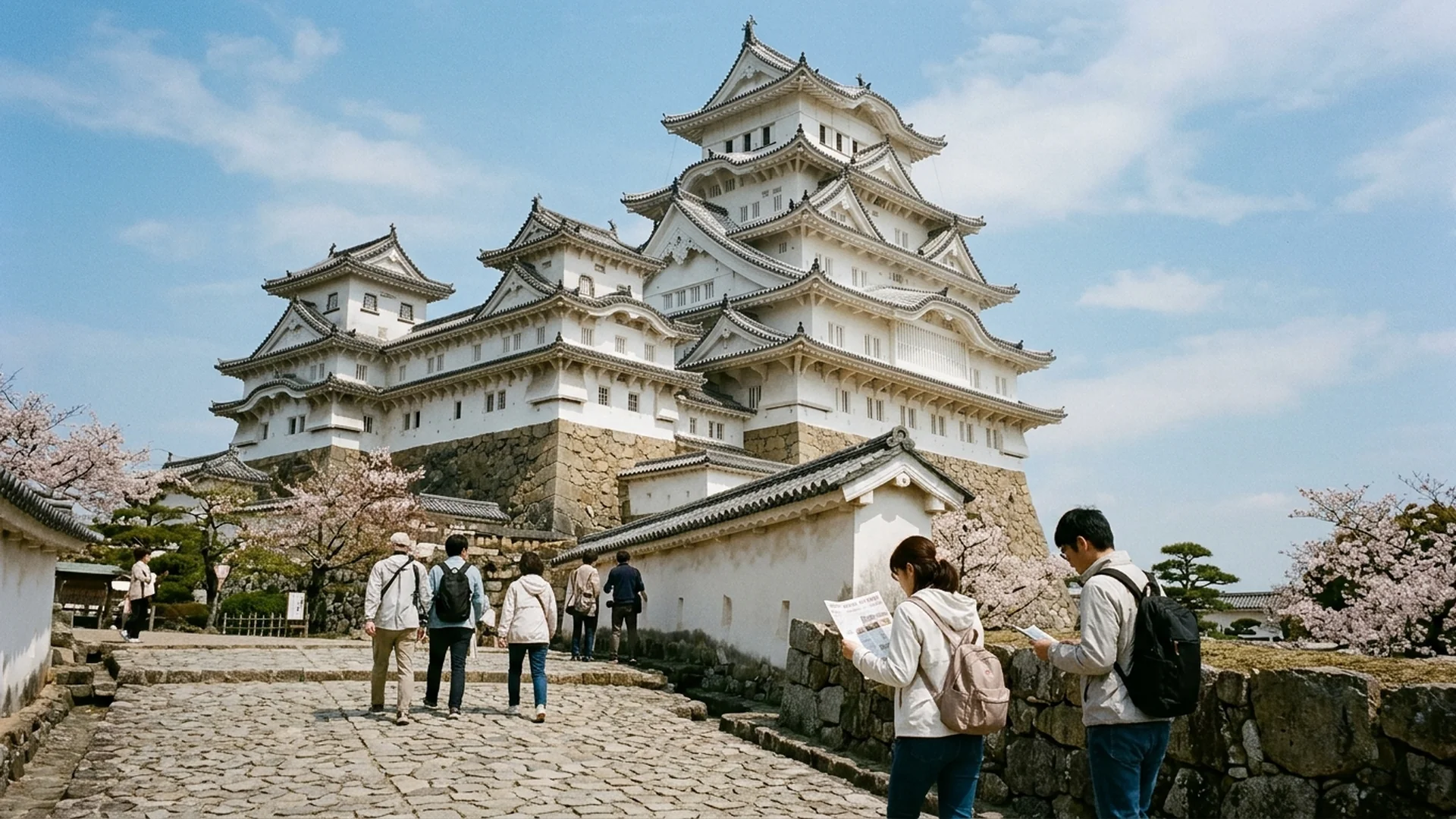
When travelers visit renowned landmarks such as Osaka Castle or Nagoya Castle, they are often struck by their imposing exterior grandeur. Yet upon stepping inside, they are met with elevators, air conditioning, and twentieth-century reinforced concrete museums. The dream of walking in the footsteps of the samurai unfortunately fades. Very few visitors realize that across the Japanese archipelago—home to thousands of castles and stone ruins—only twelve keeps (Tenshu) retain their authentic, original wooden structures, having miraculously survived the ravages of time and conflict. These twelve fortresses are known as Genzon Tenshu.
The true beauty of a Genzon Tenshu lies not merely in the elegance of its tiled roofs or whitewashed plaster walls, but in the aromatic scent of centuries-old timber, the adze marks left by Sengoku-era craftsmen, and the creak of wooden floorboards beneath the visitor’s tread. These are genuine historical spaces once used by daimyos and samurai as military command centers, where architecture and warfare merged into one. These castles escaped the three great perils that claimed the vast majority of Japan’s fortresses: the Castle Abolition Ordinance of the Meiji era, the incendiary bombings of the Second World War, and natural fires.
Journeying to experience these twelve original wooden castles is therefore much more than a routine sightseeing excursion. It is a journey back in time to decode ancient engineering wisdom built entirely without metal nails, while examining the tactical military stratagems hidden within every angle of the corridors, arrow slits, and stone base walls to deeply understand the true essence of the samurai spirit.
1. Fortresses That Defied Time: Why Only Twelve Original Wooden Castles Remain in Japan
Looking back to the civil conflicts of the Sengoku period, the Japanese archipelago once hosted more than 5,000 castles and military fortifications nationwide. Yet the decline of these precious architectural works was driven not solely by the fires of ancient wars, but by three critical historical turning points.
The first turning point occurred in 1873, when the Meiji government enacted the Castle Abolition Ordinance (Haijo-rei) to dismantle the feudal system and curtail the power of the daimyo. Numerous castles were ordered demolished, their timber and iron auctioned off, or their grounds converted into modern military bases. The second turning point arrived during World War II, when Allied aerial bombings destroyed several famous ancient wooden castles, including Nagoya Castle, the original Osaka Castle, and historic Hiroshima Castle. The final factor was natural disaster, encompassing both lightning-induced fires and catastrophic earthquakes.
Consequently, the twelve castles that survived to the present day represent historical miracles. Some, such as Himeji Castle, survived incendiary bombs that struck their upper keep only for the ordnance to fail to detonate. Others, like Inuyama Castle and Hikone Castle, endured thanks to the dedication of local villagers and leaders who pooled funds to repurchase the castles from the government to preserve them.
2. Decoding Woodwork Engineering and Samurai Defensive Stratagems
Japanese castle architecture focused on far more than visual grandeur; every component formed an advanced military engineering system calculated with absolute precision. The most astonishing technique is Kigumi, the art of joining timber using interlocking joints and pegs without a single metal nail. This technique not only withstands gale-force winds but offers high structural flexibility, allowing massive wooden frames to absorb earthquake vibrations with remarkable resilience.
In terms of military defense, castle architecture was engineered as a lethal labyrinth for invaders:
- Nawabari: Maze-like ground plans and routing. Access corridors to the main keep were designed with sharp turns, ninety-degree angles, and blind spots, preventing invading armies from charging in a straight line while exposing them to continuous high-angle attacks.
- Sama: Apertures cut into wooden walls and plaster, shaped according to weapon types. Rectangular openings, known as gun-amadō, were meant for matchlock rifles, while triangular and diamond-shaped slits served for archery, designed narrow on the outside and wide on the inside so defenders could maneuver safely.
- Ishiotoshi: Stone-dropping or boiling-water chutes hidden along the upper floor edges of the keep, projecting beyond the stone wall perimeter to deal with enemies attempting to scale the walls.
- Ishigaki: Stone base walls stacked without mortar. Natural stone arrangement techniques ensure exceptional drainage, earthquake resistance, and gentle curved gradients known as nosura-zumi, making them exceptionally difficult to climb.
3. The Five National Treasure Castles (Kokuho): Masterpieces of Architecture
Among the twelve original wooden castles, only five hold the highest designation as National Treasure Castles (Kokuho Tenshu), representing the pinnacle of ancient art and engineering:
- Himeji Castle (Hyogo Prefecture): Known as the ‘White Heron Castle’ (Shirasagi-jo) due to its brilliant white plaster walls and complex structure, it is Japan’s first UNESCO World Heritage site, featuring a perfectly integrated main keep and subordinate towers.
- Matsumoto Castle (Nagano Prefecture): The ‘Crow Castle’ (Karasu-jo). Its pitch-black keep stands out against the backdrop of the Japanese Alps, representing Japan’s oldest six-tier, five-story wooden castle, featuring both combat turret sections and a moon-viewing wing (Tsukimi Yagura) built during a peaceful era.
- Inuyama Castle (Aichi Prefecture): Believed to feature the oldest surviving main keep in its original condition (built in 1537), perched atop a high cliff overlooking the Kiso River, offering breathtaking panoramic views and strategic defensive advantages.
- Hikone Castle (Shiga Prefecture): A lakeside castle on Lake Biwa featuring diverse roof architectures (Hafu) and celebrated for preserving its original garrison structures and stables intact.
- Matsue Castle (Shimane Prefecture): The ‘Plover Castle’ (Chidori-jo), distinguished by its solemn dark tones. Inside sits an ancient well beneath the main keep to secure water supplies during sieges; it was designated a National Treasure as recently as 2015.
4. The Seven Important Cultural Property Castles: Regional Heritage That Endures
Beyond the five National Treasures, the remaining seven castles are registered as Important Cultural Properties of Japan, each possessing distinctive geographical and historical characteristics:
- Hirosaki Castle (Aomori Prefecture): The only original castle in the Tohoku region, surrounded by over 2,600 cherry trees, renowned for an engineering feat that shifted the entire wooden keep without disassembly to repair its stone foundations.
- Maruoka Castle (Fukui Prefecture): A compact wooden castle featuring interior stairs inclined at an astonishing 67 degrees and roof tiles made of split shale to withstand heavy snow.
- Bitchu-Matsuyama Castle (Okayama Prefecture): The castle standing at the highest elevation in Japan (430 meters above sea level). On autumn mornings, the castle appears to float amidst a sea of clouds, earning it the moniker ‘Castle in the Sky’.
- Marugame Castle (Kagawa Prefecture): Celebrated for having the tallest stacked stone ishigaki walls in Japan, rising four tiers high with elegant curves characteristic of ancient stonework.
- Matsuyama Castle (Ehime Prefecture): Perched on a central hill in Matsuyama city, featuring intricate tactical alleyways and complex turrets, standing as one of Shikoku’s most complete castles.
- Uwajima Castle (Ehime Prefecture): A compact castle laid out in a pentagonal footprint designed to deceive adversaries, constructed by the renowned castle architect Todo Takatora.
- Kochi Castle (Kochi Prefecture): The only castle in Japan that preserves both its original main keep (Tenshu) and the daimyo’s palace (Honmaru Goten) within the same enclosure in pristine condition.