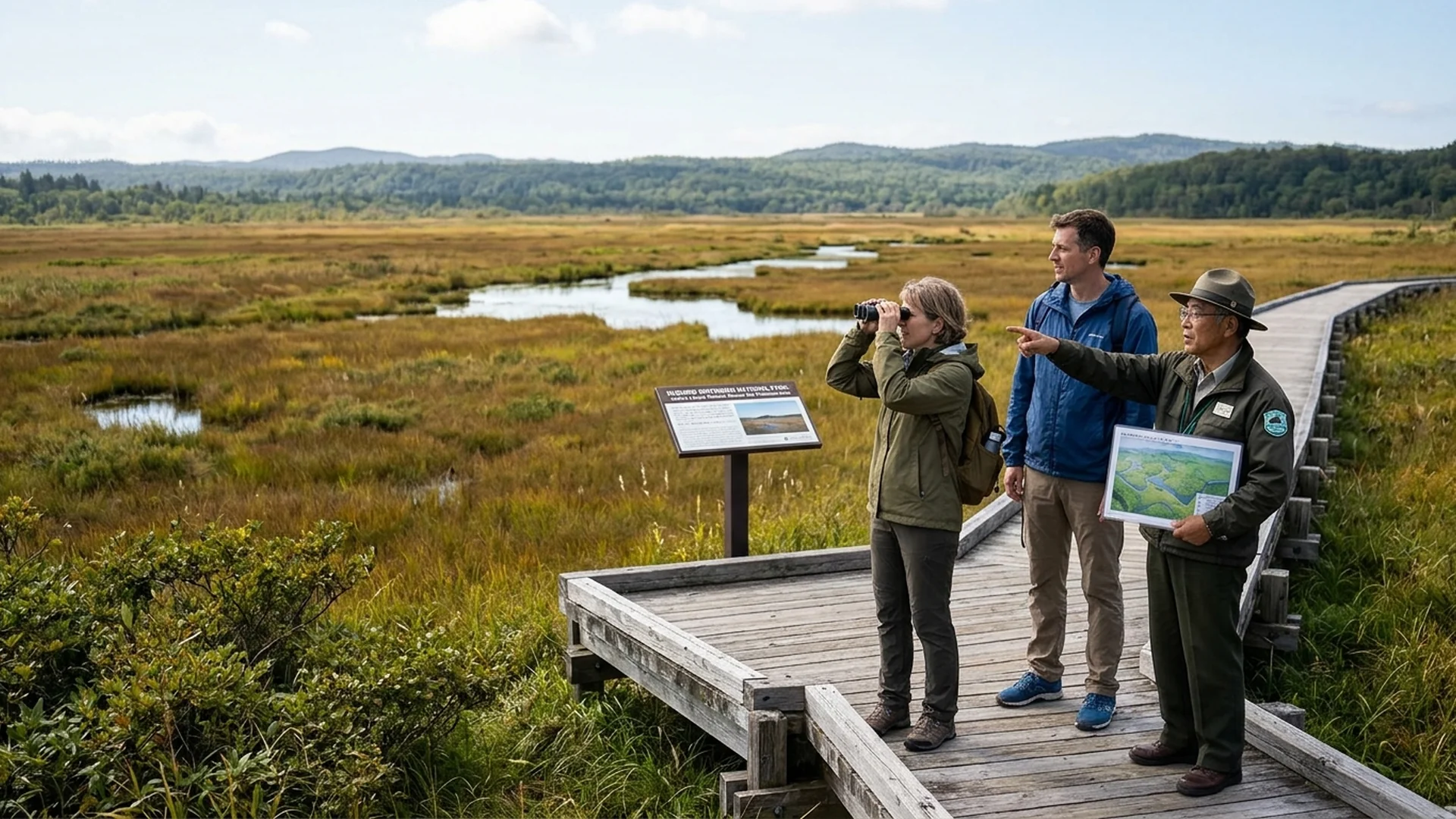
As the morning mist gently lifts across the vast expanse of Kushiro, an ancient primordial landscape emerges from the quiet dawn. Unfolding with emerald mosses and waterways that curve like sleeping serpents, this is Kushiro Shitsugen National Park—Japan’s sprawling masterwork of marshland and peat bogs. More than simply a magnificent northern vista, this sprawling sanctuary on Hokkaido serves as an immense living classroom, safeguarding millennia of geological evolution and ecological equilibrium.
Once an ancient ocean gulf before receding sea levels exposed the rich sedimentary floor, the region accumulated dense layers of peat that now anchor a singularly rare ecosystem. To journey into Kushiro is to step directly into the beating heart of global conservation. Protected under the Ramsar Convention, this internationally recognized wetland is celebrated not only for its staggering biodiversity but for its quiet, monumental role as one of the region’s most vital carbon sinks.
Evolution Through Time: The Biological Architecture of Kushiro’s Peat Bogs
The ecological marvel of Kushiro Shitsugen began thousands of years ago with the slow accumulation and decay of organic matter, forming dense layers of peat reaching depths from several centimeters to multiple meters. These deep peat beds act as an immense natural sponge, absorbing torrential rainfall and the heavy meltwaters of spring before releasing them slowly into the meandering course of the Kushiro River. This unhurried hydrological pace nurtures a specialized flora, including marsh grasses, sedges, and seasonal wildflowers that transform the palette of the earth through cyclical natural shifts. Furthermore, the structural integrity of the peatlands holds immense climatological significance. As a premier carbon sink, the subsoil locks away vast quantities of carbon dioxide, preventing its escape back into the atmosphere and allowing the planet to quietly rely on these wetlands in the ongoing mitigation of climate change.
Sanctuary of the Red-Crowned Crane and Rare Northern Fauna
If Kushiro’s marshes form a living canvas, the Tancho (Japanese Red-Crowned Crane) acts as the brushstrokes of ink and vermilion that animate the scenery. Once pushed to the very brink of extinction across Hokkaido in the early twentieth century due to habitat loss and hunting, these majestic birds have clawed their way back from oblivion through the tireless stewardship of local conservationists and the Japanese government. In the depths of winter, the sight of these towering cranes dancing across virgin snowfields stands as one of wildlife conservation’s most poignant triumphs. Beyond the cranes, Kushiro’s robust ecosystem shelters other rare denizens, including the prehistoric Kushiro salamander hiding among damp rock crevices, and the formidable Steller’s sea eagle, which frequently traces the icy river currents in search of sustenance during the coldest months.
The Art of Mindful Exploration: Four Seasons Across Kushiro Shitsugen
Experiencing the true grace of Kushiro Shitsugen requires a slowed rhythm and a deep reverence for natural boundaries. Impeccably integrated boardwalks, accessible from key vantage points such as the Hosooka and Kushiro Shitsugen observatories, invite travelers to venture deep into the marsh interior without disturbing the delicate topsoil or fragile root systems below. Summer (June through August) blankets the landscape in vibrant greens and alpine blooms, while autumn (September through October) coats the grasslands in sweeping strokes of gold against cobalt skies. Winter (December through February) reduces the realm to a silent monochrome of frost and snow, revealing an austere, transcendent dimension of Hokkaido wilderness. Guided rubber-canoe excursions down the tranquil stretches of the Kushiro River offer one of the finest low-impact ways to absorb the whispers of the reeds and the calls of migratory birds without leaving a trace.