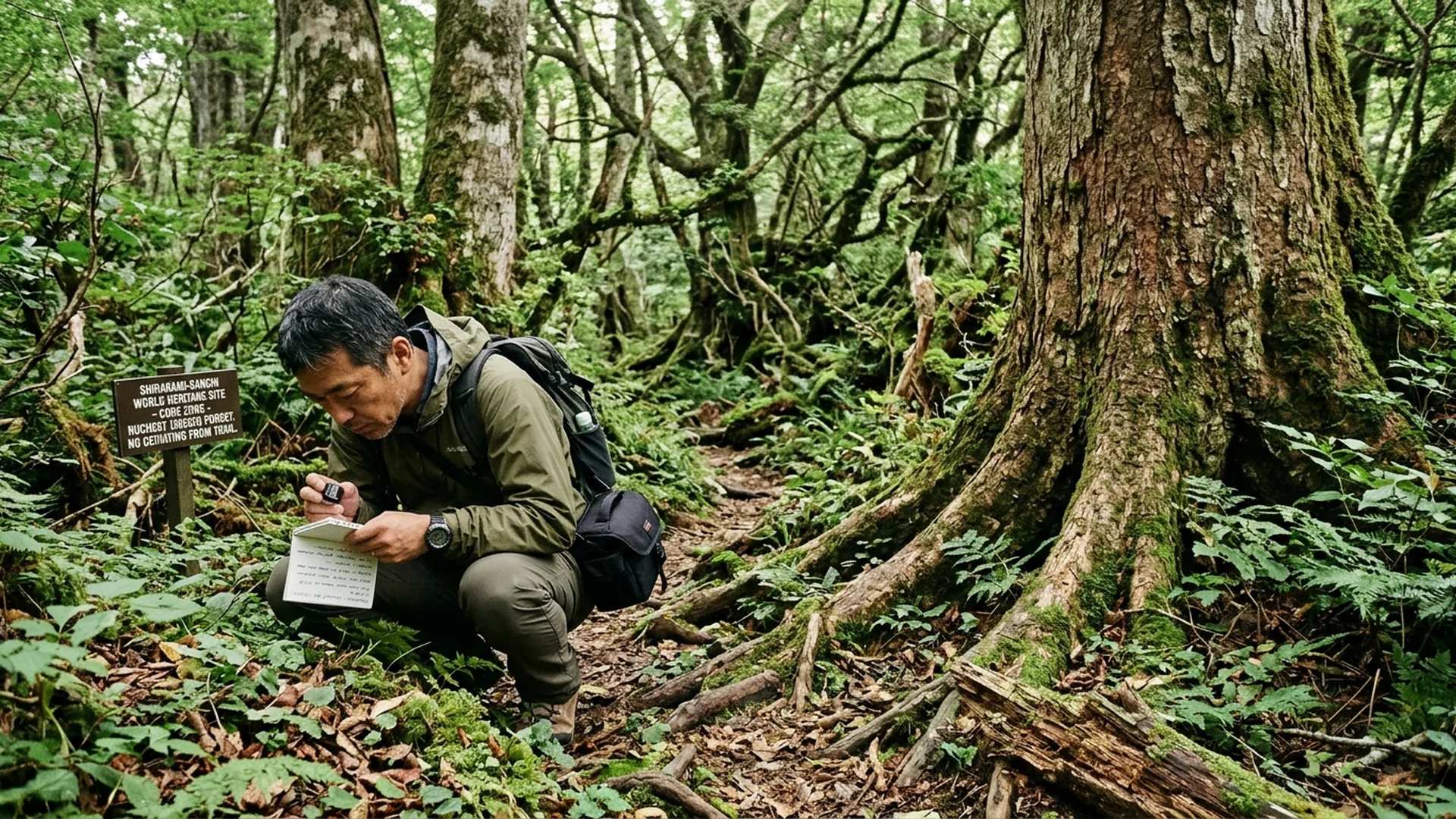
Cross the threshold between Aomori and Akita prefectures, and the ambient clamor of the modern world dissolves into absolute silence. In its place rises the sacred hush of the Shirakami-Sanchi virgin beech forest, Japan’s inaugural natural World Heritage site. This is far more than a mere woodland; it is a living laboratory that preserves the intricate secrets of an ice-age ecosystem with astonishing purity.
Amidst a delicate veil of mist clinging to rugged mountain crests, millions of Siebold’s beech trees—known locally as buna—extend their limbs to weave an emerald and copper canopy. Ancient roots plunge deep through volcanic soil, acting as a colossal natural sponge that filters and stores snowmelt and rainfall, releasing crystal-clear streams to nourish northern Honshu with pure vitality for over ten thousand years.
A Relic of the Ice Age: The Science of Survival in the Buna Forests
At the close of the last glacial period, when thick ice sheets blanketed much of the globe, the topographical contours and microclimates of the Shirakami mountains offered a sanctuary. Primitive flora, specifically the resilient buna beech, successfully adapted and weathered global climatic shifts. As temperatures gradually warmed, these trees expanded their dominion across the rugged peaks, establishing a colossal temperate woodland. The true distinction of Shirakami-Sanchi lies in its pristine interior; human interference has been virtually nonexistent, allowing the perpetual cycle of growth, senescence, and decay to unfold purely under nature’s governance. Fallen giants transform into ‘nurse logs,’ nurturing the next generation of saplings in an unbroken, eternal cycle rarely witnessed in the contemporary world.
The Heart of Water and Life: Secrets of the Shirakami Ecosystem
This primeval wilderness functions as a towering natural water tower. Decades of accumulated fallen leaves have formed a dense humus layer capable of absorbing vast quantities of rain and snowmelt. These waters percolate slowly through natural mineral strata for decades before emerging as pristine springs and crystalline rivulets. Nowhere is this hydraulic miracle more evident than at Aoike, the mesmerizing cobalt-blue pond situated deep within the forest interior. Its crystalline waters reveal sunken prehistoric driftwood at the lakebed, while its sapphire hues shift dynamically with the angles of sunlight and the changing seasons. Furthermore, the forest canopy sustains rare wildlife such as the elusive Japanese serow, Asiatic black bears, and most notably, the black woodpecker—an undeniable bio-indicator of ancient woodland health, which relies entirely upon the vast hollows of centenarian beech trunks for nesting.
Ecological Governance: Balancing Conservation and Contemplation
To safeguard the extraordinary fragility of this biosphere, Japanese authorities and UNESCO enforce a rigorous management framework. The World Heritage territory is divided into a Core Zone spanning 16,971 hectares, where human entry is strictly prohibited without specialized scientific permits, allowing nature to evolve completely unhindered. Surrounding this sanctum lies the Buffer Zone, thoughtfully designed to welcome travelers and researchers along meticulously maintained paths. Trails such as the gentle route meandering past the Nakadai Waterfalls or the ascent up Mount Futatsumori offer intimate encounters with colossal ancient beech specimens without disturbing the delicate forest floor.