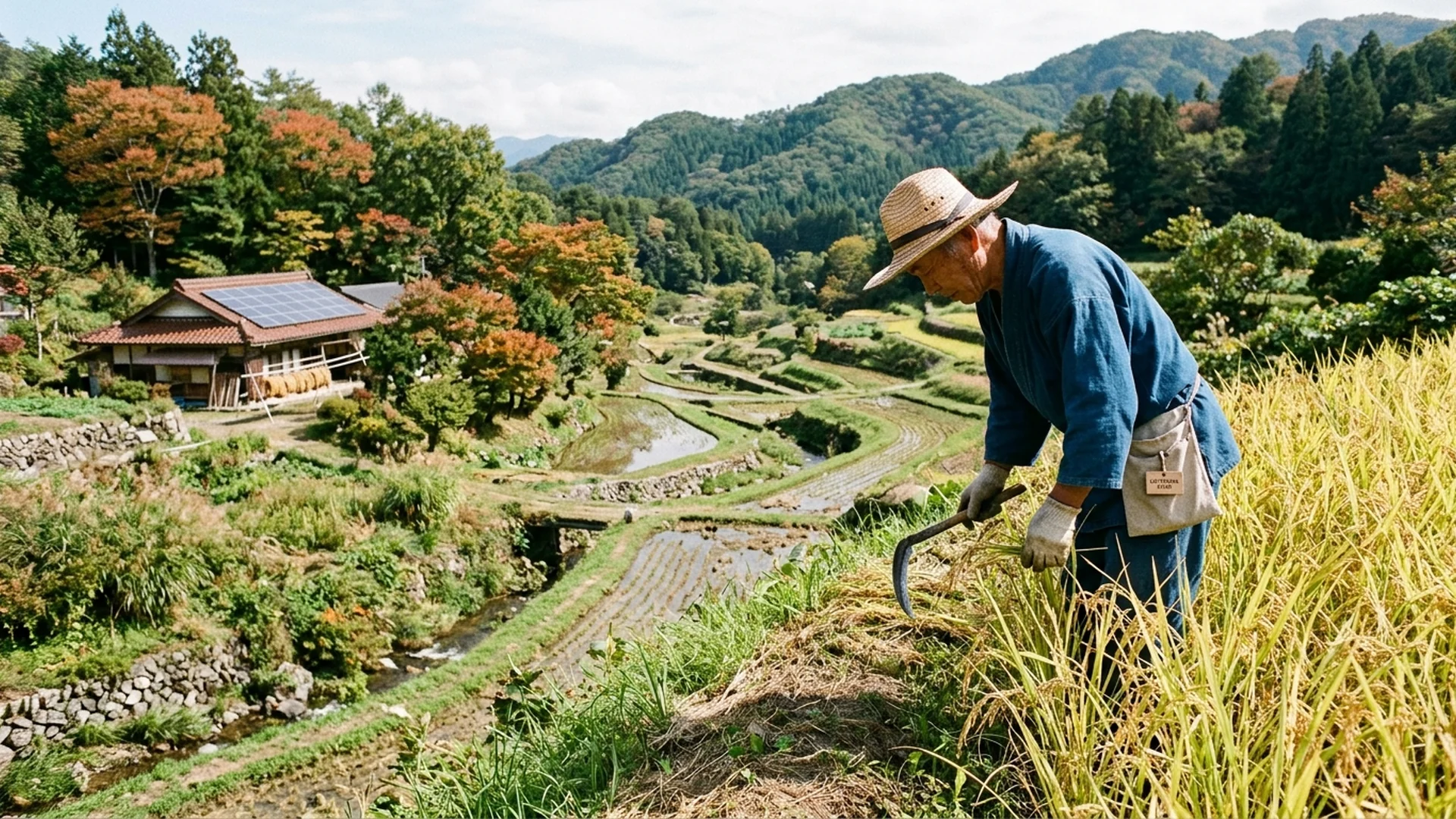
As morning mist gradually lifts over the intricate folding ridges of the Japanese highlands, the landscape revealed below is neither untouched wilderness nor cold concrete sprawl. Instead, it unfolds as an exquisite mosaic of terraced paddies, open woodlands, and ancient hamlets woven seamlessly together. This is Satoyama—the transitional ecotone nestled between rugged mountain forests and human settlements, whispering a profound philosophy of living in unbroken concert with the natural world.
Derived from sato, meaning village or habitable land, and yama, meaning mountain or forest, Satoyama is not a primeval, untamed jungle. Rather, it is a semi-natural landscape thoughtfully tended through ancestral wisdom. From the sustainable harvesting of firewood to the manual dredging of irrigation ditches that feed the emerald terraces, every intervention allows natural cycles to regenerate. These practices do not dismantle the ecosystem; instead, they cultivate vibrant biotopes—rich microhabitats where diverse flora and small fauna thrive alongside traditional agriculture.
The Architecture of Stewardship: An Ecosystem Maintained by Human Hands
To the eye of the ecologist, Satoyama serves as an open-air classroom demonstrating that human intervention does not inherently lead to environmental degradation, provided it is executed with deep reverence and understanding of planetary cycles. Historically, villagers harvested oak and kashiwa trees within the Satoyama woodlands for fuel and charcoal. Rather than engaging in destructive clear-cutting, they practiced coppicing—a rotational harvesting method that allows trees to regenerate rapidly from the stump. The resulting open woodland canopy invites sunlight to reach the forest floor, stimulating the proliferation of understory vegetation and wildflowers that attract myriad insects, birds, and amphibians. Meanwhile, the network of water channels surrounding the rice paddies transforms into essential nurseries for native fish and amphibians during the seasonal floods.
Milestones of Life: Exploring Satoyama Heritage from Noto to Lake Biwa
Across the Japanese archipelago, numerous Satoyama regions have achieved recognition as Globally Important Agricultural Heritage Systems (GIAHS). Among them is the Noto Peninsula in Ishikawa Prefecture, famed for the Senmaida rice terraces that cascade downward to meet the crashing waves of the Sea of Japan, where marine and terrestrial ecosystems are intimately intertwined. Similarly, the ancient basin surrounding Lake Biwa in Shiga Prefecture showcases an ingenious irrigation network connecting rice paddies directly to the lake. This historic design enables native fish species, such as the local crucian carp, to swim upstream into the flooded fields to spawn, sustaining an unbroken cycle of aquatic and agricultural life refined over centuries.
Wisdom and Sustainability in a Modern Era
Amid contemporary waves of globalization and accelerating climate change, the philosophy of Satoyama is being revisited with renewed urgency as a viable pathway toward sustainability. Preserving these landscapes is not an exercise in romantic nostalgia; rather, it is the integration of indigenous knowledge with modern ecological science to combat global biodiversity loss. Journeys into these regions offer far more than simple respite; they awaken our senses, demonstrating how humanity can actively contribute to ecological vitality rather than serving solely as agents of depletion.