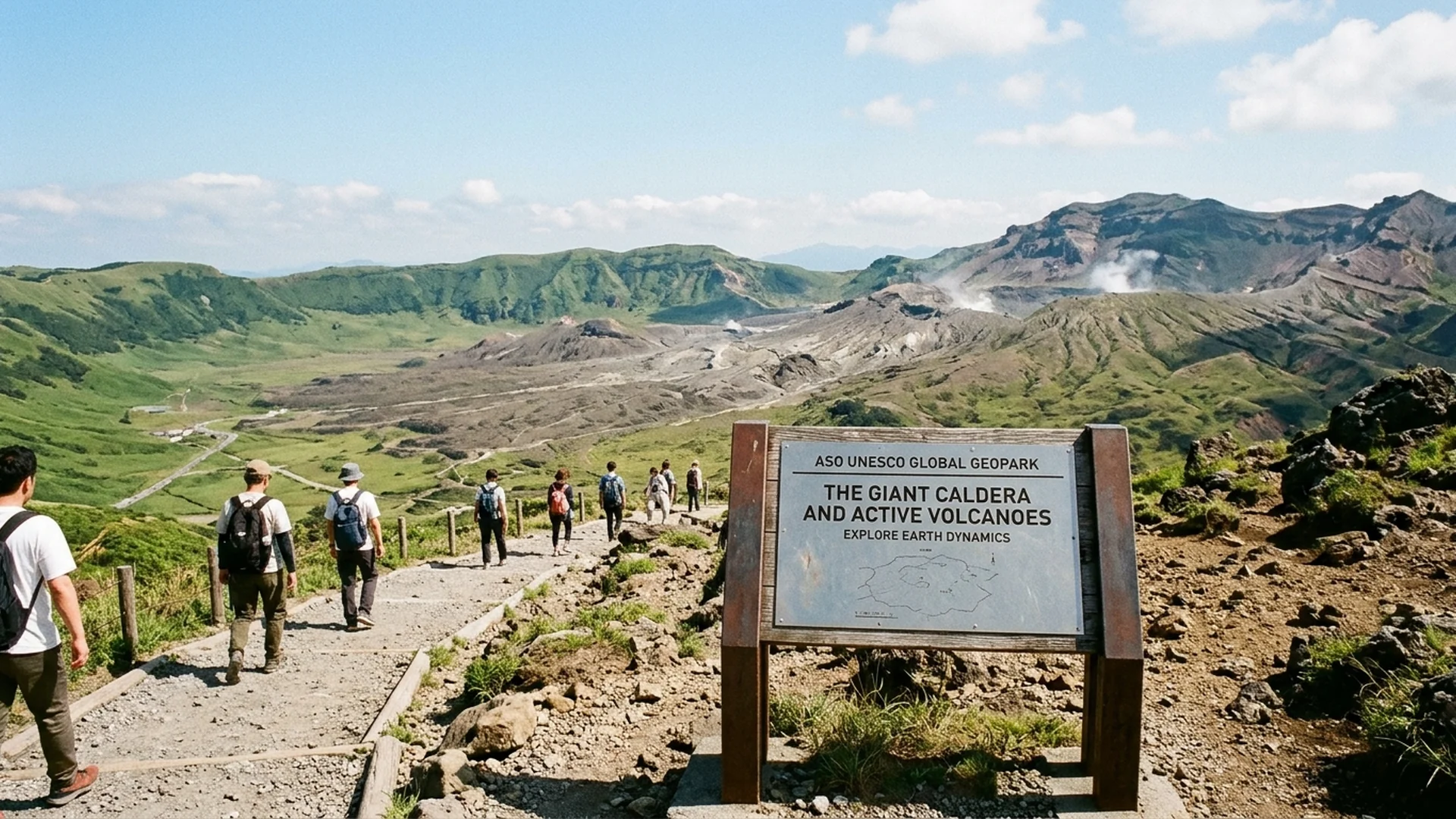
The subterranean rumble that continuously shapes the Japanese archipelago is the unseen architect behind its breathtaking, complex topography. Far beyond the ephemeral beauty of cherry blossoms and ancient traditions, Japan serves as a colossal, open-air classroom perched dramatically upon the volatile Pacific Ring of Fire. To journey through its UNESCO Global Geoparks is to step across the threshold of deep time, bearing witness to the very breath of our planet through primordial lava stones, sweeping calderas, and thermal steam escaping from the ancient fractures of the earth.
The Profound Distinction: Natural Heritage vs. UNESCO Global Geoparks
While UNESCO World Natural Heritage sites focus resolutely on biodiversity, pristine ecosystems, and undisturbed wilderness, UNESCO Global Geoparks are anchored in the narrative of Earth Heritage. A geopark is never conceived as a sterile, untouchable outdoor museum; rather, it is a living landscape where communities reside, cultivate the soil, and weave geological resource management with local cultural preservation and economic vitality. As one of the world’s most seismically active and volcanically dynamic nations, Japan showcases global geoparks where human adaptation meets overwhelming natural might in breathtaking harmony.
Four Sanctuaries of Earth Dynamics: Decoding Japan’s Geological Masterpieces
Our journey begins at the Itoigawa Geopark in Niigata Prefecture, home to the immense Itoigawa-Shizuoka Tectonic Line that cleaves the Japanese mainland in two, marking the primal seam between eastern and western Japan. Famed globally for its 500-million-year-old jade deposits, this sanctuary preserves the monumental collision of tectonic plates. Moving south, the Unzen Volcanic Area Geopark in Nagasaki Prefecture reveals the ferocious beauty of lava domes alongside poignant lessons in disaster education and ecological resilience. Further inland, the Aso Geopark in Kumamoto Prefecture cradles one of the planet’s most majestic calderas, where Mount Nakadake’s sulfurous plumes still billow before the traveler’s eyes. Finally, the Toya-Usu Geopark in Hokkaido presents the birthplace of new mountains through crustal uplift, creating a living laboratory visited by geologists worldwide.
Reading the Chronicles of Deep Time Through Strata and Magma
Visiting a Japanese geopark demands a shift in perception—an invitation to look past scenic vistas and train the eye to read the earth’s memoir written over millennia. Pitch-black basalt columns formed by the rapid cooling of ancient magma, colossal fault scarps forged by unimaginable subterranean pressures, and thermal onsen springs welling up through volcanic fissures all stand as irrefutable proof of a living, breathing planet. Standing amidst natural remnants that eventually transmuted into nutrient-rich volcanic soils offers a humbling perspective on our planet’s immense scale and fragile equilibrium.