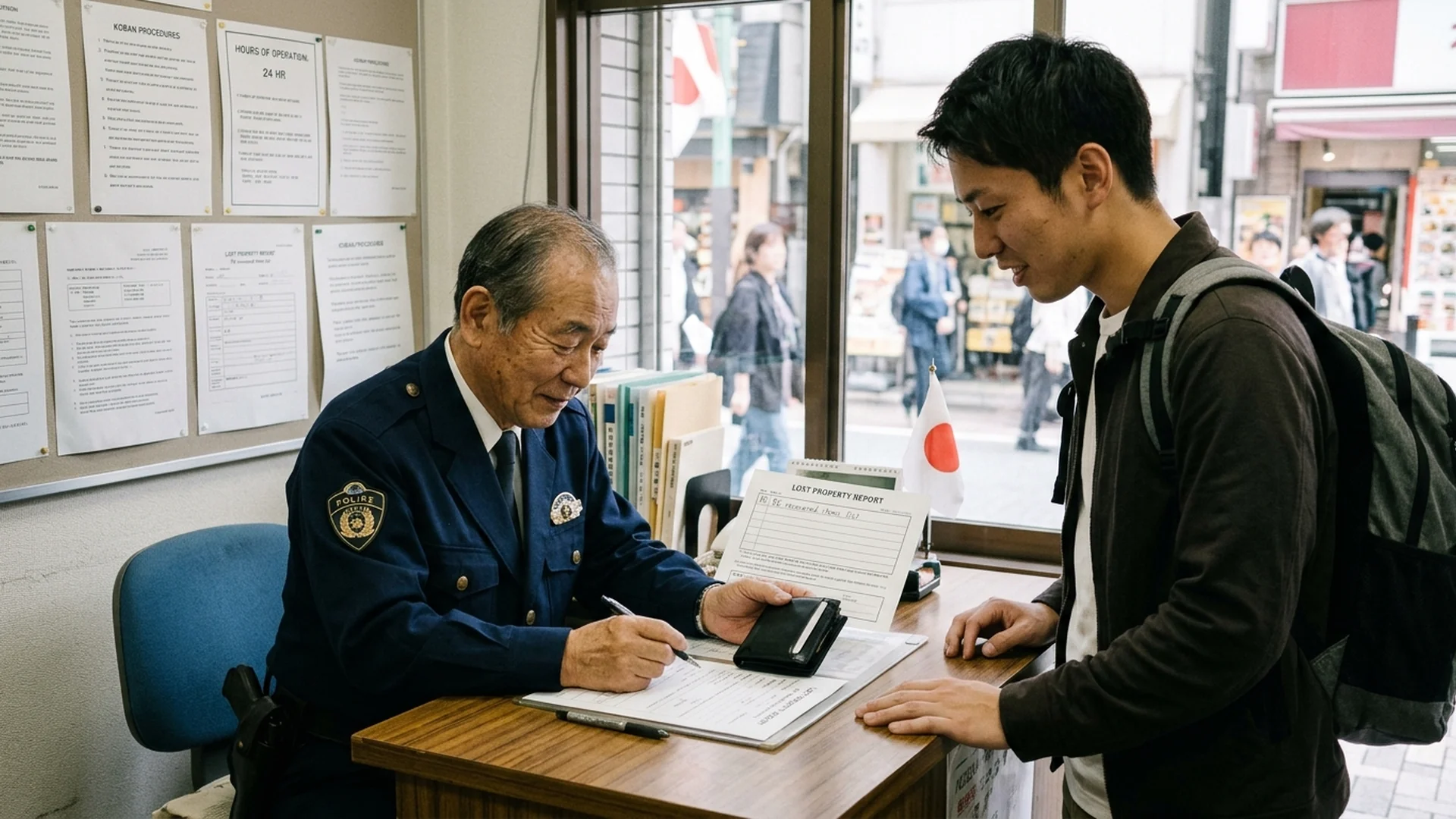
A sudden drop in the stomach often occurs in the fraction of a second when you reach for your backpack, wallet, or passport and find it missing in the Land of the Rising Sun. Yet amid the initial wave of anxiety, Japan conceals one of the most remarkably efficient and sophisticated lost property management mechanisms in the world. Known as ‘Otoshimono’ (dropped items) and ‘Wasuremono’ (forgotten items), recovering lost valuables relies not merely on deep-rooted civic integrity, but upon an exceptionally precise structural coordination between transport networks and community police boxes.
Understanding these mechanisms is the vital key to transforming sudden panic into quiet reassurance. Statistics from the National Police Agency of Japan reveal that an astonishing proportion of lost valuables and cash are successfully returned to their rightful owners. For any discerning traveler facing the unforeseen, familiarizing oneself with the ‘Koban’ system and legal recovery procedures ensures a composed and direct response.
The Architecture of Trust: Navigating Japan’s Lost Property Structure
When personal property goes missing in Japan, the path to recovery follows a clear, territorially segregated trajectory. If an item was left aboard a train, subway carriage, or municipal bus, your immediate destination should be the station master’s office or the designated Lost & Found counter of that specific railway operator (such as JR, Tokyo Metro, or private rail lines). Staff will immediately coordinate via radio with terminal stations or daily holding depots. However, if items are misplaced along city streets, public parks, or bustling shopping districts, jurisdiction falls to the neighborhood police boxes known as ‘Koban,’ which stand prominently at nearly every major intersection across the country. Accurately identifying this starting point saves valuable time and eliminates redundant steps in your search.
Filing an Otoshimono-todoke at a Koban Police Box
Upon arriving at a Koban, your primary objective is to file an ‘Otoshimono-todoke’ (lost property report). Japanese police officers will inquire about specific details to enter into their centralized database. Prepare to provide precise information including the estimated time and location of the loss, along with distinctive characteristics such as brand, color, or unique flaws. The more specific your description, the faster authorities can cross-reference it with items turned in by civic-minded citizens. Providing a working telephone number within Japan—such as a tourist SIM card or hotel contact—allows officers to easily reach you the moment a match is found.
Critical Scenarios: Passports, IC Cards, and Smartphones
Urgency multiplies exponentially when the misplaced item is a critical travel document like a passport or an essential digital device. For smartphones, the immediate priority before visiting authorities is contacting your network provider to suspend service temporarily, safeguarding your personal data. For missing passports or critical credentials, if searches through the Koban and railway networks yield no immediate results, the subsequent step involves taking the police report to your embassy or consulate in Tokyo to arrange emergency travel documentation. For IC cards (such as Suica or Pasmo), personalized or digitally linked cards can often have their balances transferred and new cards reissued directly at railway station offices.