Amidst the quiet reverence of ancient alleyways in Kyoto and the synchronized pulse of Tokyo, Japan often appears as an idealized sanctuary of effortless safety and order. Yet beneath the veneer of meticulous hospitality lies a web of stringent, unyielding statutory codes. For the uninitiated visitor, these unfamiliar regulations can occasionally transform a tranquil holiday into an unexpected bureaucratic entanglement.
Familiarity with independent travel can easily breed complacency regarding minor details: a multi-purpose pocketknife tucked into a rucksack, standard household remedies carried for convenience, or a casual stroll without official identification. These are not matters of mere reprimand; they can precipitate serious complications ranging from temporary detention at local koban police boxes to formal criminal charges. Cultivating awareness of these legal boundaries is not an exercise in alarmism, but rather an essential layer of quiet preparation for the discerning global traveler.
The Six-Centimeter Blade Trap: When Utility Becomes Contraband
The traveler’s instinct for preparedness—whether carrying a multi-tool, a robust manicure kit, or a pocket fruit knife—is second nature in many Western nations and commonplace across domestic journeys. In Japan, however, the Swords and Firearms Control Law and the Minor Offense Act are uncompromising. Carrying a blade longer than six centimeters (and in certain contexts, even shorter blades without an explicit, verifiable purpose) outside of a private residence constitutes a criminal offense.
Japanese law enforcement officers possess broad authority for stop-and-search procedures. If a folding knife is discovered in a backpack without a demonstrable justification—such as having been freshly purchased and remaining sealed in its original retail packaging alongside the receipt—the bearer may face immediate detention. Crucially, the defense of carrying a tool ‘for self-defense’ holds no legal validity whatsoever within the Japanese judicial framework.
Pharmacological Perils: When Common Remedies Cross the Line
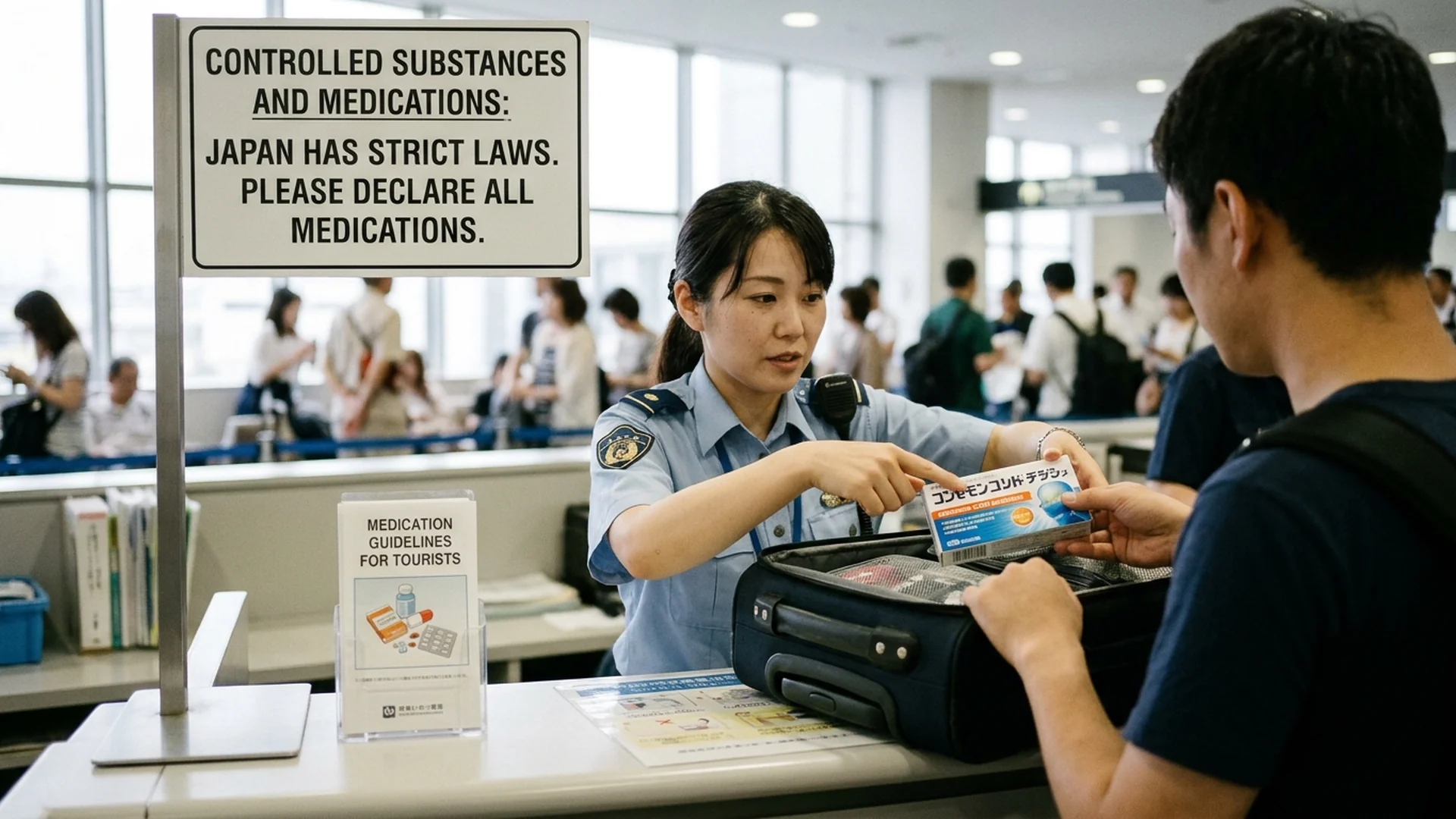
Decongestants, anti-influenza formulas, and allergy treatments readily available over the counter in pharmacies worldwide frequently contain pseudoephedrine, a compound classified under Japanese narcotics regulations as a raw material for stimulants. Importing these substances beyond the permitted personal allowance—typically a two-month supply for general over-the-counter pharmaceuticals or a one-month supply for prescription medications—without an approved import certificate (Yunyu Kakunin-sho) can result in airport detention and prosecution for the importation of restricted substances.
The Physical Passport Mandate and Strict Urban Smoking Codes
A classic oversight among international visitors involves leaving the physical passport secured in a hotel safe while carrying merely a digital scan or smartphone photograph. Under Japanese immigration law, every foreign national is legally mandated to carry their original passport on their person at all times in public spaces. Inability to produce the physical document upon request by law enforcement can lead to immediate escort to a police station for immigration status verification.
Concurrently, the immaculate cleanliness of major metropolitan centers like Tokyo and Osaka is maintained through stringent public behavioral codes. Smoking while walking along thoroughfares or lingering in unapproved alcoves violates municipal ordinances, carrying substantial financial penalties. Smokers must confine their habit strictly to designated municipal or establishment smoking corners.