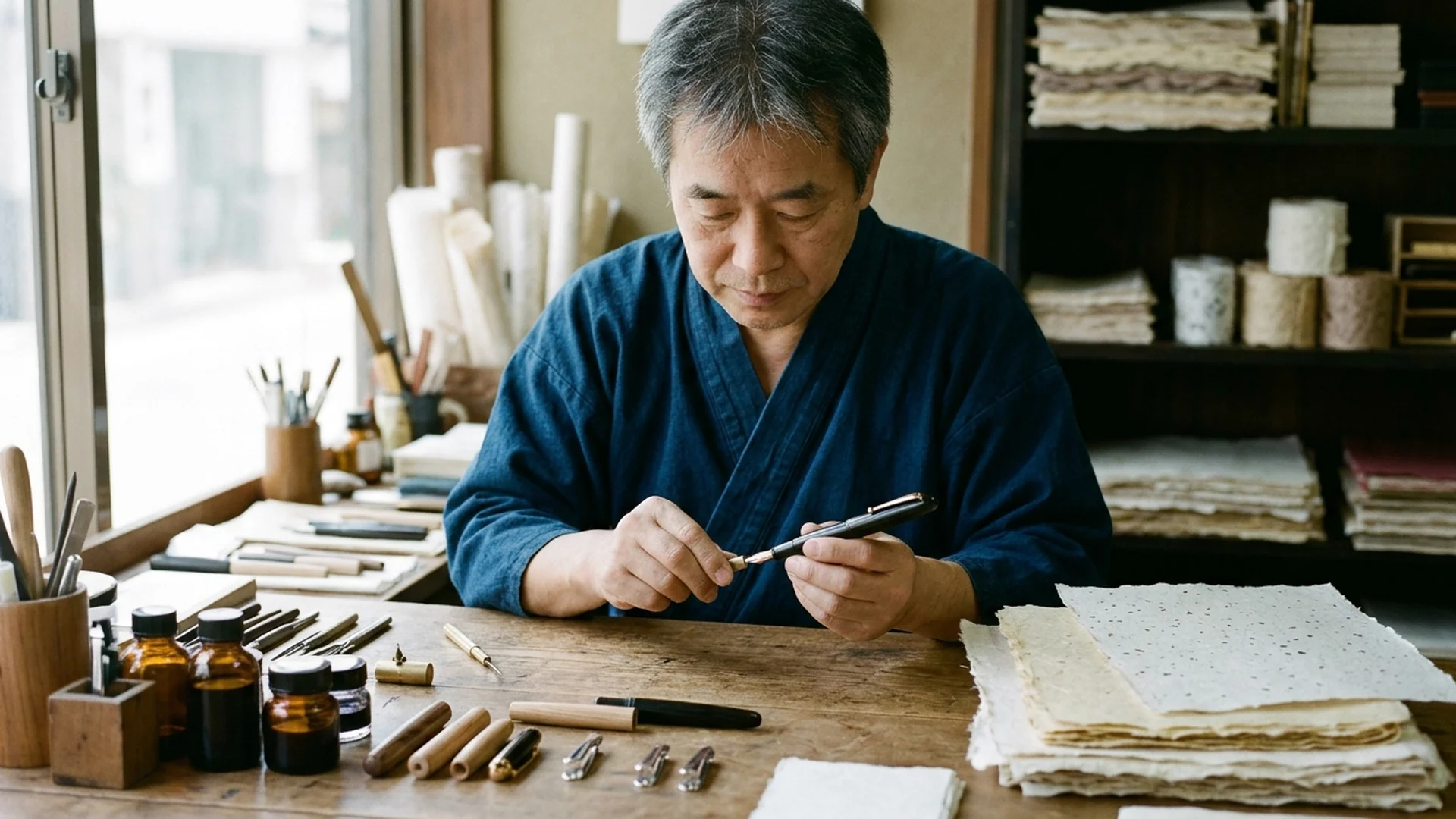
In an era where every keystroke migrates to cool, frictionless glass screens, the gentle, tactile whisper of a fountain pen nib meeting handmade paper grows ever more precious. It serves as an intimate bridge, tethering the writer’s spirit deeply to the present moment. Japan is a sanctuary that preserves this venerated culture not merely as a relic of memory, but elevates writing instruments into living, breathing works of fine art. A profound craftsmanship breathes within every nuance, stretching from monumental concept towers in bustling commercial districts to serene, quiet sanctuaries in Shitamachi where time slows down to let us savor the profound beauty of inscription.
Embarking on a quest for premier stationery across Tokyo and Kyoto transcends mere retail acquisition; it is a contemplative exploration of distinct aesthetics where modern innovation harmonizes seamlessly with centuries-old heritage. This pilgrimage plunges the discerning traveler into a sensory world defined by proprietary fountain pen ink aromas, the plush tactile embrace of organic plant fibers, and the immaculate mechanical perfection crafted with uncompromising devotion to detail.
The Cathedral of Paper: The Twelve-Story Universe of Ginza Itoya
Amidst the glittering luxury of Tokyo’s premier shopping district stands a striking architectural landmark crowned by a monumental red paperclip. This is Ginza Itoya, a legendary flagship established in 1904 that transcends conventional retail to function as a profound architectural dedication to the simple joy of writing. Each of the twelve floors is meticulously curated, ranging from salons showcasing world-class fountain pens and notebooks with meticulously engineered paper textures to expansive floors displaying thousands of varieties of fine art and artisanal wrapping papers. The interior lighting is deliberately subdued to encourage the slow, contemplative inspection of each piece. Furthermore, dedicated craft and exhibition spaces reflect the distinct Japanese philosophy that exceptional everyday implements cultivate grace and tranquility in daily life.
The Art of Identity: Custom Ink Studios and Handbound Notebooks in Kuramae
Stepping away from the urban cadence leads to Kuramae, a tranquil riverside Shitamachi neighborhood brimming with studios belonging to a new generation of artisans. Here lies Kakimori, a celebrated bastion for correspondence and custom-blended inks. The cornerstone of its global appeal is the bespoke notebook service, inviting patrons to select exquisite cover stocks, spines, interior papers tailored to specific nib weights, and artisanal closure hardware under the gentle guidance of resident craftspeople.
Nearby lies a haven for fountain pen ink enthusiasts, offering the rare privilege of formulating an entirely personalized hue. Visitors dispense pigments drop by drop, testing them against actual paper until achieving a singular shade matched nowhere else on earth. The resulting proprietary formula is preserved in a teardrop glass flacon resembling a sculptural objet d’art—an immersive, sensory encounter marrying unbridled creativity with impeccable aesthetic discipline.
The Heritage of Kyoto: The Soft Embrace of Ancient Washi Paper
Journeying south to the ancient capital of Kyoto reveals a city where time is fiercely yet tenderly protected. Tucked between traditional machiya townhouses are generational shops specializing in handmade washi paper. Fashioned from natural fibers such as the kozo mulberry tree, washi is born through a rigorous ritual of beating, pressing, and sun-drying across crystalline waters by master hands. The resulting sheets possess a remarkable tensile resilience, a yielding softness, and subtle organic fiber patterns ensuring no two leaves are ever identical.
Handling washi within these ancestral Kyoto shops amounts to a tactile lesson in history. These papers transcend noble calligraphy scrolls and ceremonial correspondence; they serve as the foundational medium for fine arts, heirloom gift wrapping, and conservation crafts that embody a deep, quiet reverence for the natural world.