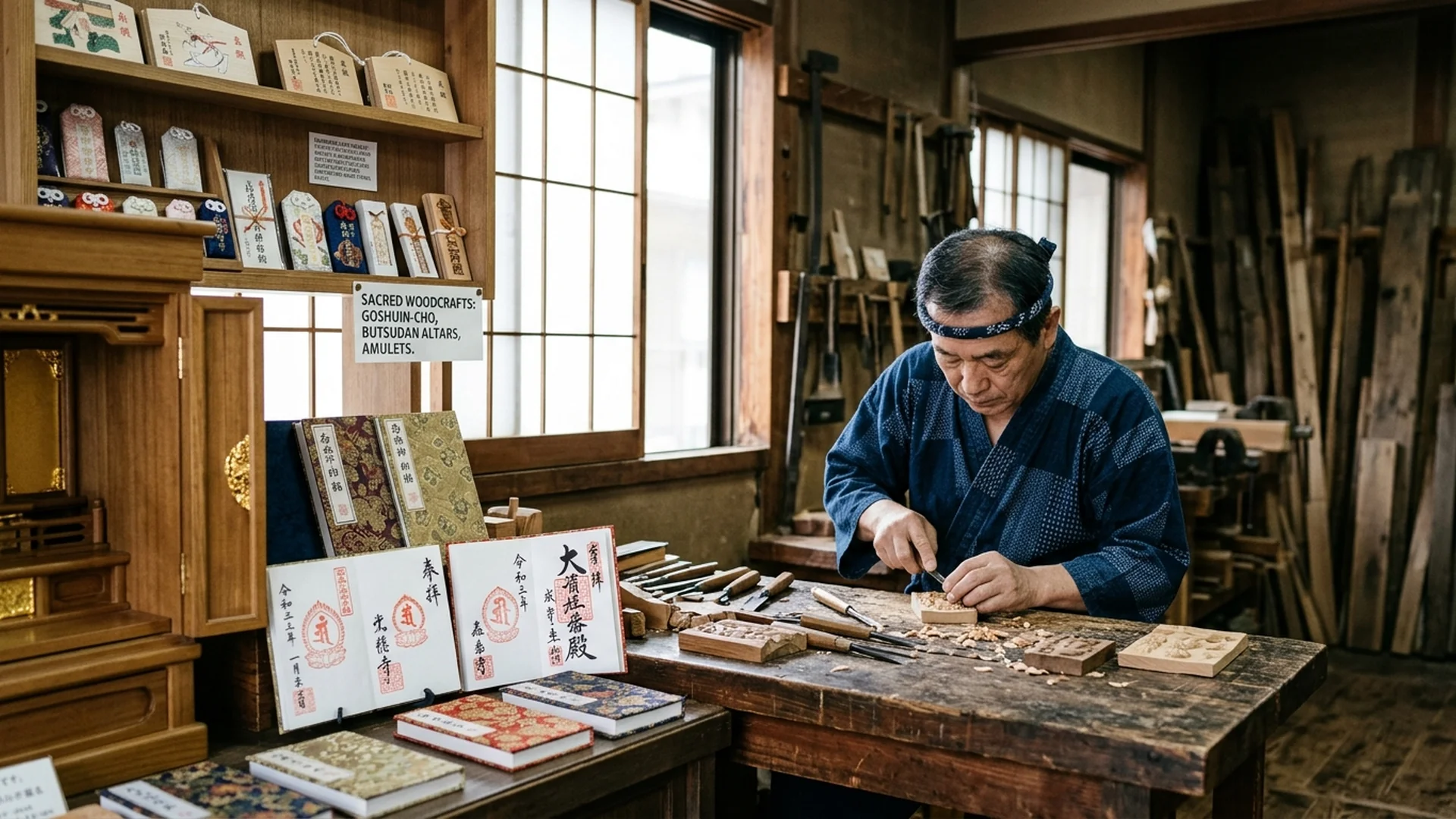
Amidst the quiet stillness of ancient forests and the gentle, lingering fragrance of hinoki resin drifting through historic sanctuaries across Japan, woodwork is never merely architecture or furniture. It is a living bridge between the material realm and the sacred domain. When master artisans, heirs to centuries of unbroken lineage, gently guide their chisels across grain and timber, every stroke captures the passage of time, a profound reverence for nature, and a faith rooted deep in the Japanese psyche.
For the discerning traveler and dedicated collector drawn to objects of enduring resonance, the pursuit of sacred Japanese woodcrafts transcends conventional curation. It becomes an intimate pilgrimage into the realm of breathing art—ranging from meticulously bound temple seal books to pocket-sized manifestations of Buddhist pantheons and sacred talismans embodying ancient architectural mastery.
Goshuin-cho: The Accordion-Fold Journals of Faith and Textile Mastery
More than simple journals, Goshuin-cho are deeply personal codices that chronicle the spiritual dialogue between the traveler and Japan’s sacred sites. Bound in the traditional accordion-fold or orihon style, these volumes utilize heavy-weight washi paper specifically engineered to receive sweeping calligraphy brushstrokes and vibrant vermilion temple stamps without bleeding through to the reverse side.
Today, the true distinction of a fine Goshuin-cho lies in its cover artistry. Master binders frequently incorporate antique kimono textiles, exquisite Nishijin-ori brocades from Kyoto, or paper-thin sheets of shaved hinoki wood embossed with auspicious motifs such as chrysanthemums or Mount Fuji. To collect a Goshuin-cho is to preserve a portable masterpiece of textile and woodworking heritage, reflecting an uncompromising refinement of taste.
Miniature Sacred Architecture: Butsudan and Kamidana as Sculptural Mastery
For connoisseurs seeking monumental wooden artistry echoing the traditions of miyadaiku shrine carpenters, Butsudan Buddhist altars and Kamidana Shinto household shrines represent the absolute zenith of collection. Crafted entirely through traditional interlocking joinery known as kigumi—without a single metal nail—these structures are designed to expand and contract naturally with changing atmospheric humidity and temperature.
The intricate fretwork, floral carvings, and divine iconography housed within a Butsudan showcase astonishing meticulousness. Artisans traditionally rely on fine-grained hinoki or sugi cedar, whose surfaces gradually darken over decades to emit a profound, luminous warmth. Such pieces ultimately evolve into irreplaceable heirloom treasures carrying immeasurable sentimental and spiritual gravity.
The Living Spirit of Hinoki: Talismans and Auspicious Animal Carvings
Hinoki, or Japanese cypress, has been revered as a sacred tree since antiquity due to its weather resistance and natural aromatic oils that promote deep serenity. Woodcarvers favor hinoki to fashion portable talismans and sacred images, including manifestations of Kannon Bosatsu, Daikokuten the deity of wealth, and auspicious guardian animals such as dragons and kitune foxes.
The allure of these carved objects lies in their tactile evolution; with every touch, the wood develops a smoother, more lustrous patina born from the oils of the owner’s hands. Selecting such a piece involves evaluating the crispness of the chisel work, the heft of the timber, and the resonant energy of an object brought to life through the artisan’s reverence for the natural world.