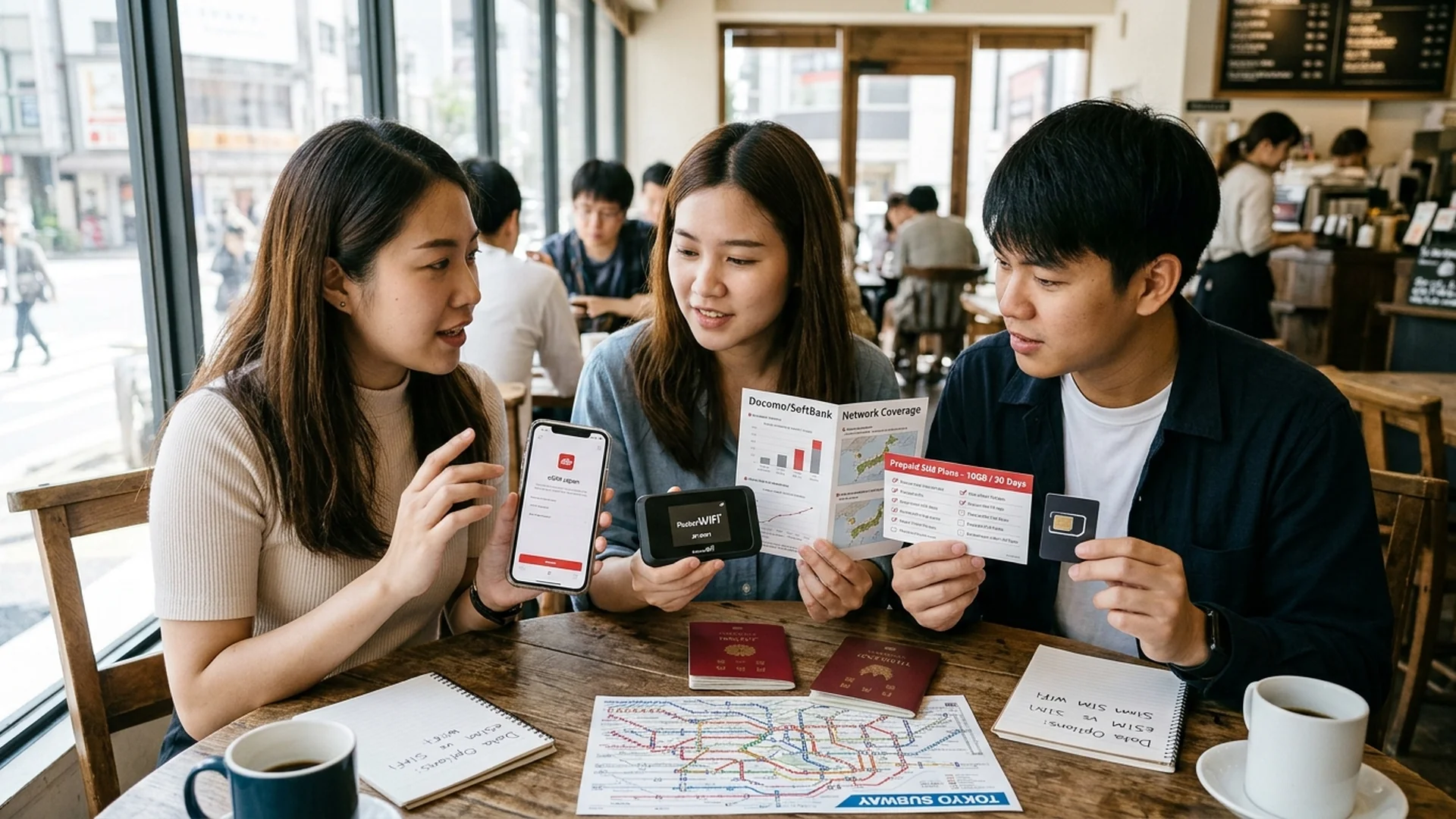
When a Japanese itinerary shifts effortlessly from the electric velocity of Tokyo to the hushed cedar forests of the Japanese Alps or the mist-veiled cultural corridors of the Tohoku region, the discerning traveler prepares for more than rail passes and ryokan reservations. We must consider the invisible digital filaments that tether us to the wider world. Mobile internet has become our most indispensable modern compass, yet the question remains: amid countless choices, which format and network will prevent you from standing stranded and signal-less in the morning fog?
Contemporary travel—particularly when plunging deep into rural provinces and remote wilderness—reveals an essential truth: cellular coverage across the Japanese archipelago is far from uniform. Understanding the underlying telecommunications architecture is the quiet key to transforming a journey from a disconnected trial into an experience of seamless, confident exploration.
Digital Artifacts: Weighing eSIM, Physical SIM, and Pocket WiFi
Deciding upon a connectivity format begins with a thoughtful assessment of your travel habits and party size. For the solo voyager or the purveyor of absolute agility, eSIM has rapidly become the preferred medium. Its supreme convenience eliminates the fragility of physical cards, evades the hazard of loss, and activates instantly upon touchdown through a simple QR code scan.
Meanwhile, the traditional physical SIM card remains a steadfast, reliable companion for older devices unacquainted with embedded subscriber identity modules. Pocket WiFi routers, conversely, reveal their true worth when traveling in small groups or managing multiple devices—such as tablets and laptops—simultaneously. While they require accommodations for luggage weight and diligent daily battery management, their shared-access utility remains unmatched in remote settings.
The Network Vanguard: Docomo, SoftBank, and au Beyond the Metropolis
The true crucible of Japanese connectivity lies beyond the city limits, governed by three principal telecommunication titans, each possessing distinct geographical strengths.
NTT Docomo stands as the grand patriarch, boasting the most comprehensive blanket of transmission towers across the nation, particularly piercing through deep forests, national parks, and sequestered valleys in the Chubu and Tohoku regions. For alpine treks, deep wilderness campaigns, or quiet provincial explorations, Docomo provides unmatched peace of mind.
SoftBank reigns supreme within urban cores, commercial districts, and primary rail arteries, offering blazing speeds and exceptional stability. Yet, as one ventures into deep gorges or remote islands, its signal may occasionally fluctuate. au (KDDI) maintains a balanced equilibrium comparable to Docomo in numerous territories, though international traveler-focused providers predominantly anchor their offerings within Docomo and SoftBank infrastructures.
Pre-Departure Calibration: Device Preparation and Navigating the FUP
Before embarking, verifying whether your smartphone is fully carrier-unlocked is an indispensable foundational step. For those utilizing eSIM technology, downloading the digital profile while still situated in your home country with stable Wi-Fi ensures a tranquil transition, followed by precise APN (Access Point Name) configurations.
Furthermore, travelers are frequently surprised by the realities of Fair Usage Policy (FUP) guidelines. Even when marketed as ‘unlimited,’ the vast majority of operators enforce a daily high-speed threshold—typically the first 1GB or 2GB. Exceeding this boundary prompts a temporary speed reduction until the cycle refreshes. Comprehending this framework permits discerning travelers to gracefully pace large cloud backups and high-definition video calls throughout the voyage.