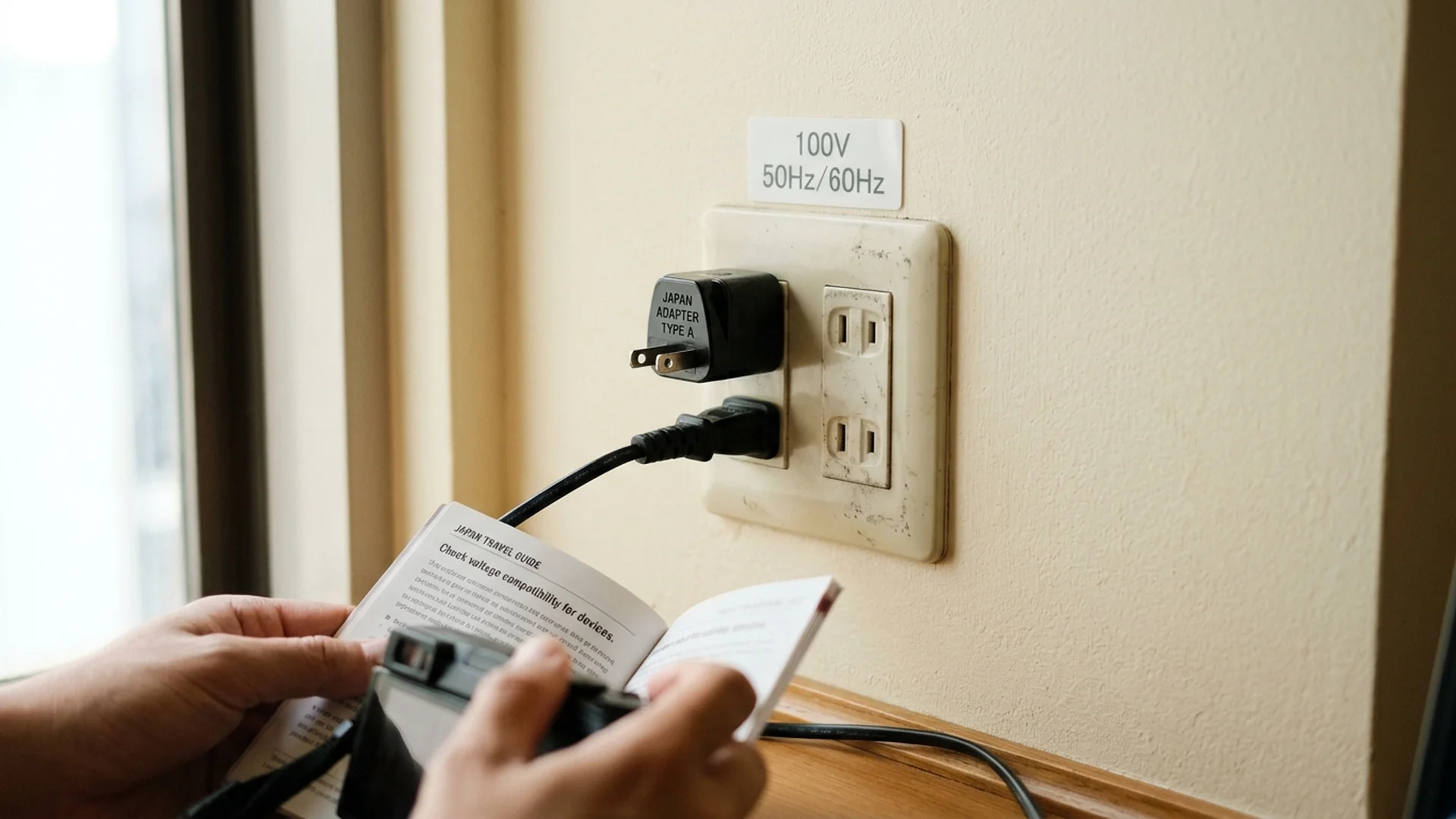
Amidst the hyper-modern skyline of the Land of the Rising Sun, where contemporary technology seamlessly intersects with ancient heritage, Japan conceals subtle electrical engineering nuances that discerning travelers frequently overlook. The moment you step onto Japanese soil and prepare to charge your indispensable devices, a fundamental understanding of local currents becomes the primary key to an uninterrupted, impeccably smooth journey.
The structural divergence between domestic power systems—such as Thailand’s robust 220 volts—and Japan’s delicate 100-volt grid represents an invisible border between two different worlds. Examining technical specifications and power labels on your electronic belongings transcends mundane preparation; it is an exercise in mindful travel, reflecting a profound appreciation for every facet of your expedition.
The Architecture of 100V Power: Historical Legacy and Safety Rationale
Tracing back to the nascent stages of electrical grid development in the late 19th century, Japan concurrently imported generation technologies from various Western nations. The eastern half adopted German standards, while the western territories favored American influence. Through decades of infrastructure integration challenges, the nation ultimately standardized around 100 volts. While this lower potential difference imposes certain operational limits, it trades them for exceptional household safety, significantly mitigating the severity of domestic electrical accidents and shocks.
Decoding Input Labels: The Essential Key for Smart Devices and Laptops
For the modern digital traveler carrying smartphones, tablets, cameras, and portable workstations, the reassuring news is that these gadgets are universally engineered for global voltage compatibility. A quick glance at the silver metallic label or fine print indicating Input: 100-240V, 50/60Hz confirms that your chargers are entirely safe for use with flat Type A plug adapters, eliminating the need to burden your luggage with cumbersome, heavy voltage transformers.
The Silent Hazard of Heating Appliances: Why Domestic Hair Dryers Fail Abroad
One of the most frequent traveler missteps involves packing high-heat electrical appliances—such as hair dryers, curling wands, or portable irons designed exclusively for 220V systems—and attempting to run them in Japan via a basic adapter. Because Japan’s 100V current falls short of these devices’ heavy power requirements, internal heating elements fail to reach optimal temperatures, resulting in weak airflow or potential damage from irregular current draws. The most refined solution is to utilize the high-grade amenities provided directly in your luxury accommodation or source dual-voltage equivalents from reputable local electronics boutiques.
The 50Hz and 60Hz Frequency Divide: The Meeting Point of Eastern and Western Waves
Another fascinating idiosyncrasy of the Japanese archipelago is its bifurcated electrical frequency. Eastern regions, including Tokyo and Hokkaido, operate on 50 Hertz, whereas western prefectures like Osaka, Kyoto, and Nagoya function on 60 Hertz. This natural boundary traces roughly along the Fuji River in Shizuoka Prefecture and the Itoigawa River in Niigata. While contemporary solid-state electronics remain unaffected by this variance, delicate motorized instruments or vintage analog desk clocks may exhibit minor timing discrepancies.