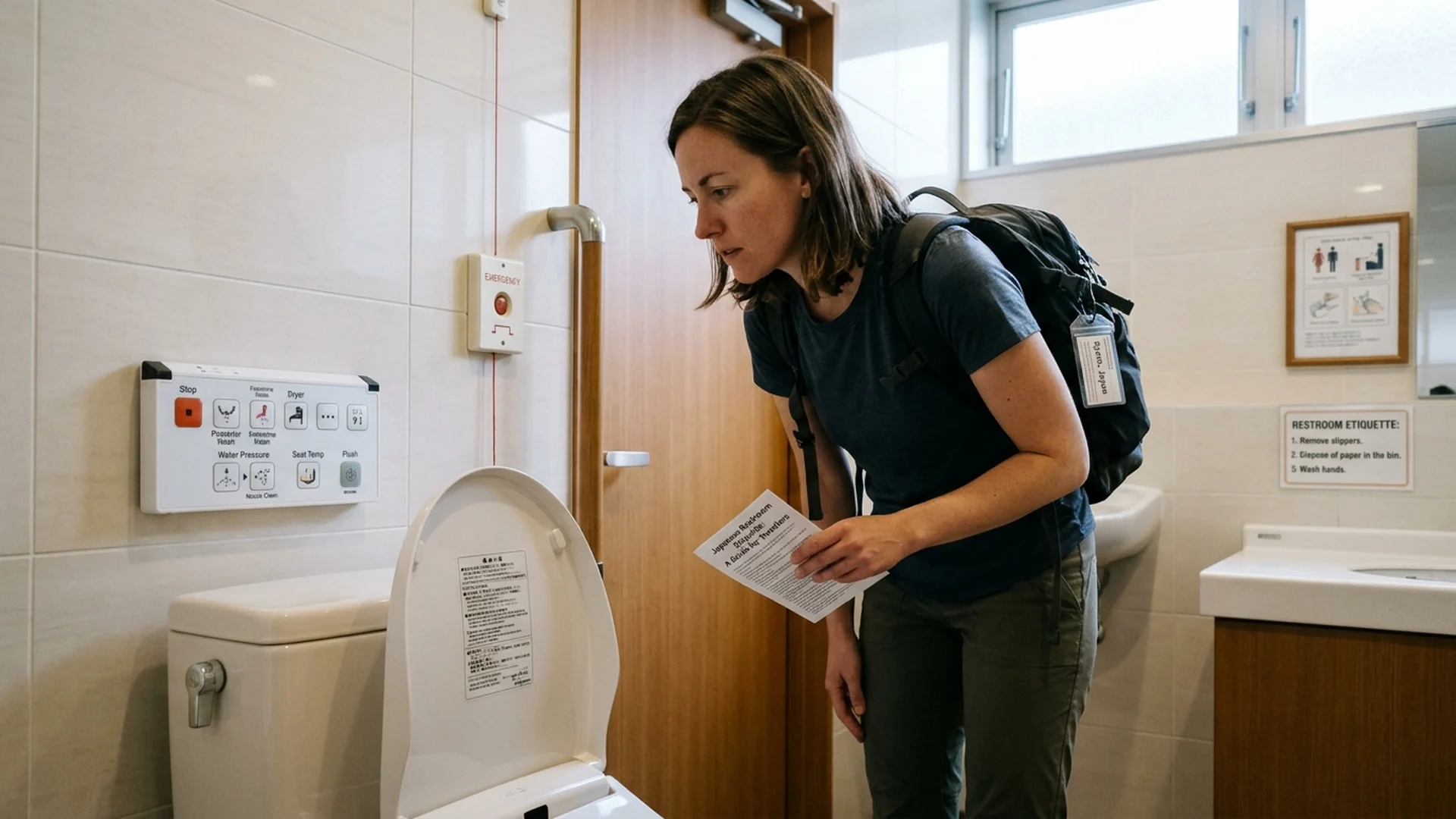
Stepping into the Land of the Rising Sun brings endless wonder, yet for many travelers, a quiet point of mild apprehension lingers behind the locked door of the Japanese restroom. Far from a mere utilitarian closet, this sanctuary is often outfitted with state-of-the-art technology, its wall-mounted control panels gleaming with kanji and pictograms that feel less like plumbing and more like the cockpit of a spacecraft. Yet beneath these dozens of glowing buttons lies the profound mindfulness of omotenashi—the Japanese ethos of wholehearted hospitality—engineered entirely to elevate hygiene and personal comfort.
Demystifying the automated washlet is far more than a matter of mechanical convenience; it is an invitation to cross a cultural threshold and immerse yourself in your journey completely unburdened. From selecting a gentle cleansing arc and triggering ambient privacy sounds to distinguishing a standard flush from an emergency summon button, this guide decodes every essential function, ensuring your encounters with Japanese washlets become a surprisingly delightful highlight of your travels.
Decoding the Washlet Control Panel: Essential Symbols Before You Press
The moment you settle onto a heated seat maintained at an impeccably comfortable temperature, your attention is inevitably drawn to the control panel—whether embedded in the armrest or mounted on the adjacent wall. Without understanding the universal icons, these panels invite the occasional mistimed press that changes everything.
Begin with the foundational buttons: Oshiri, marked with a water spray icon directed toward the rear, provides the standard cleansing function. This is followed by Bide, indicated by a gentle spray icon tailored for feminine hygiene at a carefully calibrated angle. The prominent red Stop button serves as your immediate emergency brake, halting all active cycles instantly. Pressure adjustment arrows or plus and minus symbols allow fine-tuning of water force, accompanied by nozzle positioning controls to shift the spray forward or backward according to your anatomy. Finally, the Kansou symbol activates the warm air dryer, leaving you feeling fresh and dry without relying heavily on paper.
Otohime: The Art of Quietude and Acoustic Etiquette
Japanese culture places profound emphasis on discretion and consideration for others sharing public spaces. Historically, women felt immense social pressure to flush repeatedly simply to mask natural sounds during private moments—a practice that squandered vast volumes of precious water resources.
The advent of Otohime, or the Sound Princess, solved this elegantly. Modern restrooms frequently feature motion sensors; simply waving your hand or pressing a button marked with a musical note or sound wave triggers a robust, naturalistic rush of water audio for twenty to thirty seconds. This discreetly obscures ambient sounds, and you may trigger it again should you require more time. It is a brilliant technological embodiment of deep empathy for the peace of others.
The Fine Line Between Flushing and Emergency SOS Buttons
One of the most frequent missteps among international travelers is confusing the flush mechanism with the emergency summon button, Yobidashi or SOS, as control panels often array numerous uniform buttons in similar color tones.
Flush controls are typically located toward the back of the toilet or labeled with Nagasu alongside directional arrows, occasionally differentiated into Large and Small for dual-flush porcelain. Conversely, the emergency SOS button is mounted prominently on the wall within easy reach, frequently near the toilet paper dispenser. Encased in a distinct red border and marked with a bell or telephone icon alongside the character for calling, triggering this button sounds an alert at the facility’s reception desk. While entirely harmless when unintentional, careful observation beforehand spares you a startle and prevents unnecessary burdens on local staff.