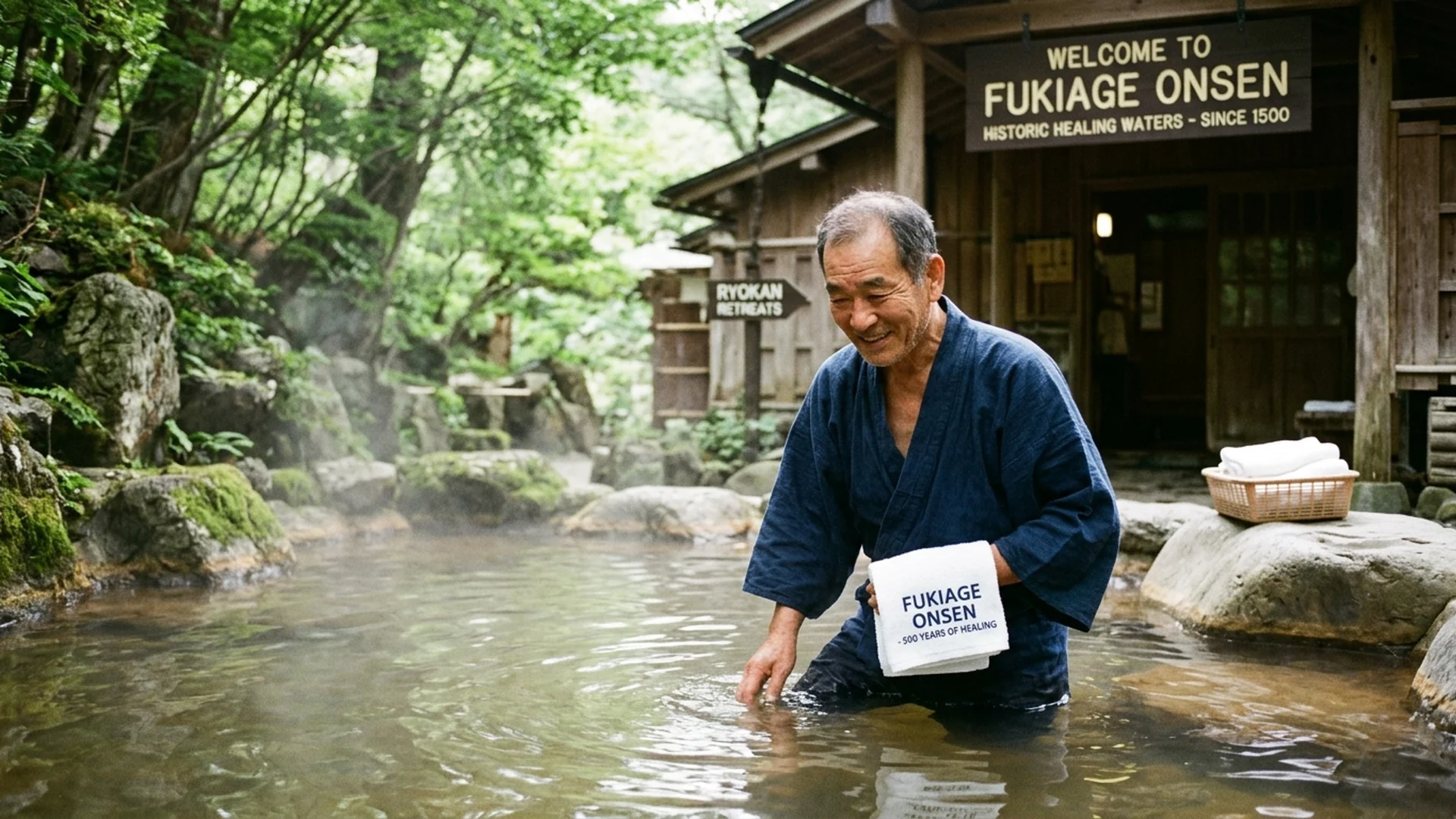
As the delicate morning mist drifts across dense pine forests and glassy, undisturbed waters, a faint, clean trace of pure sulfur awakens the senses. You realize instantly you are standing upon ancient terrain devoted to healing for more than half a millennium. Fukiage Onsen—historically known as Isaku Onsen—rests within the mystical, volcanic embrace of Kyushu’s Kagoshima Prefecture. This storied enclave is far more than a simple sanctuary for aquatic relaxation; it is a living historical archive where legendary samurai once sought refuge from the turbulent tides of history, cleansing their spirits and restoring their physical vessels through the time-honored art of Touji, or therapeutic hot spring immersion.
In our contemporary era where velocity dictates existence, arriving at Fukiage Onsen acts as a deliberate deceleration into refined, unhurried time. Here, pristine nature, deep-rooted history, and the exquisite hospitality of premier ryokan retreats converge seamlessly. Discerning travelers yearning for genuine solitude will uncover the truest essence of luxury wellness—one defined by profound simplicity and understated elegance, far removed from standard tourist thoroughfares.
A Quincentennial Legacy and the Footsteps of Legendary Samurai
The history of Fukiage Onsen is inextricably bound to the Shimazu clan, the powerful lords who governed the Satsuma Domain for centuries. While the subterranean bounty of thermal waters naturally transformed this valley into a curative haven, what elevates Fukiage beyond a mere spa destination is its profound association with Saigo Takamori, universally revered as the ‘last samurai’ and the driving spiritual force behind the Meiji Restoration. Saigo frequently chose the quiet forests and restorative waters of this secluded enclave to retreat from political turmoil, allowing his thoughts to settle while healing his body from chronic ailments. Walking the quiet pathways of Fukiage today feels akin to tracing the footsteps of a titan, absorbing the same resonant stillness that once fortified the mind and spirit of Japan’s most revered warrior.
The Science of Alkaline Mineral Immersion: The Heart of Touji Healing
From the perspective of natural hydrotherapy and physiological science, the thermal waters of Fukiage Onsen represent an exceptionally rare and valuable natural resource. Flowing directly from underground subterranean springs without artificial heating or dilution, the water is entirely free-flowing, or kakenagashi. Boasting a remarkably high alkaline level with a pH of approximately 8.9, the spring is historically celebrated as Bijin-no-yu—the ‘waters of beauty’—owing to its gentle exfoliating capacity that leaves skin feeling remarkably silken. When combined with naturally balanced sulfur concentrations, the waters actively stimulate microcirculation and dissolve deep-seated muscular tension. Bathing here transcends mere hygiene; it is an almost sacred ritual of physical and spiritual realignment in accordance with traditional Japanese Touji culture.
The Aesthetics of Slow Living: Premier Ryokan Heritage and Surrounding Wilderness
To fully comprehend the atmosphere of Fukiage Onsen, one must experience a stay at a revered legacy retreat such as Kohannoyado Midoriso, harmoniously integrated into pristine nature along the banks of a tranquil lake that mirrors forest shadows at dawn and dusk. This sanctuary embodies the quintessential Japanese ethos of omotenashi—anticipatory, heartfelt hospitality manifested through traditional timber architecture, tatami chambers framing serene garden vistas, and meticulously curated kaiseki dinners. Each seasonal menu highlights the finest epicurean treasures of Kagoshima, from celebrated Kurobuta pork to freshly caught seafood and hyper-local heirloom vegetables. Beyond the ryokan grounds lie breathtaking natural landscapes, including Fukiagehama Beach, one of Japan’s most spectacular sweeping coastal expanses, where endless sands meet vast horizons to offer breathtaking, contemplative sunsets.