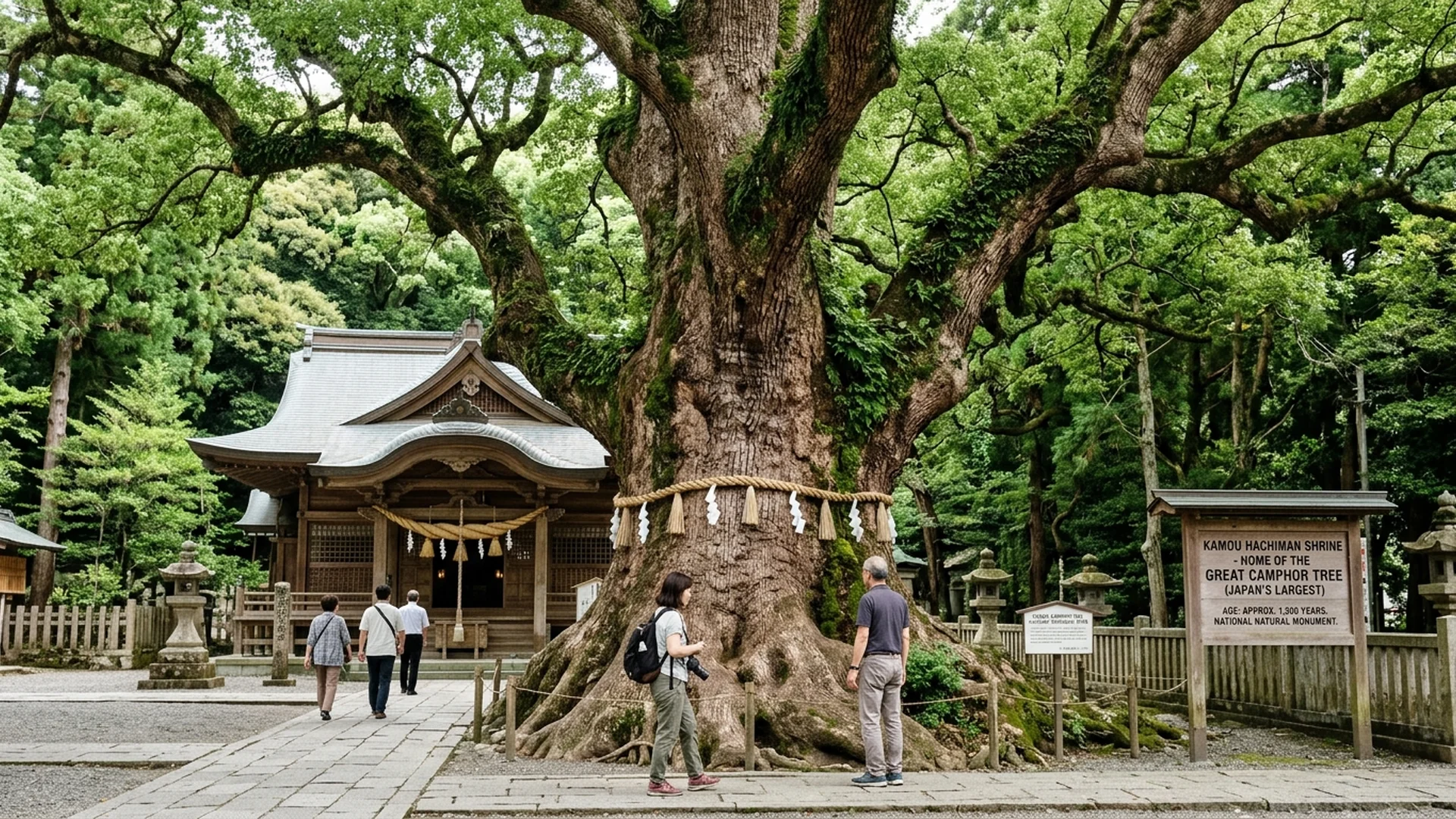
Amidst the tranquil landscapes of Aira in Kagoshima Prefecture lies a sanctuary where time appears to pause, and the silent breath of an ancient forest converges with millennia of quiet devotion. Kamou Hachiman Shrine is not merely a revered spiritual anchor for southern Kyushu; it is a profound power spot where discerning travelers seeking deeper meaning come to witness the unyielding majesty of nature untouched by the rushing currents of modernity.
Stepping past the vermilion torii gate, visitors are immediately greeted by the subtle fragrance of ancient bark and crisp mountain mist clinging to the valley ridges, instantly washing away the discord of the outside world. This is far more than a fleeting photographic waypoint. It is a contemplative space designed for recognizing the sacred continuum between humanity, divinity, and eternity, sheltered under the emerald canopy of trees that have quietly witnessed the rise and fall of powerful samurai dynasties.
Roots of Faith and the Echoes of the Samurai Era
Historical chronicles trace the origins of Kamou Hachiman Shrine back to the 12th century during the Heian period, founded to enshrine Hachiman, the protective deity of martial valor and harmony according to classical Japanese tradition. Historically, these lands fell under the jurisdiction of the Gamo clan before transitioning into the sphere of the Shimazu daimyos who governed Satsuma Province with enduring authority. The shrine’s classical architecture showcases exquisite traditional carpentry, delicate bracket joinery, and a harmonious integration with the surrounding topography, transforming the grounds into a living museum that eloquently narrates the architectural and spiritual evolution of feudal Japan.
Kamou no Okusu: Japan’s Most Magnificent Botanical Wonder
The undisputed crown jewel drawing naturalists, botanists, and mindful wanderers alike is the monumental Kamou no Okusu (蒲生の大楠), which stands in quiet majesty within the shrine courtyard. Estimated to be over 1,500 years old, this arboreal titan began its silent germination long before written regional histories were ever recorded. Its staggering trunk, boasting a circumference exceeding 24 meters, enfolds a vast natural hollow carved by centuries of patient natural evolution. Its sprawling boughs create a living cathedral ceiling that filters the sunlight into ethereal shafts of gold. To stand beneath its towering crown is to partake in an incomparable spiritual communion with deep time.
The Shinto Dimension of Power Spots and Inner Healing
In traditional Japanese animism, ancient centenarian trees are recognized as sacred abodes for Kodama, the ethereal spirits inhabiting the forest. Pilgrimages to Kamou Hachiman Shrine are thus embraced as quintessential power spot journeys in southern Japan. Visitors gently place a hand upon the weathered bark in reverent silence, drawing upon the grounding energies of stability, endurance, and quiet resilience offered by the ancient wood. The enveloping stillness, punctuated only by the rustle of leaves and the cooling shade of the canopy, gently resets the emotional equilibrium, offering an immaculate sanctuary far removed from the cadence of contemporary life.