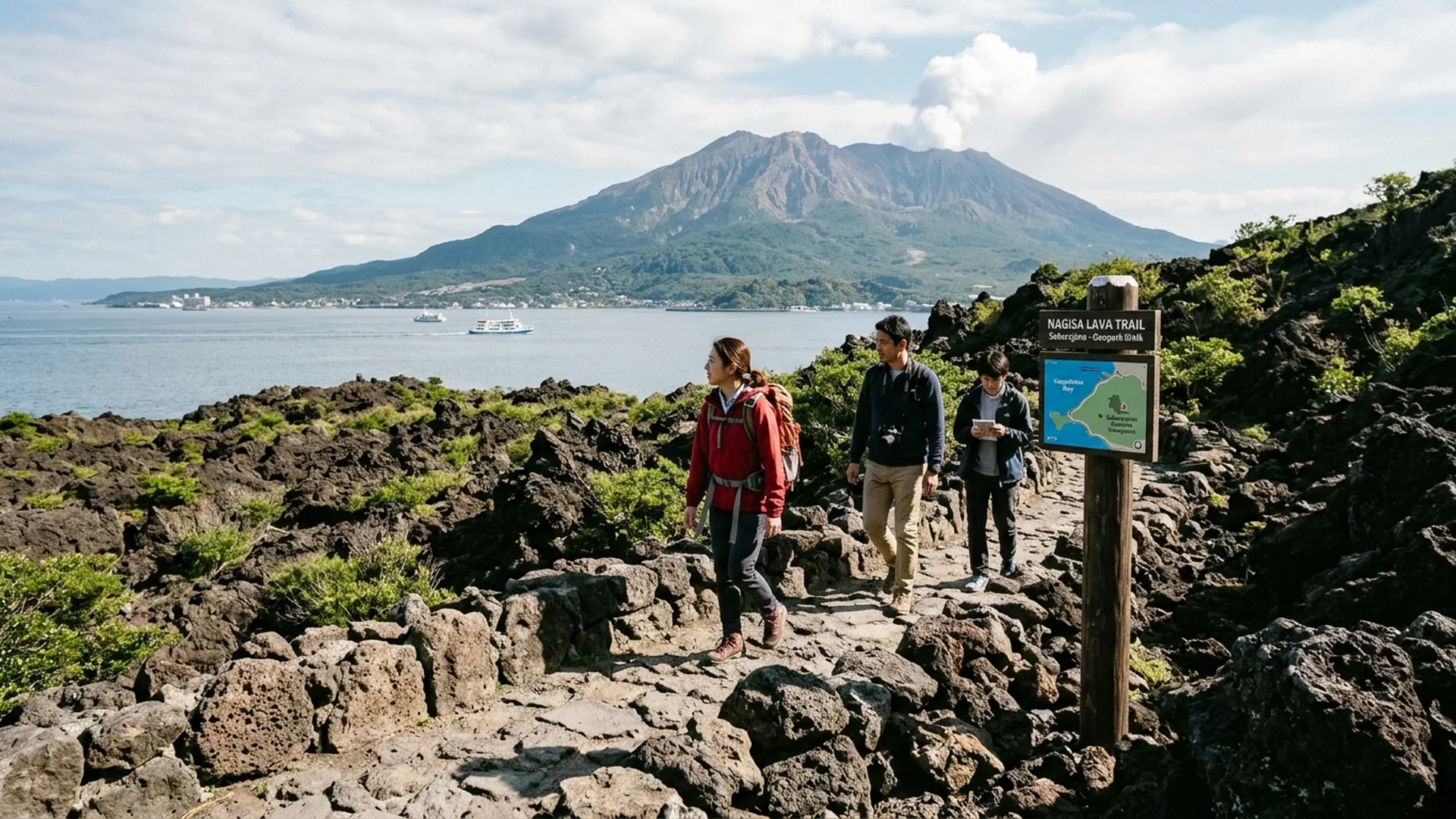
When your first step settles upon the obsidian expanse of hardened magma, unfurling like a frozen sea of stone, the earth speaks not merely of ancient cataclysm, but of profound regeneration. Beneath the watchful plume of Mount Sakurajima—an eternal sentinel venting quiet whispers of white smoke into the azure sky—the Nagisa Lava Trail on Kagoshima’s Osumi Peninsula serves as a living bridge between the searing turbulence of the historic 1914 eruption and the profound, mirror-like calm of contemporary Kinko Bay.
To wander this terrain is to embark upon both a geological pilgrimage and a contemplative retreat. Here, nature demonstrates her astonishing resilience. Amidst the desolate, pitch-black lava beds, resilient pioneer species—delicate Japanese black pines and alpine grasses—quietly reclaim the stone, creating a striking chiaroscuro of elemental fire and forest green. It is an invitation to slow travel, where the discerning voyager is summoned to pause, breathe deeply, and listen to the slow, measured cadence of deep time.
Geology and History: When Scars Evolve into Sculpted Time
The cataclysmic eruption of Mount Sakurajima in 1914 stands as one of the most violent natural upheavals in modern Japanese history. Torrents of molten rock poured forth with such ferocity that they completely bridged the narrow strait separating the erstwhile island from the Osumi Peninsula, fusing them into a unified landmass. The sweeping Taisho lava plateaus that define the geography today are the enduring monuments to that terrifying day. Yet, a century of quiet restoration has transformed this geological devastation into a living canvas of ecological rebirth.
The Nagisa Lava Trail has been masterfully engineered to allow visitors intimate proximity to this living museum without disturbing its fragile equilibrium. The pathway is paved with materials that harmonize seamlessly with the rugged terrain, winding gracefully around colossal boulders of cooled basalt. This stark black sculpture garden contrasts sharply with the cobalt sea and the emerging emerald canopy of pioneering black pines, offering an outdoor classroom that lays bare the eternal cycle of planetary renewal.
Panoramic Perspectives: Where Kinko Bay Meets Volcanic Shadows
Throughout the three-kilometer journey, the landscape shifts fluidly with the turning of light and shadow. On one flank rises the formidable bulk of Sakurajima, defying time with its brooding majesty. On the other lies the glassy expanse of Kinko Bay. At dawn, the water shimmers with a tender golden hue; as twilight approaches, the setting sun washes the jagged lava formations in deep amber and terracotta tones, evoking a living impressionist canvas.
Thoughtfully positioned viewpoints punctuate the route, framing distant islets and the faint, elegant skyline of Kagoshima city across the water. The pervasive silence is punctuated only by the gentle percussion of waves lapping against the shore and the whisper of coastal winds through the pine needles—a sanctuary of stillness far removed from the clamor of conventional tourism.
The Art of Rejuvenation: Mineral Footbaths by the Lava Shore
The fitting crescendo to this geological exploration awaits at the threshold of Sakurajima Yogan Nagisa Park, home to one of Japan’s most extraordinary wellness features. Stretching over 100 meters parallel to the ocean, the park houses the nation’s longest outdoor foot onsen.
The mineral-rich thermal waters—drawn from a depth of over 1,000 meters beneath the earth—emerge as a rust-hued, iron-dense elixir designed to soothe weary limbs and quiet the nervous system. To sit here, submerging one’s feet in therapeutic warmth while gazing out over the vast, shimmering bay with the monumental volcano as a backdrop, is the quintessential embodiment of Japanese wellbeing—an effortless synthesis of raw nature and restorative care.