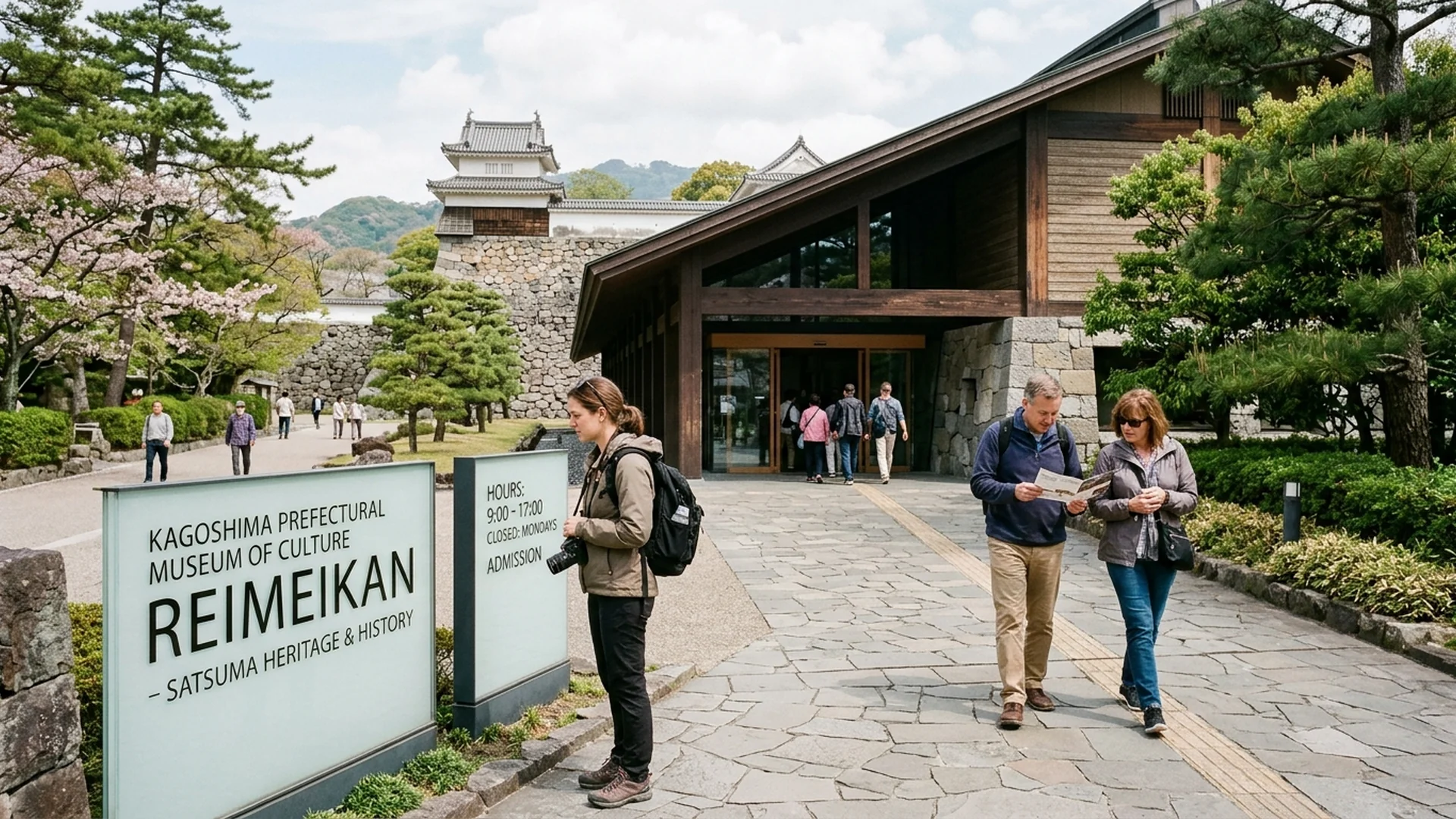
As the gentle wind ripples across the ancient moat and weathered stone ramparts of the Tsurumaru Castle ruins, time seems to drift backward into an era when southern Kyushu was shaped by the fierce spirit and fierce independence of the Satsuma domain. At the historic heart of Kagoshima, upon grounds that once served as the seat of power for the illustrious Shimazu clan, stands the Kagoshima Prefectural Museum of Culture Reimeikan. This institution transcends the traditional boundaries of a museum, serving instead as a cultural portal that invites discerning travelers to touch the living breath of Japan’s most profound historical transformation.
Visiting Reimeikan—whose name translates gracefully to ‘Dawn of Civilization’—offers an experience far superior to conventional sightseeing. Every step across these grounds resonates with echoes of the past, from the initial approach through the magnificent timber Goromon Gate to the deep exploration of the samurai architects of the Meiji Restoration. It is an invaluable destination for the traveler who yearns to genuinely understand the foundational roots of Satsuma culture.
Historical Strata Upon Tsurumaru Castle and the Goromon Gate
Beneath the serene exterior of the Reimeikan building lies the legendary footprint of Tsurumaru Castle, alternately known as Kagoshima Castle, erected in 1601 by the Shimazu family, the immensely influential daimyos of the Satsuma domain. Architecturally, the castle is distinguished by its deliberate absence of a traditional central keep (Tenshu). The Shimazu clan firmly adhered to the philosophical conviction that ‘men are our castles, men are our stone walls,’ placing their ultimate security in unswerving loyalty and the rugged natural topography of their domain rather than towering stone keeps.
The recent meticulous restoration of the Goromon Gate has successfully breathed renewed vitality into the museum’s outer precincts. Its massive timber structures and refined craftsmanship vividly evoke the opulent aesthetic of the Edo period. Strolling through this majestic gateway before entering the exhibition halls serves almost as a meditative rite of passage, attuning the senses for a deeply contemplative encounter with history.
The Spirit of Satsuma and the Landmarks of the Meiji Restoration
Within the permanent galleries of Reimeikan, the epic narrative of the Shimazu clan is unspooled across more than ten thousand cultural artifacts, spanning from the ancient Jomon period and the feudal middle ages down to the pivotal upheavals of the Bakumatsu era and the Meiji Restoration. The Satsuma domain functioned as one of the primary intellectual and political engines driving Japan’s modernization, fueled by the strategic brilliance of legendary figures such as Saigo Takamori and Okubo Toshimichi.
Visitors encounter arsenals of Satsuma-style armor, iconic battle regalia, master-forged antique samurai swords, combat relics, and confidential diplomatic correspondence with Western powers. These enduring testaments reveal precisely why Satsuma possessed both the technological readiness and the psychological resolve to spearhead the most consequential structural transition in modern Asian history.
Dimensions of Folk Life, Craftsmanship, and the Ryukyu Islands
Beyond its military and political chronicles, Reimeikan accords profound significance to ethnography and traditional folk culture. Kagoshima’s geographical reach extends far southward into a constellation of islands, including the Ryukyu archipelago, maintaining a deep, complex historical web of trade and cultural exchange with the Satsuma mainland.
Expansive, hyper-detailed dioramas realistically recreate the daily routines of coastal fishers, rural artisans, the crafting of renowned Satsuma-yaki ceramics, and traditional indigo dyeing, engendering the sensation of wandering through an authentic historical settlement. Interactive multimedia installations within the galleries ensure these localized heritage traditions remain readily accessible and deeply resonant for visitors of every background.