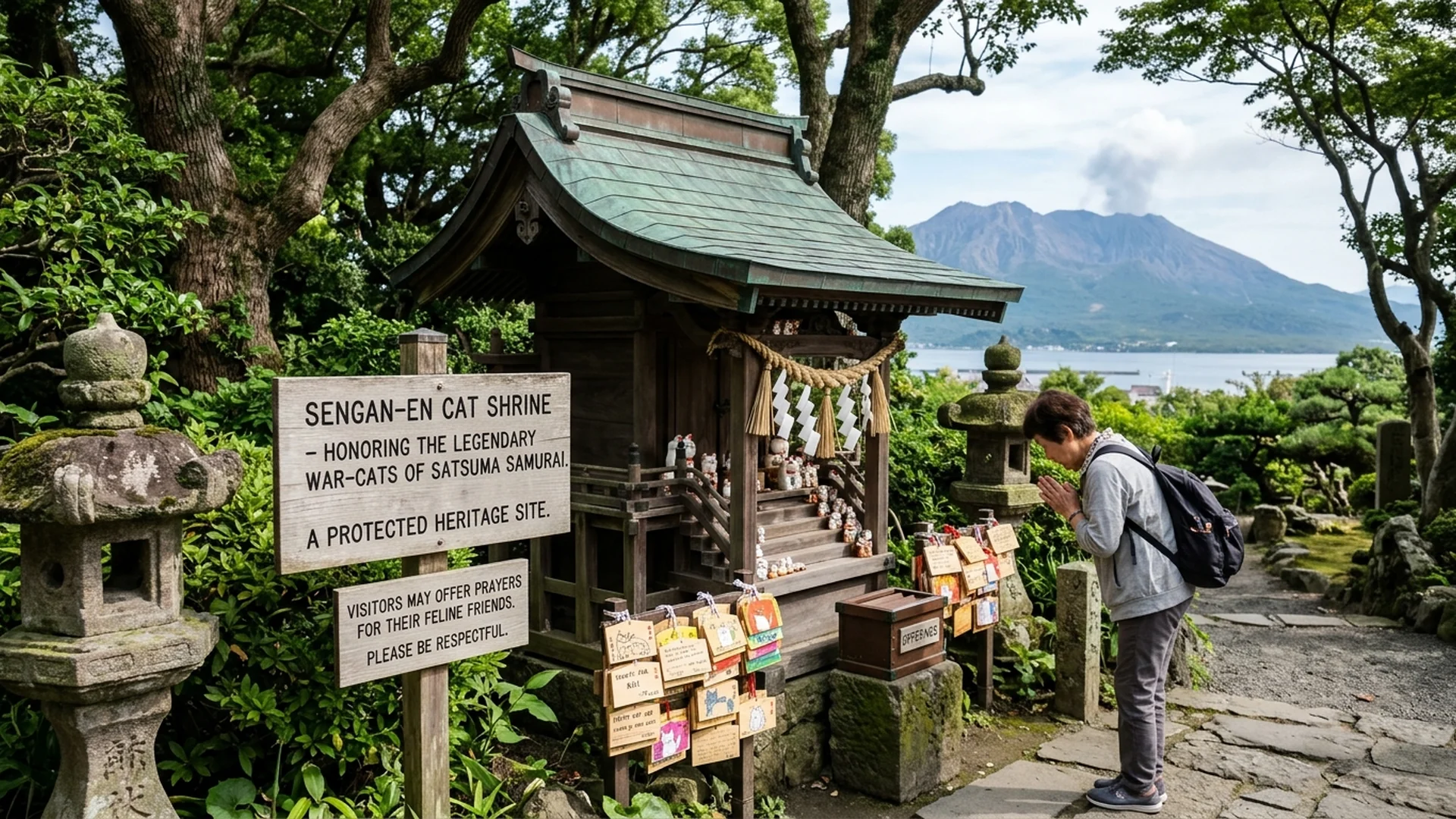
As the gentle breezes of the Satsuma Peninsula whisper through the ancient pines and polished wooden corridors of Sengan-en, the soft chime of wind bells carries more than mere tranquility. It echoes a timeless journey across centuries—a journey belonging to the legendary ‘war-cats’ who marched shoulder-to-shoulder with the formidable daimyos of the Shimazu clan. Here, in Japan’s southernmost bastion of Kyushu, the domestic feline is elevated far beyond a household companion, immortalized as a steadfast guardian of the battlefield.
Against the commanding, smoky backdrop of Mount Sakurajima brooding over Kagoshima Bay, the Nekogami (Cat Shrine) at Sengan-en stands as a sanctuary not only for global cat lovers, but for anyone attuned to the convergence of samurai stoicism, the genius of shakkei (borrowed-scenery) garden design, and the lingering echoes of a world-renowned UNESCO heritage. Join us as we trace this captivating history and immerse ourselves in a refined aesthetic that forever transforms the traveler’s perspective of Japanese culture.
Nekogami: The Legend of the War-Cats and Their Living Clock Eyes in Sengoku Japan
The chronicle begins in an era defined by martial fervor and unyielding loyalty, when Lord Yoshihiro Shimazu marched seven feline companions into the crucible of the Bunroku-Keicho campaigns (the late-sixth-century incursions into Korea). These animals were far more than mere mascots; they served as vital, living chronometers for the samurai army. Because a cat’s pupils naturally dilate and contract in response to shifting ambient light, astute warriors could accurately gauge the passage of time during nighttime operations simply by observing the subtle adjustments within their companions’ eyes when precise timekeeping devices were unavailable.
In honor of their faithful service and ultimate sacrifice, these cats were eventually enshrined at the Nekogami (Cat Shrine) nestled within the verdant grounds of the Sengan-en estate, validating a spiritual devotion equal to that bestowed upon any human retainer. Today, this sanctuary draws discerning travelers from across the globe who arrive to offer quiet prayers for the health, longevity, and safe passage of their own domestic companions.
Architecture and Sengan-en: A Masterclass in Borrowed-Scenery Gardening
Beyond the poignant charm of the cat shrine lies Sengan-en itself, established in 1658 by the Shimazu clan as a premier example of a daimyo garden, where human artistry and untamed nature exist in seamless equilibrium. At the heart of this landscape lies the philosophy of shakkei, or ‘borrowed scenery,’ which gracefully incorporates the distant majesty of the smoldering Mount Sakurajima and the deep indigo expanse of Kagoshima Bay into the immediate garden composition, creating a living canvas curated by the elements.
Strolling along moss-dusted stone pathways, past crystalline ponds and whispering bamboo groves, instills a profound, contemplative stillness. Every footstep echoes the lifestyle philosophy of the historical ruling class, who placed immense value on living in harmonious dialogue with the natural world and embedding refined artistry into every facet of daily existence.
Satsuma Cultural Heritage: From Earthenware to Satsuma Kiriko Cut Glass
The cultural sphere surrounding Sengan-en extends well beyond botanical landscapes, serving as the cradle and ongoing showcase for the elite crafts of the Satsuma domain—most notably Satsuma Kiriko. This distinct form of cut glass features vibrant layers of colored glass fused over clear crystal, meticulously hand-carved by master artisans to produce striking gradients and luminous geometric patterns. Reserved historically for the upper echelons, this preserved art form remains a highly coveted treasure for discerning international collectors.
Visiting the estate’s curated galleries and historic artisan workshops elevates the cultural journey, offering deep insight into the Shimazu family’s enduring patronage of the arts, which allowed refined craftsmanship to flourish even amid turbulent historical transitions.