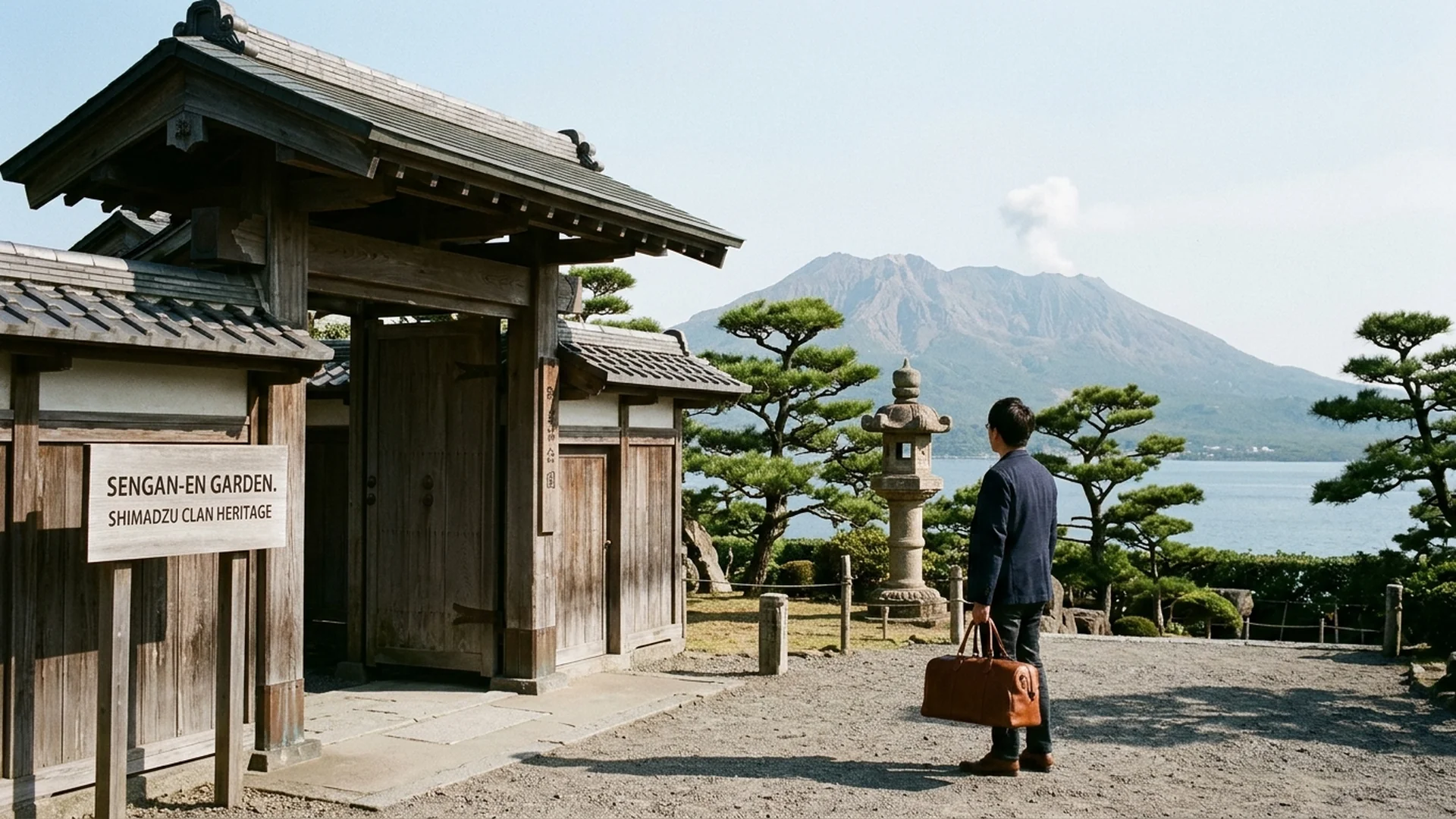
As the breeze from Kagoshima sweeps across the shimmering expanse of Kinko Bay, the brooding silhouette of Sakurajima—its summit wreathed in delicate wisps of grey vapor—emerges upon the horizon like a masterwork of classical ink wash painting deliberately poised at the edge of the world. This is the enduring enchantment of Sengan-en, a peerless jewel of Kyushu where the hushed resonance of the samurai era converges seamlessly with sublime, untamed nature.
Nestled within the serene dominion of the Shimazu clan, who held formidable sway over the Satsuma domain for over seven centuries, this historic sanctuary embodies the elevated landscape philosophy known as shakkei, or ‘borrowed scenery.’ By claiming the raw, dynamic majesty of the volcano and the bay as its ultimate backdrop, Sengan-en infuses every footstep with an arresting gravity, offering an aesthetic profundity that every discerning connoisseur of history and fine arts must experience firsthand.
The Philosophy of Borrowed Nature: When Sakurajima Became a Daimyo’s Canvas
Commissioned in 1658 by Mitsuhisa Shimazu, the 19th head of the illustrious clan, Sengan-en was conceived as a coastal retreat and seaside villa that reflected unrivaled political power and aristocratic taste. The soul of the estate lies in its pioneering application of shakkei, elevating traditional Japanese gardening by integrating Kinko Bay as a foreground pond and the imposing mass of Sakurajima as a distant mountain sanctuary. Viewed from the central pavilion, these colossal elements of the natural world are masterfully scaled down within the human field of vision, transforming the landscape into a living tableau that shifts in mood and chromatic brilliance with every passing hour—from the pristine golden luminescence of dawn to the romantic twilight mists.
Life Within the Goten Residence and the Roots of Modernization
Deep within the sanctuary of the estate stands the Goten, the private residential quarters of the feudal lords, inviting travelers to step directly into the refined domestic reality of high-ranking samurai. The interior rooms are adorned with delicate woodwork, historic sliding door panels, and deep verandas designed to catch the pristine sea breeze. This storied pavilion not only hosted dignitaries of the highest order but has frequently served as a cinematic backdrop for sweeping historical dramas.
Just beyond the residence lies the Shoko Shuseikan Museum, designated as part of UNESCO’s Sites of Japan’s Meiji Industrial Revolution. This illuminating archive chronicles the visionary foresight of the Shimazu clan in introducing Western technology to the Satsuma domain—establishing reverberating furnaces, ironworks, and armories that laid the vital industrial foundations for modern Japan.
Aesthetic Tastes and Craftsmanship: Jambo-Mochi and Satsuma Kiriko
No pilgrimage to Sengan-en is complete without surrendering to the region’s culinary and artistic legacies. Within the garden grounds, historic teahouses serve rich, ceremonial matcha paired with jambo-mochi—traditional twice-skewered rice cakes glazed in a century-old savory-sweet sauce, best enjoyed against the whispering backdrop of rustling bamboo and wind-swept pines.
Just outside the exit lies the exhibition and atelier for Satsuma Kiriko, a distinctive double-layered cut-glass art form. Each piece is meticulously shaped and polished by hand to reveal complex geometric motifs and breathtaking color gradations. Once nearly lost to history, this brilliant craft has been lovingly revived to claim its place among the most coveted luxury collectibles in the world.