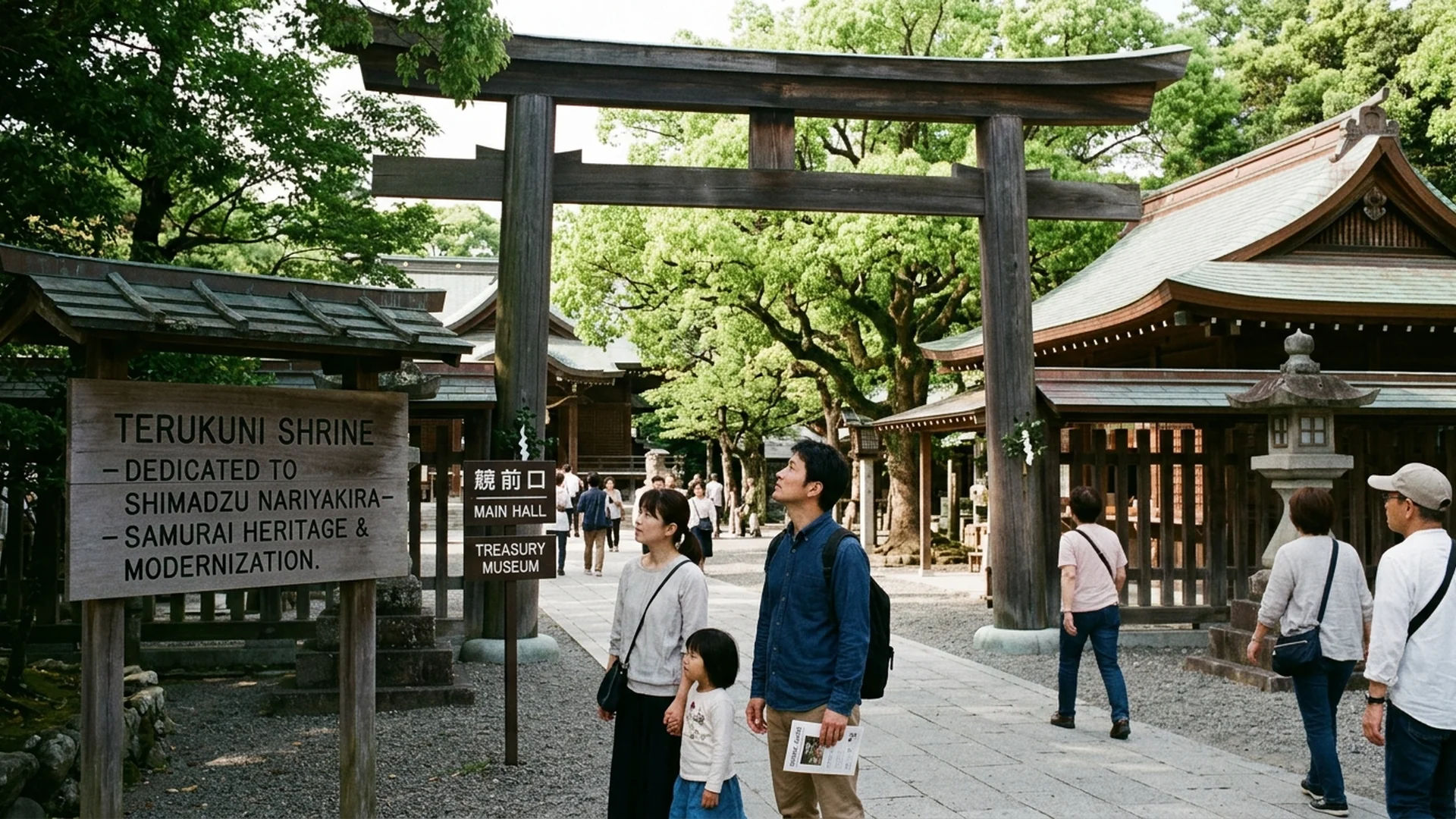
As the gentle wind from the Satsuma Peninsula sweeps through the quiet perimeter of ancient woods, the bronze bell chiming from weathered eaves sounds like a resonant whisper from history. At the beating heart of Kagoshima stands a sacred ground serving as a timeless bridge between unyielding samurai heritage and a bold, visionary modernity: Terukuni Shrine. This is far more than a conventional Shinto sanctuary; it is a monumental testament to gratitude and the profound spiritual force that propelled Japan’s modern evolution.
Crossing the threshold beneath the monumental, snow-white torii gate feels akin to stepping backward into an intense era of transformation, where the towering shadows of elite warriors and visionary statesmen continue to shape the cultural rhythm of southern Kyushu. This hallowed ground immortalizes Lord Shimazu Nariakira, a daimyō whose intellect outpaced his era, perceiving his nation’s future through the industrial glow of iron furnaces and steamships long before the dawn of the Meiji Restoration.
The Satsuma Vision: Unveiling the Legacy of Shimazu Nariakira
To truly comprehend the trajectory of late-Edo period modernization in Japan, the name of Shimazu Nariakira stands as the foundational key. This brilliant daimyō governed the Satsuma domain under the guiding philosophy of fukoku kyohei—a wealthy nation coupled with a strong military. Nariakira refused to view the world through the insular lens of traditional feudal boundaries; instead, he embraced Western sciences, advanced medicine, astronomy, and cutting-edge military manufacturing. The pioneering Shuseikan industrial complex he established along the shores of Kagoshima Bay laid the bedrock for Japan’s eventual Industrial Revolution. When he passed, a deeply devoted Satsuma populace established Terukuni Shrine in 1873 to enshrine him as a divine guardian of the realm.
Sacred Architecture and Botanical Artistry
The architectural language of Terukuni Shrine reflects the sublime purity of traditional Shinto design, marrying structural simplicity with profound dignity. The primary timber structures are crafted with exceptional precision, their lintels and doors bearing the prestigious crest of the Shimazu clan—a bold cross encircled by a ring. Capturing the traveler’s gaze immediately upon arrival is the colossal white torii gate, standing in dramatic contrast against the azure skies of Kagoshima. Furthermore, the sacred grounds are enveloped by ancient flora, most notably the Inumaki trees, expertly pruned into the magnificent silhouette of cranes spreading their wings. This rare feat of botanical craftsmanship embodies the exquisite aesthetic sensitivity cherished by the local artisans.
Historical Treasures at Terukuni Bunko and the Rokugatsu-do Festival
For travelers seeking granular historical immersion, the intimate Terukuni Bunko museum nestled within the grounds serves as a captivating repository of artifacts. It exhibits revered antique katana forged by master swordsmen, battle armor worn by Satsuma retainers, historical maritime trade documents, and evocative photographs chronicling an era in flux. During the heat of midsummer in July, the shrine transforms into the luminous focal point of the centuries-old Rokugatsu-do festival. Thousands of delicately painted paper lanterns illuminate the sacred precinct, casting an otherworldly, enchanting glow that captures the timeless mysticism of Kyushu’s living traditions.