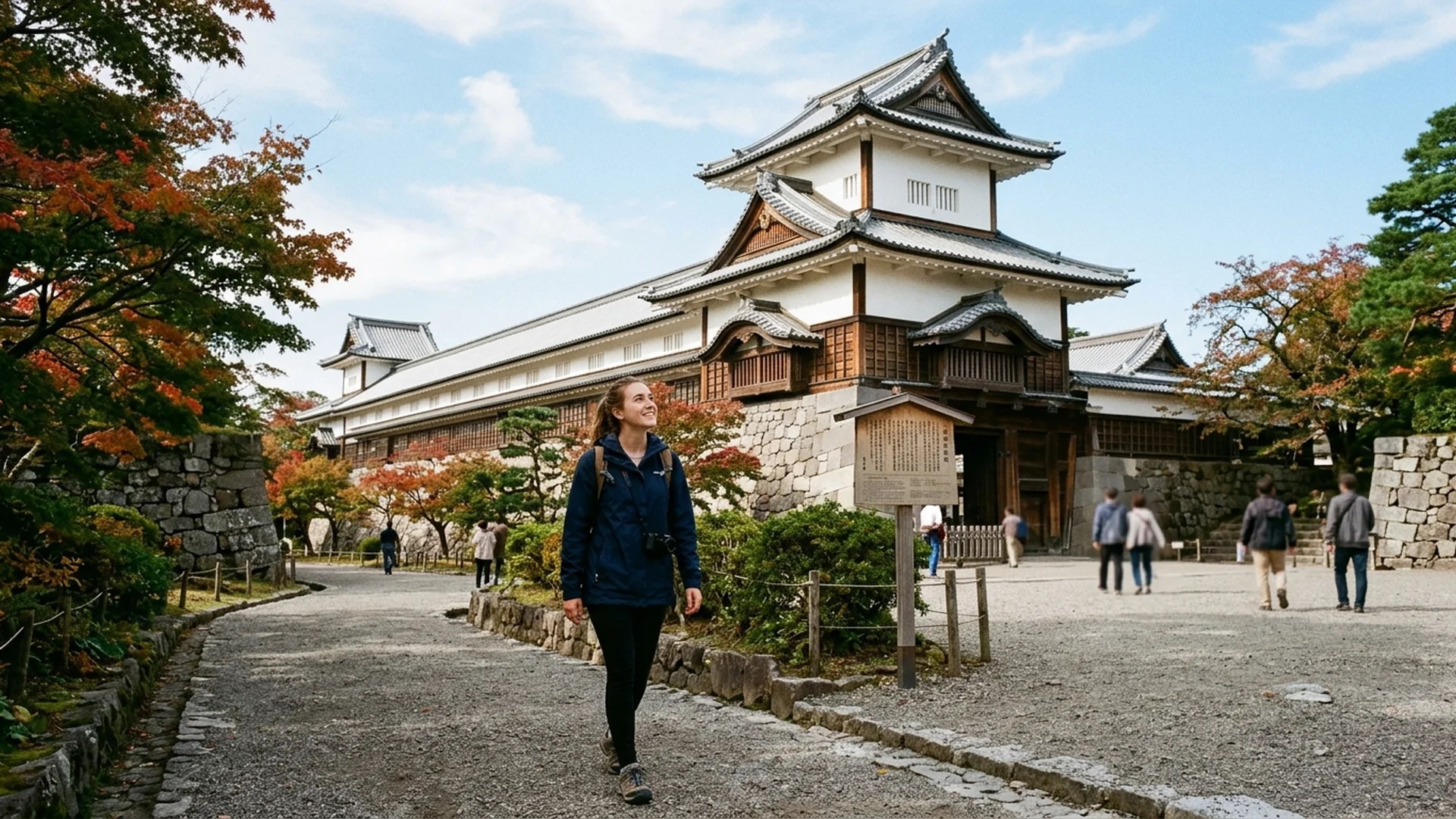
As morning mists gently lift above silvery lead-tiled rooftops, the shadow of ancient wooden keeps within Kanazawa Castle Park emerges sharply against the azure sky. This sanctuary is far more than a public expanse for quiet repose; it remains a vital chronicle of Japan’s Edo period, where the extraordinary prosperity of the formidable Kaga Domain converges seamlessly with the peerless craftsmanship of master carpenters.
From the very first step upon granite paving stones and immense oak frameworks, the imagination drifts back to an era when samurai patrolled these historic ramparts. Kanazawa Castle once steered the economic and political destiny of the Hokuriku region under the stewardship of the Maeda family, celebrated as the million-koku lords. This immense stature reveals itself not merely through the sprawling grounds, but in architectural intricacies designed to endure centuries of time and the trials of fire.
The Vast Domain of the Maeda Clan: Echoes of Kaga’s Golden Age
In the annals of Edo-period Japan, the Kaga Domain stood as the wealthiest and most influential feudal territory second only to the ruling Tokugawa shogunate. The Maeda clan, lords of this prosperous realm, selected Kanazawa as their strategic stronghold, transforming a riverside fortress settlement into a refined castletown humming with artistic and cultural vitality. Although the primary keep suffered repeated fires over the centuries, an unwavering commitment to authentic restoration using traditional techniques has returned Kanazawa Castle Park to its former splendor. A leisurely stroll past diverse stone wall styles—such as the interlocking Tatsumi-ishi or the refined Oyama masonry—reveals an evolutionary engineering legacy preserved within every stone.
Masterpieces of Ancient Joinery: The Art of the Nail-Free Keep
For travelers enamored with historical architecture, the crown jewels of the park are its meticulously reconstructed wooden structures: the rhombus-shaped Hishi Yagura, the Tatsumi Yagura armory, and the connecting Hashizumemon Tsuzumiyagura gatehouse. These edifices were raised using entirely traditional carpentry wisdom, constructed without the use of a single metal nail. The structural integrity relies entirely on precision interlocking joints, wedges, and carved grooves designed to absorb seismic tremors. Within, delicate paper lattice screens, fragrant cedar ceilings, and defensive arrow slits offer a palpable glimpse into the tactical ingenuity of feudal defense.
A Symphony of Landscapes: Bridging Two Cultural Icons
One of the profound joys of Kanazawa Castle Park is its central urban location, anchored by the graceful Ishikawa-bashi Bridge. This stone-arched span acts as a threshold bridging two distinct realms of heritage, carrying visitors directly across the moat into Kenrokuen Garden, revered among the three most exquisite landscape gardens in Japan. The surrounding geography flows in quiet harmony with nature, encompassing expansive moats and ancient trees whose foliage shifts with breathtaking poetry through the four seasons—from delicate spring sakura and lush summer greenery to fiery autumn maples and serene winter snowscapes.