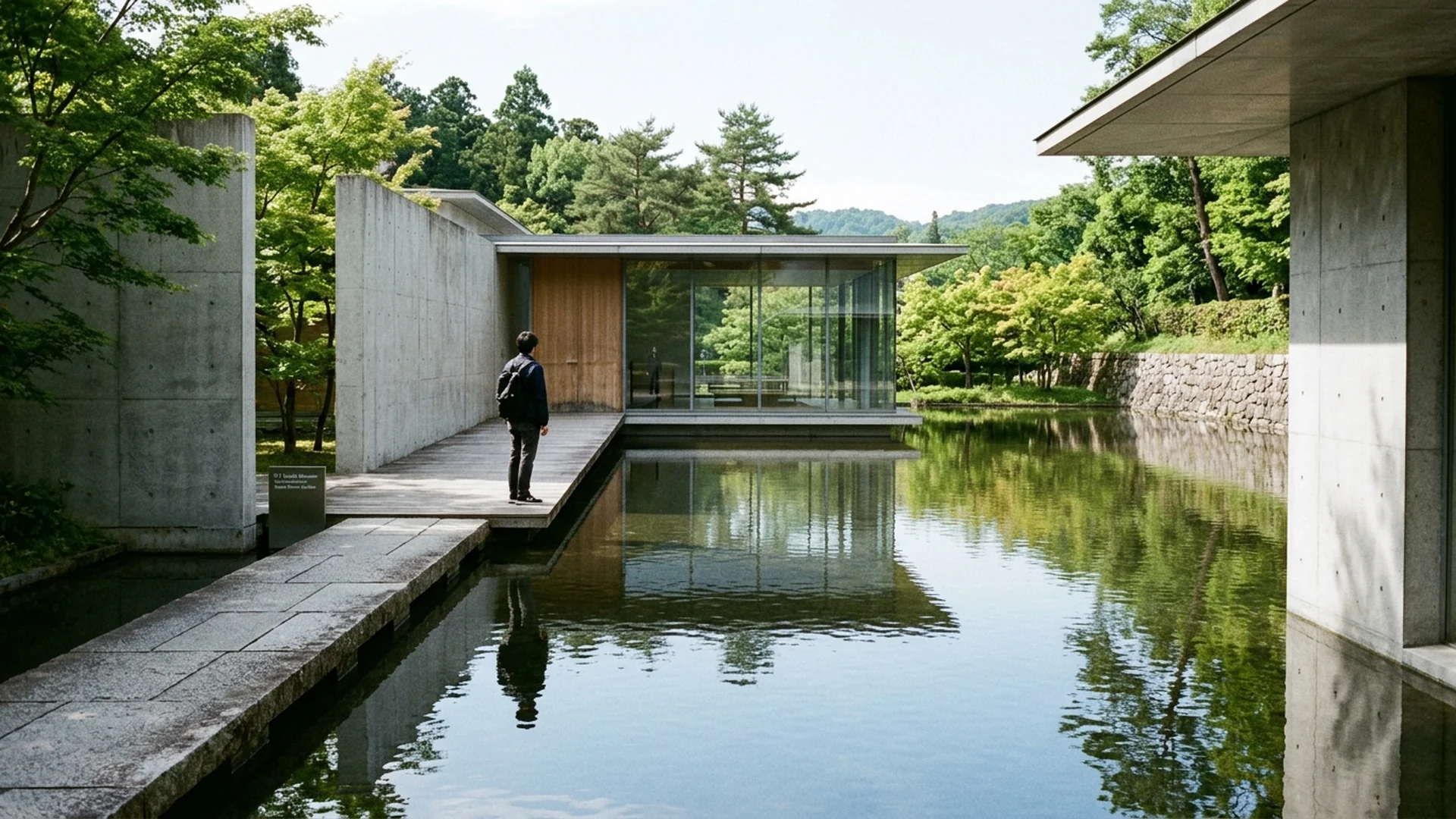
Transcending the conventional boundaries of museum curation, the D.T. Suzuki Museum emerges as a minimalist masterpiece designed by Yoshio Taniguchi. It translates the profound Zen philosophy of Daisetz Teitaro Suzuki into a tangible spatial experience through three interconnected wings and the contemplative Water Mirror Garden, offering a refined journey of meditation and self-reflection.
Nestled quietly within a leafy residential neighborhood of Kanazawa—a city otherwise celebrated for its samurai heritage and intricate artisanal crafts—this sanctuary does not merely chronicle the life of the scholar who introduced Zen Buddhism to the West. Instead, it operates as a living work of art, gently urging discerning travelers to decelerate the rhythm of daily life and attune their senses to the subtle whispers within.
Architecture of Emptiness: Where Geometry Meets Zen Philosophy
Yoshio Taniguchi, an architect celebrated for his uncompromising precision, razor-sharp lines, and honest use of natural materials, approached the complexities of Zen philosophy by distilling them into the purest geometric forms. The museum is structured into three primary pavilions, linked seamlessly by covered walkways that invite gentle breezes and natural daylight. The deliberate palette of exposed concrete, crystal-clear glass, and dark timber louvering creates a measured cadence of movement. Taniguchi avoids monumental grandeur; rather, he crafts spatial volumes where ‘emptiness’ articulates the entire discourse. As visitors navigate the transitional corridors, the external turbulence of the modern world dissolves, leaving only the cadence of footsteps and the rhythm of one’s breath.
Water Mirror Garden: A Specular Canvas for the Soul
The emotional core of the complex is the Water Mirror Garden—a serene, still expanse of shallow water meticulously leveled with adjacent stone pathways, free of traditional barriers. This aquatic plane functions as a colossal mirror, capturing the ephemeral choreography of drifting clouds, the minimalist geometries of the exhibition wings, and the silhouette of bamboo dancing in the wind. Every ten minutes, submerged mechanisms generate delicate, imperceptible ripples across the surface, an artistic nuance designed to disrupt absolute stillness and gently remind the contemplative observer of the impermanence and perpetual flux defining all things in the universe.
Daisetz Teitaro Suzuki: The Bridge Between Zen and the Universal
To fully comprehend the quiet gravity of this place, one must look to the legacy of Daisetz Teitaro Suzuki. Born in Kanazawa in the late 19th century, Suzuki devoted his life to translating and explicating Zen, Buddhism, and Eastern consciousness into English, ultimately captivating Western intellectuals such as Carl Jung and Alan Watts. The interior galleries exhibit his original manuscripts, journals, and publications with minimalist restraint, prioritizing textual contemplation and intellectual immersion over sensory overload.