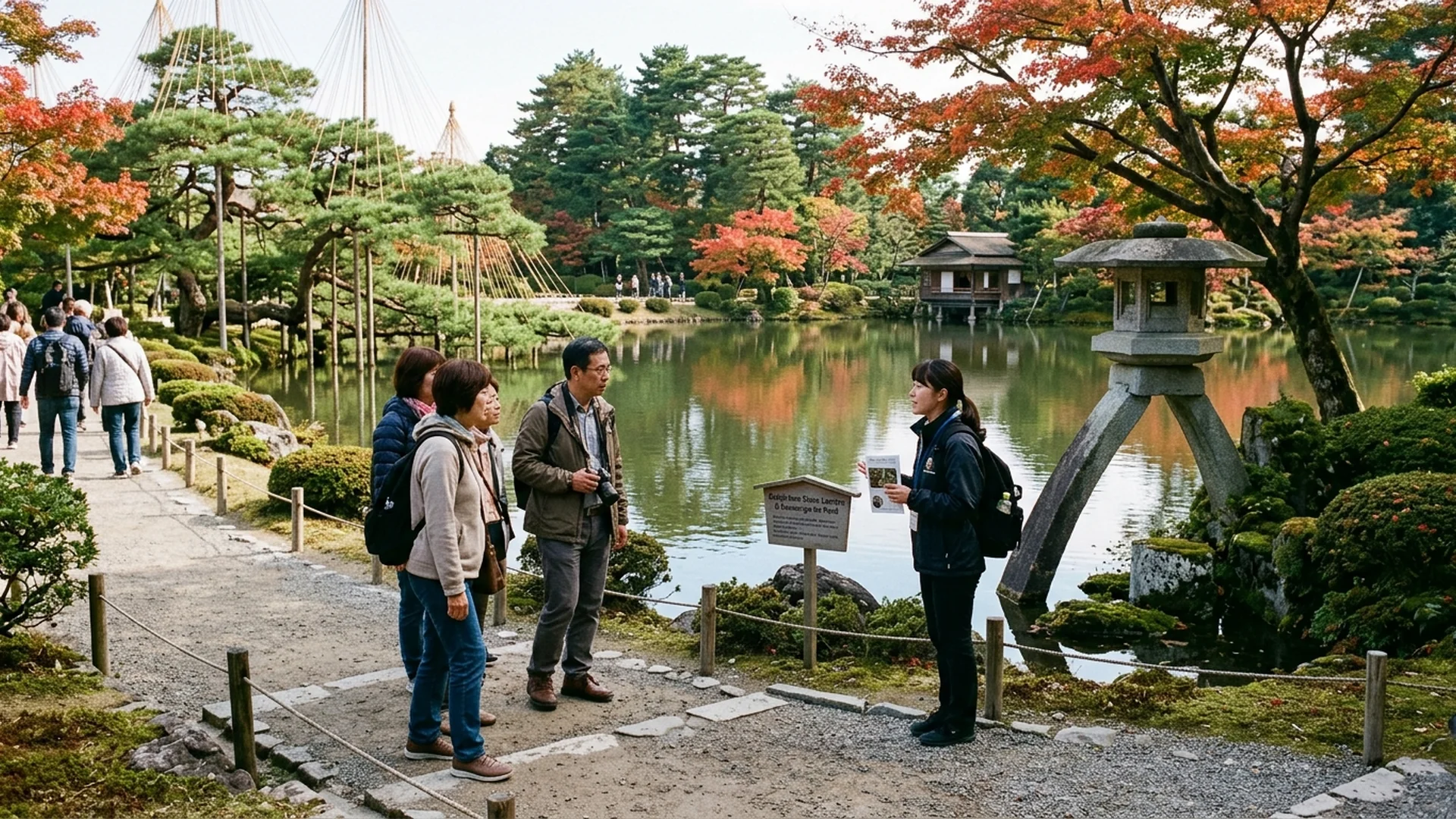
As a soft morning mist lingers over the obsidian expanse of Kasumigaike Pond and the distinct silhouette of the two-legged stone lantern casts a tranquil reflection, time in Kanazawa appears to hold its breath. This is Kenroku-en, a venerated sanctuary rightfully celebrated as one of the three finest landscape gardens in Japan (Nihon Sanmeien). More than a mere ornamental park, it is a living poem that articulates profound philosophical and aesthetic ideals refined across more than two centuries.
Crossing into this sacred domain is akin to stepping back into the Edo period, curated meticulously through generations by the influential Maeda clan, lords of the powerful Kaga Domain. Kenroku-en was never a matter of accidental beauty; it was deliberately sculpted according to ancient Chinese landscape treatises that dictate six distinct architectural attributes. While theoretical texts deemed these qualities mutually exclusive and virtually impossible to unite within a single geography, Kenroku-en achieved the impossible, emerging as an eternal sanctuary for discerning travelers seeking pure, unhurried harmony between human artistry and the natural world.
Deciphering the ‘Kenroku’ Philosophy: The Harmony of Six Sublime Virtues
In classical Chinese garden treatises, an ideal landscape demands the integration of six cardinal attributes that customarily negate one another in practical design: spaciousness (Jinro) and seclusion (An’i), artifice (Jinso) and antiquity (Koko), alongside flowing watercourses (Suisen) and expansive panoramas (Chobo). Conventional estates could generally capture only one or two of these qualities due to strict spatial and topographical limitations. However, the Maeda clan devoted generations from the 17th to the 19th century to continuously expanding and refining this urban expanse, ultimately uniting all six conflicting ideals into a seamless architectural symphony.
Upon wandering deeper into the garden’s embrace, visitors immediately experience the sweeping openness of grand vistas (Chobo) before seamlessly transitioning into profound, meditative seclusion (An’i) beneath dense canopies of ancient pines. Winding stone pathways and gentle brooks—diverted ingeniously from the pristine Saigawa River—breathe continuous life into every corner of the grounds. Every single step mirrors a deliberate aspiration to construct a serene microcosm, gathering the finest expressions of the natural world into one singular, unified horizon.
Monuments of Time: The Kotoji Lantern and Ancient Waters
No visual emblem defines Kenroku-en more indelibly than the Kotoji-toro stone lantern. Distinguished by its unique dual-legged structure where one leg is deliberately elongated while the other remains shorter, it stands quietly beside the banks of Kasumigaike Pond. The sculptural geometry of the lantern echoes the freestanding bridge-posts of the koto, a traditional Japanese stringed instrument. Reflected perfectly upon the glassy surface of the water alongside the arched stone bridge of Higanbashi, this composition remains an enduring muse for photographers, poets, and painters alike.
Just a short stroll away lies the oldest natural water fountain in Japan. Utilizing an ingenious historical mechanism driven entirely by the natural elevation gradient between the waters of Kasumigaike Pond, this antique fountain propels a steady jet into the air without the aid of modern pumps. It serves as a quiet testament to the brilliant empirical engineering of feudal artisans, who effortlessly married rudimentary physics with the refined poetics of landscape architecture.
A Symphony of Four Seasons: From Sakura Blossoms to Yukitsuri Canopies
Kenroku-en transforms dramatically through the turning seasons, carrying the vibrant pulse of life year-round. In spring, the grounds awaken in delicate shades of pink as over forty varieties of cherry blossoms unfurl, led by the rare and exquisite Kenrokuen Higan-zakura. Summer follows with deep, emerald canopies offering cool respite from the afternoon sun, while autumn paints the landscape in fiery strokes of crimson maple leaves mirrored vividly upon tranquil ponds.
Yet, it is winter that garners worldwide renown. When the season’s first snows blanket the region, groundskeepers initiate the meticulous art of Yukitsuri—a complex radial array of ropes strung from central bamboo poles over the grand Karasaki pines. This intricate geometrical umbrella prevents heavy snow accumulation from snapping venerable branches. The resulting intricate network of straw ropes against stark white snow and dark evergreen needles forms an iconic, culturally evocative tableau unique to the Hokuriku region.