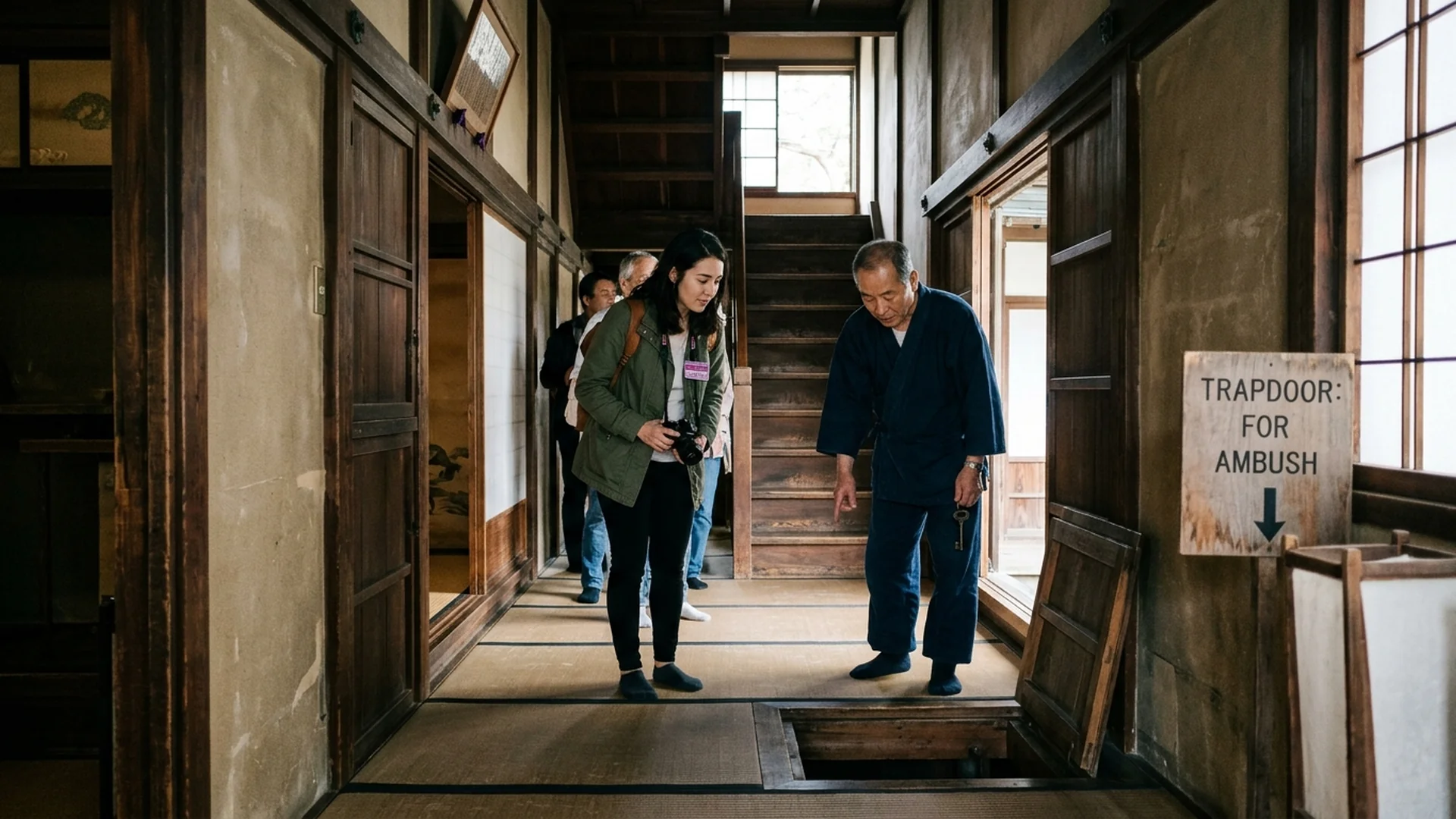
In the tranquil embrace of Kanazawa’s Teramachi temple district lies a structure that defies every convention of sacred Buddhist architecture. Myoryuji—universally known as the Ninja Temple—has no direct lineage to clandestine ninja clans. Instead, it stands as a brilliant exercise in strategic engineering conceived by the powerful Maeda clan, lords of the influential Kaga Domain.
During the Edo period, when the Tokugawa shogunate maintained an eagle eye on regional daimyos, the Maeda clan needed to covertly fortify Kanazawa Castle against sudden incursions. Their solution was to disguise a military bastion as a humble Buddhist temple. From the outside, it appears as an unassuming two-story dwelling; within, it unfolds as a labyrinthine seven-level stronghold concealing scores of tactical traps. For the discerning traveler of Japanese history, this architectural masterpiece invites you to peer behind the facade and decode the brilliant pragmatism of the samurai age.
Architectural Deception: Two Stories Concealing Seven Tiers of Strategy
Upon crossing the temple threshold, visitors are immediately struck by an austere simplicity that belies hidden complexities. Period architects designed the exterior as a modest two-story building to satisfy shogunal decrees forbidding daimyos from erecting taller structures that might overlook nearby castles. Yet, the interior timberwork is intricately subdivided into seven staggered levels, a dizzying maze of mezzanine lofts, sloping corridors, and seemingly endless stairways.
This engineering brilliance was never mere architectural vanity; every square meter was calibrated for guerrilla warfare. Should intruders breach the perimeter, they would instantly lose their bearings in a bewildering network of intersecting passages. Certain stairways were engineered to ascend only, denying return passage, or could be retracted upward into the ceiling with a single motion to sever pursuit. Historical records indicate that in an emergency, the temple could transform from a quiet sanctuary into an active military command post within minutes.
Lethal Mechanisms and Escape Routes: The Heart of the Maeda Bastion
Within Myoryuji’s twenty-three chambers, defensive mechanisms reveal the paranoia and meticulous planning demanded by wartime. The centerpiece is the main staircase, hewn from a massive single log. In the event of a breach, attendants could disengage a pin to instantly flip the heavy wooden treads into a smooth, impassable incline, turning the stair into an offensive slide against attackers.
Discreetly integrated into the plastered walls and wooden lattice are ‘Yazama’—hidden arrow and matchlock slits. From the outside, these apertures remain entirely invisible, yet defenders within could aim and fire with lethal precision. Another notable feature is a five-meter-deep well rumored to connect to a subterranean escape tunnel leading straight to Kanazawa Castle, offering clan leaders a discreet route out of the city if defeat seemed imminent. While the tunnel is sealed today for safety, these historical traces continue to captivate every traveler who crosses the threshold.