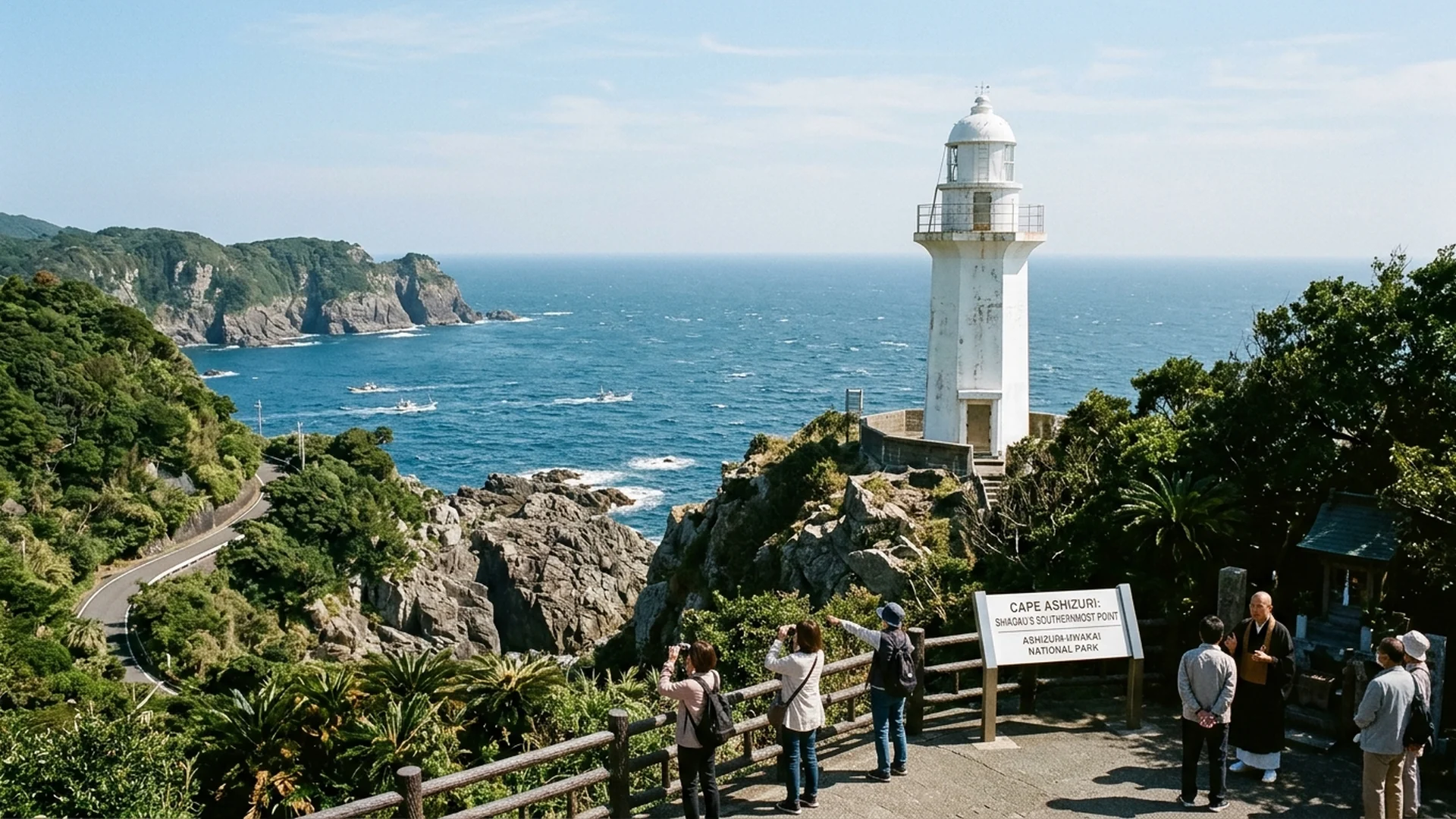
Standing at the absolute southernmost precipice of Shikoku, the horizon before you ceases to be a mere dividing line between water and sky. Instead, it sweeps outward in a magnificent 270-degree arc, quietly reminding the observer of the curvature and boundless expanse of our planet. Cape Ashizuri, poised within Kochi Prefecture, operates as a cathedral of the natural world carved out of the open Pacific. Here, the warm Kuroshio Current brushes against dark granite cliffs, carrying with it an ancient richness and brisk salty mists. This destination transcends the ordinary parameters of scenic tourism; it is a sacred sanctuary where time slows its relentless pace, inviting contemplative travelers to slip away from contemporary clamor and absorb both the wild elegance of the coast and a spiritual lineage rooted in a millennium of devotion.
Architecture of the Cliffs and the White Lighthouse: Where the Curving Horizon Meets the Sea
The Ashizurizaki Lighthouse, gleaming in immaculate white against the indigo canvas of the Pacific, stands as an enduring maritime landmark that has guided seafarers for generations. Surrounding the beacon, a network of footpaths weaves along dramatic precipices, framing some of the most pronounced oceanic horizons in Japan. To stand here as restless waves crash against the rock faces far below, accompanied by a clean, bracing ocean breeze, is to achieve a rare, meditative stillness. The landscape is further sculpted by extraordinary geological phenomena—wind-carved sea caves and striking rock formations shaped by millions of years of relentless marine erosion.
The Spiritual Legacy of Kongofukuji: The Threshold Between the Secular and the Sublime
Tucked deep within a subtropical sanctuary of ancient trees and emerald foliage lies Kongofukuji, the 38th temple on the legendary Shikoku 88 Temple Pilgrimage. According to historical lore, the sanctuary was established by imperial decree of Emperor Koko in the late eighth century to serve as a bastion of esoteric Buddhist protection over the nation’s southern frontier. The temple grounds exude an unhurried serenity, punctuated by the soft murmur of chanting and the quiet presence of pilgrims dressed in white (o-henro) who arrive with unshakeable devotion, keeping a deeply rooted cultural heritage vibrantly alive today.
Seasonal Splendor and the Natural Stone Arch of Hakusan Domon
Cape Ashizuri resists simple seasonal categorization, offering distinct wonders throughout the changing year. From winter into early spring, the promontory transforms as some 150,000 wild camellias (yabu-tsubaki) burst into brilliant crimson blossoms, contrasting sharply against glossy deep-green foliage along the coastal trails. Nearby, the dramatic sea arch of Hakusan Domon stands as a testament to sculptural marine erosion, featuring a colossal natural stone gateway through which the glittering sapphire sea reveals itself. It remains an unforgettable focal point for contemplation and photography alike.