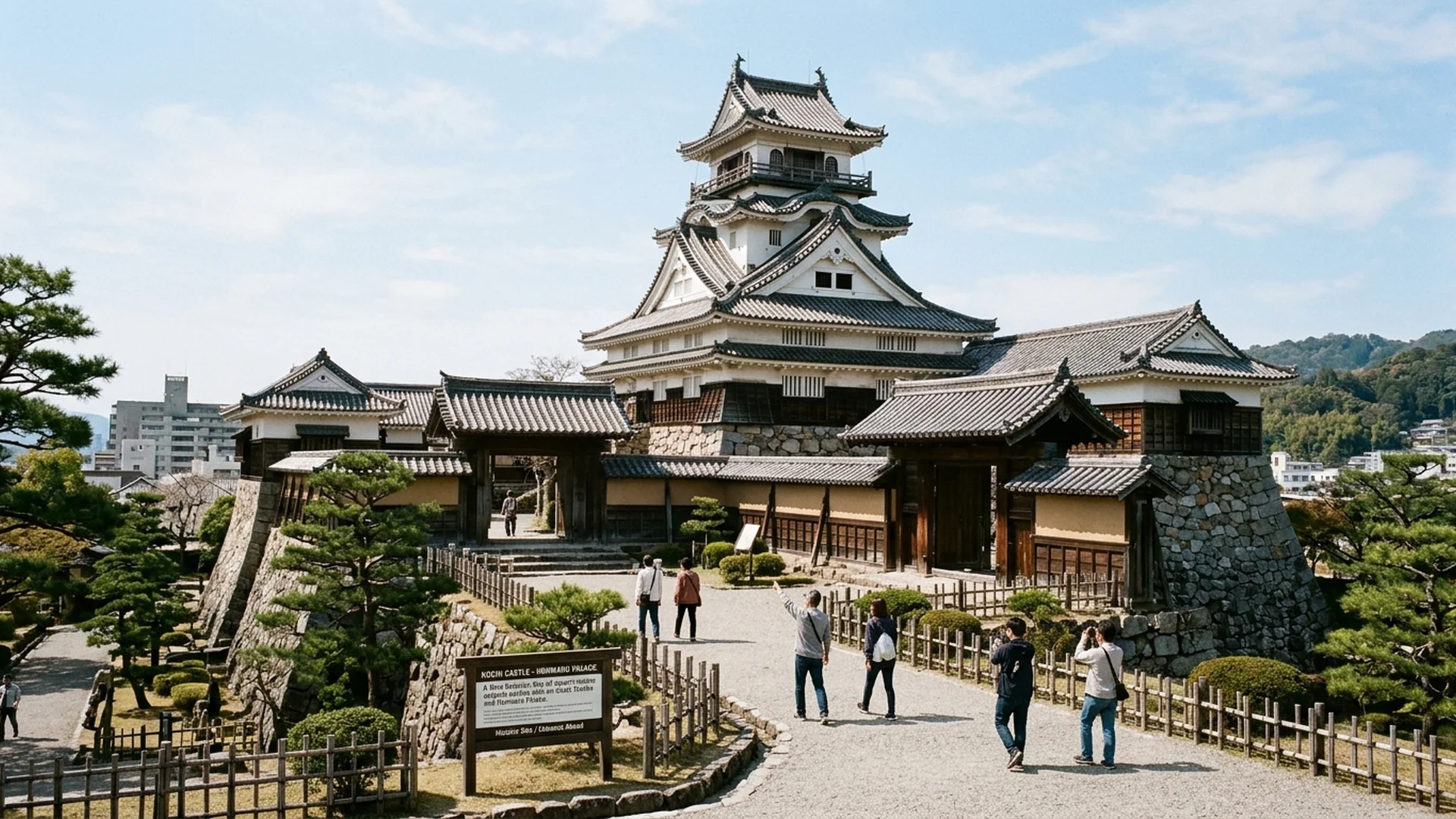
Amidst the verdant landscapes of Shikoku, Kochi Castle stands resilient against the passage of time, a rare testament of history that miraculously escaped the ravages of war, Meiji-era land reforms, and natural catastrophes. It is not merely one of the twelve surviving ‘Original Keeps’ of Japan; it holds a peerless distinction—the only place in the Land of the Rising Sun where travelers may walk through ancient timber gates into a precinct where both the soaring castle tower and the sprawling residence of the daimyo remain side by side, exactly as they did in the Edo period.
Ascending the fortress atop Mount Katsurayama is akin to turning the pages of history chapter by chapter, passing through arched stone ramparts and strategic military checkpoints once designed to repel invaders. The lingering fragrance of aged cedar and the quiet creak of traditional tatami floors within the palace serve as whispers from the past, recounting the lifestyle, wealth, and absolute authority of the Yamauchi clan, the lords of Tosa who meticulously crafted this architectural masterpiece.
Dual Architecture: The Fusion of Military Stronghold and Aristocratic Manor
In the broader history of Japanese castle design, the main keep typically served strictly as a final military redoubt, while the lord’s private residence was erected separately in secondary enclosures for security. Yet Kochi Castle—begun in 1601 under Yamauchi Kazutoyo, the first daimyo of Tosa Province—defied convention by engineering the Honmaru Palace to directly adjoin the four-story keep upon a unified foundation.
As visitors slip off their shoes and step onto polished wooden floors within the manor, they encounter the refined serenity of tatami-matted chambers, gold-leaf screen paintings, and open-air verandas catching the mountain breezes. This layout mirrors the Yamauchi philosophy: viewing the castle not merely as a cold barracks, but as a prestigious residence, an administrative center, and a symbol of the hard-won peace of the fledgling Tokugawa shogunate.
Samurai Strategy and the Defensive Engineering of Tosa
Beyond its aesthetic grace, Kochi Castle serves as a living textbook of historic military engineering. Its formidable stone walls were constructed using ‘Nozurazumi’ and ‘Sangizumi’ techniques—fitting natural stones together without mortar—yielding an earthquake-resistant structure with exceptional drainage, vital for Kochi’s rain-drenched climate.
Along the winding ascent, explorers encounter ingenious defensive features, including ‘Ishi-otoshi’ (stone-drop chutes) designed to hurl boulders or boiling water upon scaling adversaries. Multi-tiered gate networks further slowed intruders, funneling them into blind angles exposed to samurai archers stationed behind trapezoidal and triangular loopholes.
A Living Historic Legacy in the Heart of Kochi City
A pilgrimage to Kochi Castle transcends mere architectural appreciation; it is an immersion into a cityscape that has evolved alongside its monuments. Perched upon a forested hill in the city center, the upper tier of the Tenshu rewards visitors with a sweeping 360-degree panorama of Kochi, the mirror-like Kagami River, and distant, undulating mountain ranges—the exact vantage once utilized by daimyo to survey their domain.
Surrounding the fortifications, mature trees and carefully curated gardens shift hues with the seasons, from vernal cherry blossoms to the amber canopy of autumn. The resulting atmosphere is one of profound tranquility, far removed from the hurried pace of Tokyo or Kyoto.