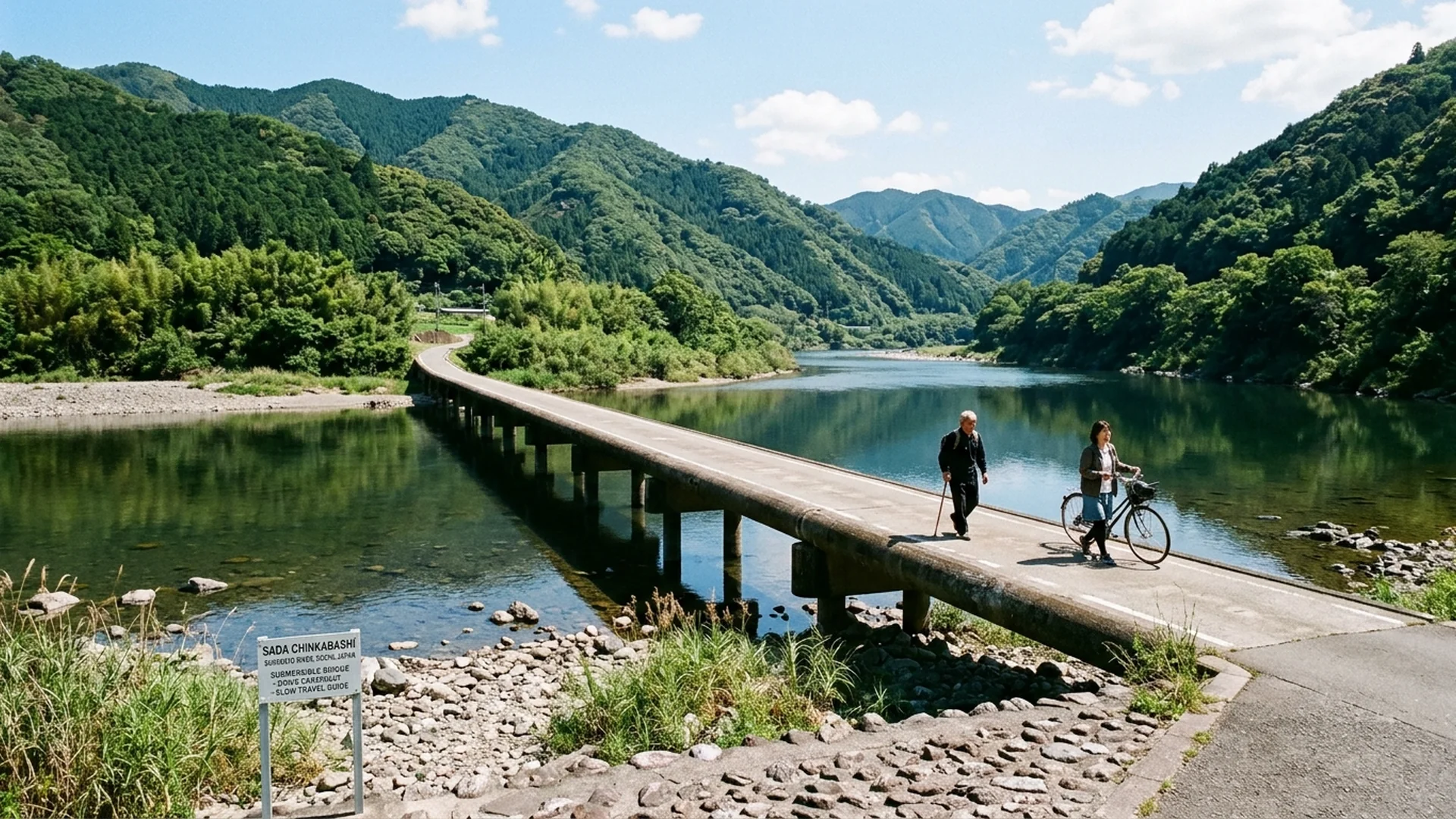
When water ceases to be an obstacle to be conquered and instead becomes a familiar neighbor with whom one learns to coexist in quiet humility, we begin to understand the soul of the Chinkabashi. These singular, rail-less bridges span the crystalline currents of the Shimanto River in Kochi Prefecture, deep within Shikoku. They were never conceived to defy the elements with arrogant permanence; rather, they are crafted from a profound philosophical commitment to yield, submerging gracefully beneath rising floodwaters so that the main structure survives intact while nature flows onward without impediment.
To journey into this serene river valley is to step beyond the well-trodden paths of conventional tourism into an unhurried dimension of travel—one that honors nuance, cultivates stillness, and reconnects the modern wanderer with the elemental world. Crisp mountain air, the scent of ancient forests, and mirror-like waters reflecting the endless blue canopy await those who approach with an open and reverent heart.
The Philosophy of Surrender: Engineering in Harmony with the Current
Across the length of the Shimanto River—the longest waterway on Shikoku island—dozens of Chinkabashi bridges trace the contours of the valley. Their most striking characteristic is radical simplicity: an utter absence of guardrails along either flank. This vernacular engineering is not a design oversight, but an ingenious adaptation to torrential seasonal rains and typhoons that rapidly swell the river. Had these bridges been built high with protective railings, the immense hydraulic pressure of floodwaters would sweep the entire structure away. By keeping the deck low and rail-less, rising waters wash directly over the span, drastically reducing resistance. Once the river recedes, the bridge reemerges, ready for passage with minimal damage. This is the tangible expression of yielding for the sake of survival—a deeply resonant tenet of the Japanese worldview.
Sada and Iwama: Two Aesthetic Landmarks Along the Shimanto
Among all the Chinkabashi, Sada Chinkabashi near the river mouth stands as the longest and most accessible span. Its understated grey concrete silhouette harmonizes seamlessly with the verdant mountain backdrop and expansive water meadows, offering travelers a meditative spot to stand against the breeze and absorb the sweeping valley vistas.
Venturing deeper into the upper gorges reveals Iwama Chinkabashi, tucked away in an exceptionally tranquil and pristine location. Here, silence is broken only by the gentle murmur of the current and the calls of forest birds. Surrounded by mountains that transform in palette with every passing season, this hidden crossing is a cherished refuge for photographers and those seeking profound solitude far from the clamor of the modern world.
True Slow Travel: Two Wheels by the Water and Ancient Boat Journeys
To truly absorb the spirit of the Chinkabashi and the Shimanto River, one must adopt an unhurried rhythm of life. Renting a bicycle to pedal along the rural lanes running parallel to the waterway is the finest method for discovering local life, exchanging quiet smiles with farmers, inhaling the scent of emerald rice paddies, and pausing upon a bridge whenever inspiration strikes. * Furthermore, a voyage aboard a traditional Yakatabune—a canopied wooden skiff—reveals fresh perspectives across the transparent, jade-hued water. At certain stretches along the journey, local fishers may be observed practicing traditional Hibazuke fishing, sinking submerged branches to shelter fish in an age-old demonstration of harmonious coexistence between humanity and the riverine ecosystem.