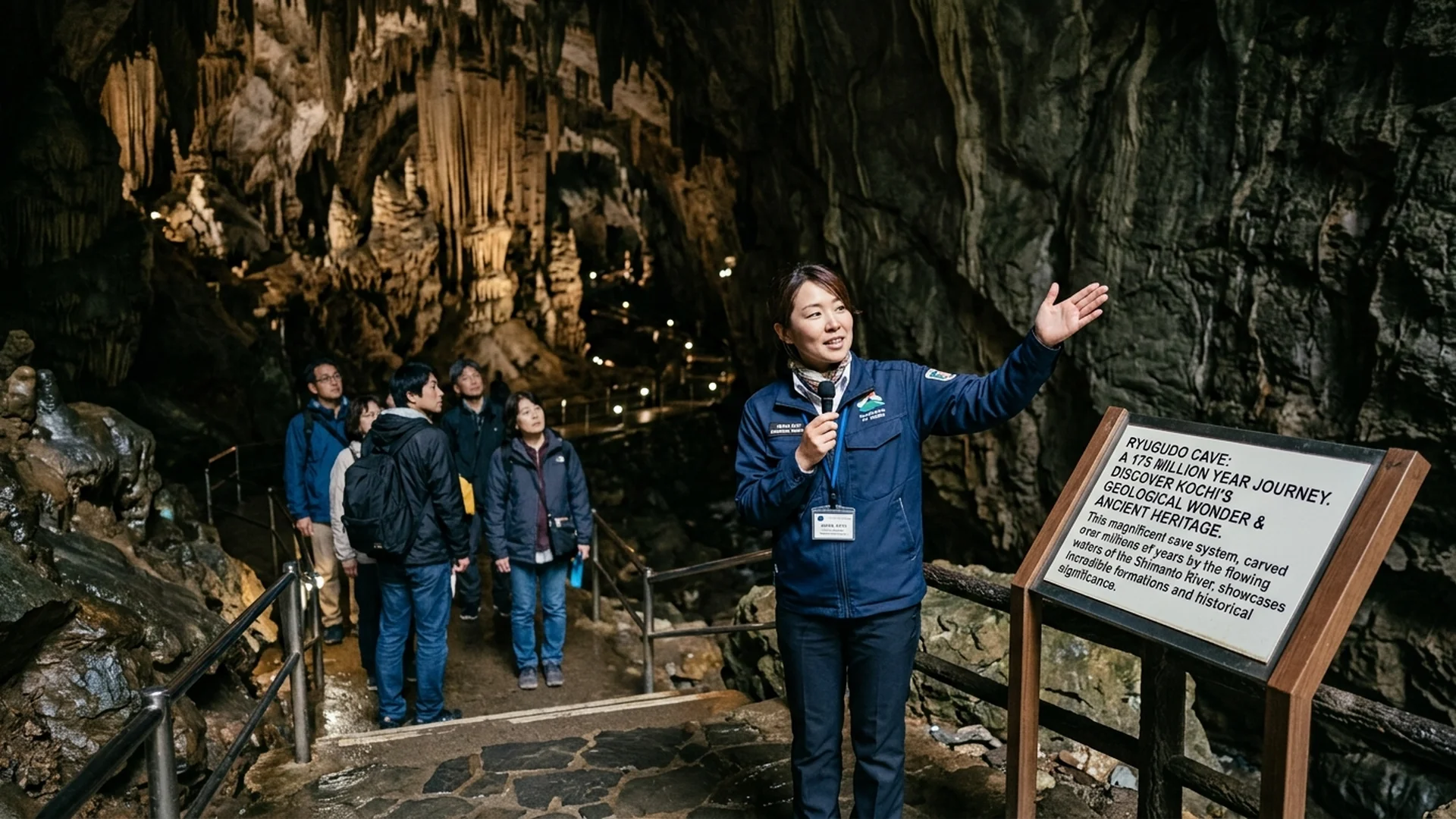
As one crosses the threshold from the sunlit Shikoku forest into the profound subterranean quiet, time appears to instantly suspend its frantic march. This is Ryugudo Cave, a designated natural and historical monument of Japan situated within Kochi Prefecture, concealing secrets shaped across 175 million years of patient hydrology and tectonic evolution. More than a mere limestone cavity, the cavern reveals itself as a majestic subterranean gallery sculpted by mineral-rich waters carving through the ancient bedrock in hypnotic, labyrinthine curves.
Journeying into this deep-earth realm is a seamless crossing of dimensional boundaries, transporting the discerning traveler from the modern epoch deep into primordial antiquity. It offers an untamed yet deeply meditative atmosphere where advanced, low-impact illumination highlights the stark architecture of the stone without disturbing the fragile ecological equilibrium. Ryugudo Cave invites quiet contemplation, urging us to decode a magnificent narrative jointly authored by raw earth and early human civilization.
The Grand Hall of Stone: A 175-Million-Year Symphony in Droplets
Beneath the verdant canopy of Kochi’s mountainous terrain, subterranean currents have sculpted massive chambers through continuous, unhurried dissolution over 175 million years. Within Ryugudo Cave, the ambient temperature remains remarkably constant year-round, cultivating a solemn, chilly sanctuary that naturally stills the wandering mind. As curated illumination strikes the massive stalactites suspended from the vaulted ceilings, one experiences the breathtaking sensation of standing within an immense marble cathedral designed by nature itself. Every alcove reveals soaring columns and intricate mineral formations that grow by mere centimeters over centuries, reminding observers of geological scales far beyond human comprehension and inspiring a profound sense of reverence.
Echoes of the Yayoi Civilization and the Mystery of the ‘God’s Pot’
What truly elevates Ryugudo Cave above standard subterranean destinations is the preservation of ancient human habitation, most notably epitomized by the ‘God’s Pot.’ This artifact—a Yayoi-period pottery vessel dating back roughly two millennia—was left deep within the cavern’s recesses, where mineral-laden water steadily encased it in crystalline layers of calcium carbonate. Witnessing this archaeological marvel with one’s own eyes serves as a bridge across millennia, connecting the mysterious lives of ancestral inhabitants with the modern traveler. It stands as quiet testimony that this subterranean expanse was never merely a geological curiosity, but a sacred refuge freighted with deep human significance.
Aesthetic Illumination and the New Dimension of Cavern Exploration
The intrinsic beauty of Ryugudo Cave is elevated through thoughtful, ecologically sensitive lighting design and subtle projection mapping. Soft, amber glows trace the complex textures and contours of the limestone walls, lending the interior the atmosphere of a mythic, hidden realm. For those seeking a more rigorous form of engagement, the cave offers the ‘Adventure Course,’ wherein visitors don protective gear to crawl, squeeze, and climb through narrow fissures. This specialized route grants access to untouched perspectives hidden from the casual tourist path, delivering an immersive, bespoke journey tailored for discerning travelers seeking authentic off-the-beaten-path discovery.