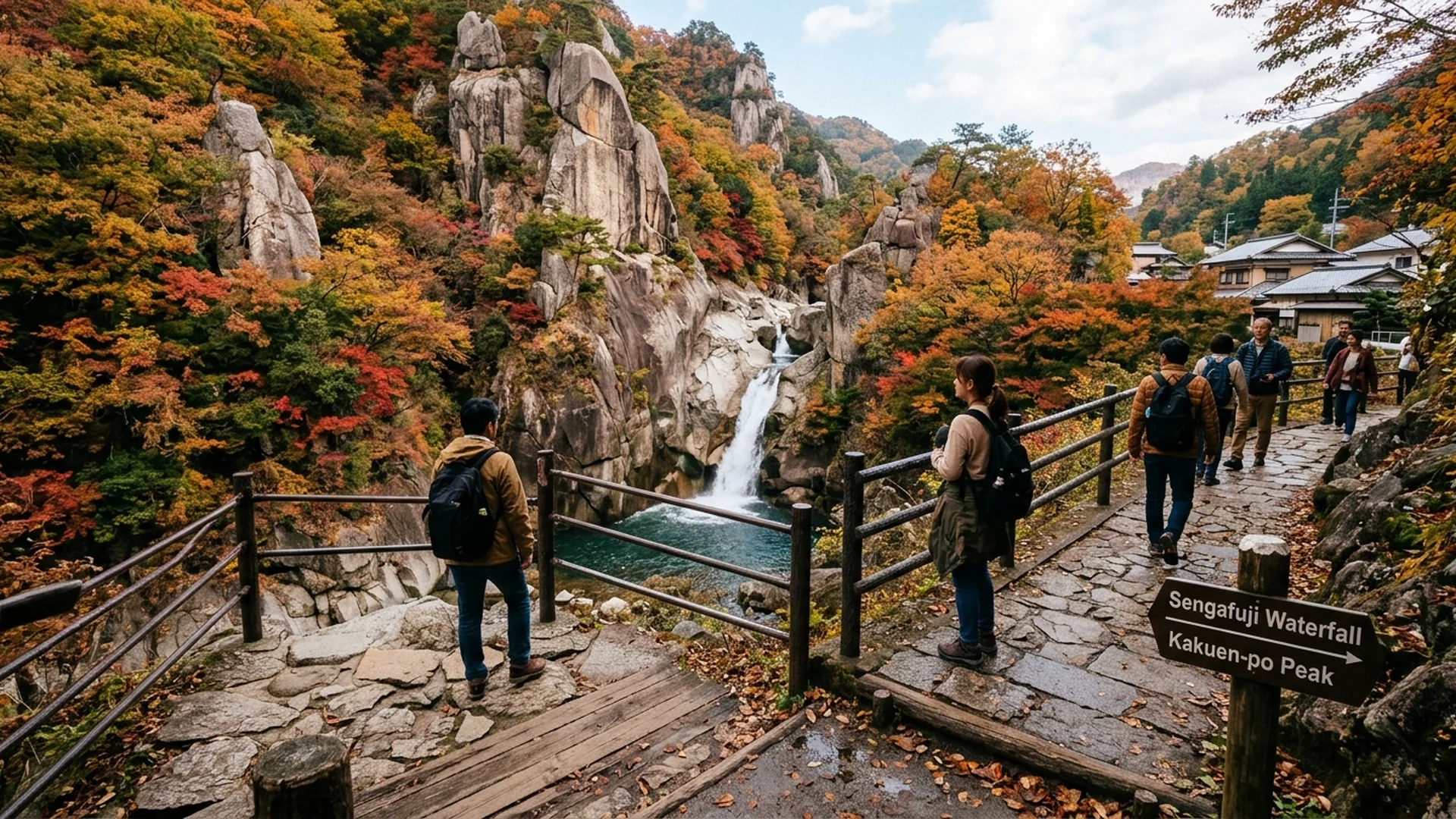
When morning mists linger among pine crests and pale grey granite precipices, the soft, enduring murmur of water carving through millennia awakens a primal symphony of nature. Within Shosenkyo Gorge, an untouched sanctuary nestled in the northern reaches of Kofu City in Yamanashi Prefecture, travelers encounter what many revere as the most captivating valley in Japan. Yet, only the discerning eye truly perceives the quiet poetry woven deep within this verdant expanse—where the earth unfurls as a living canvas brushed by the subtle, transient hues of the changing seasons.
To journey to Shosenkyo is not merely to cross a geographic threshold, but to step gracefully into an aesthetic realm where rugged granite cliffs converse effortlessly with crystal-clear waters. It stands as a profound testament to natural equilibrium—a world seemingly worlds away from the electric pulse of Tokyo, yet resting just within reach for those whose spirits yearn for pristine beauty and contemplative stillness.
Architecture of Time: Kakuenbo and the Sculpted Granite Monoliths
What distinguishes Shosenkyo Gorge from other alpine valleys across Japan is its extraordinary geological heritage. Over countless millennia, the rushing currents of the Arakawa River have sculpted the native granite into sheer, arresting precipices and curious, mythological formations. Foremost among these is the Kakuenbo cliff, soaring majestically over 180 meters against cobalt skies and dense woodland. When autumn arrives, the surrounding canopy ignites in brilliant shades of copper and gold, contrasting sharply against the cool, weathered grey of the ancient stone. Nearby stands Ishimon, or the Natural Stone Gate, where two colossal boulders have fallen into a precise architectural embrace, creating a magnificent natural arch that welcomes travelers as if placed by an unseen hand.
Symphony of Waters: Sengataki Waterfall and the Four-Kilometer Emerald Stream
A tranquil four-kilometer walking trail meanders alongside the river, offering a rare sanctuary for unhurried reflection. The gentle rush of water harmonizes with the whispering canopy, instilling a deep sense of psychological restoration. The trail culminates at the sacred Sengataki Waterfall, where crystal waters plunge over thirty meters down a dark granite facade. Fine mists rise from the basin, catching slanting sunbeams to cast faint, fleeting rainbows across the mossy glen. Along the path, observant travelers will encounter rock formations christened after familiar shapes—turtles, stone lanterns, and quiet human profiles—reflecting the intimate, animist dialogue between Japanese culture and the natural world.
Alpine Horizons: Panoramic Vistas of the Southern Alps and Mount Fuji
To elevate the Shosenkyo experience to its absolute zenith, travelers may board the Shosenkyo Ropeway near the base of Sengataki, ascending to the Panorama Dai summit in just five minutes. Before the observer unfolds a sweeping 360-degree panorama of the complex, snow-dusted peaks of the Southern Alps. On exceptionally clear days, the sublime silhouette of Mount Fuji emerges on the far horizon, casting a serene shadow against the heavens. At the summit platform, hidden among pine and rhododendron, rest a quiet sanctuary bell and a diminutive shrine, inviting visitors to pause in absolute silence and absorb the monumental scale of Yamanashi’s topography.
Legacy of the Spark: The Artisanal Soul of Kofu’s Crystal Cutters
Beyond its arresting physical topography, Shosenkyo is inextricably bound to the heritage of Japanese craftsmanship. Kofu city stands as the undisputed center of gemstone polishing and crystal cutting in Japan, a legacy rooted in the ancient discovery of high-grade quartz deposits within this very gorge. Arriving near the entrance of the valley, one encounters the traditional workshops, artisan jewelers, and lapidary ateliers that have passed meticulous techniques down through generations. This living tradition honors the profound symbiosis between the human hand and the mineral wealth forged within Shosenkyo’s ancient forests.