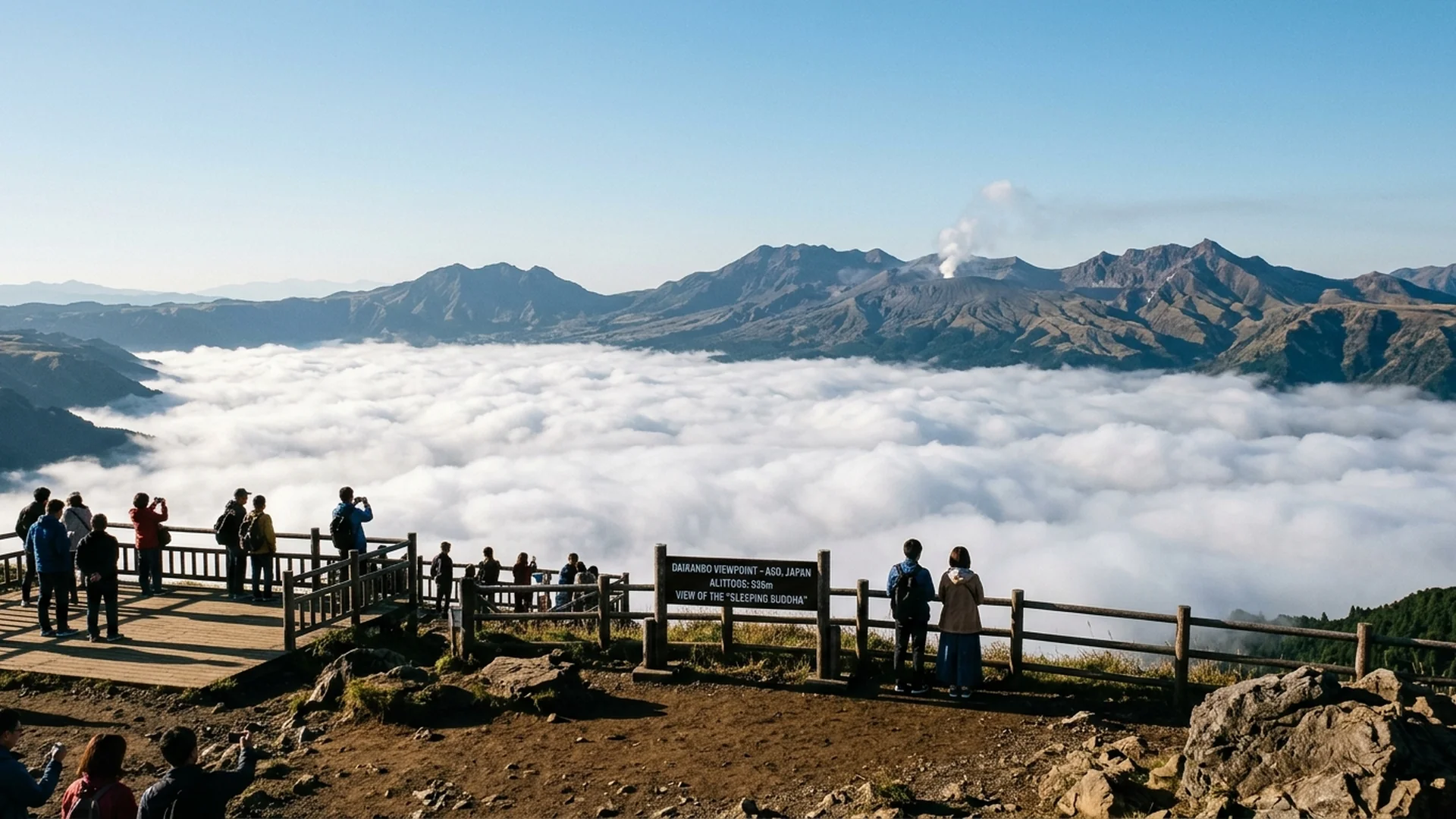
As the morning mist slowly unfurls its pristine white canvas across the vast valley below, a profound, resonant silence commands every human sense. Standing at 936 meters above sea level, the Daikanbo Viewpoint along the northern rim of the Aso Caldera in Kumamoto Prefecture is far more than a mere scenic stop. It functions as a magnificent open-air salon meticulously sculpted by nature, inviting travelers to stand in awe before one of the largest and most dramatic calderas on Earth.
This sanctuary holds an aesthetic secret ardently sought after by those attuned to the subtleties of the natural world. Sweeping your gaze across the sweeping grasslands that shift hues with the turning seasons, the five central peaks of Aso—collectively known as Aso Gogaku—align against the horizon with arresting precision. They conjure an astonishing optical illusion: a serene Nirvana Buddha resting in eternal slumber amidst the shifting dimensions of time, serving as a profound reflection where the volatile geography of fire and earth melts seamlessly into spiritual tranquility.
Architecture of the Earth: The Aso Caldera and the Shadow of the Nirvana Buddha
Comprehending the topography of Aso is essential to truly appreciating the poetry of Daikanbo. This super-colossal caldera was forged by ancient cataclysmic eruptions, leaving behind a sprawling basin where communities and agriculture quietly thrive today. Originally known as ‘Jigokoishi’ before receiving its present name from the celebrated author Tokutomi Soho—who was struck by the peerless grandeur from this vantage—Daikanbo offers a sweeping perspective of a volcanic ring spanning dozens of kilometers. The hidden marvel lies in the eastern mountain chain, comprising Mount Neko, Mount Kamodake, Mount Takadake, Mount Nakadake, and Mount Kishima. When viewed from this elevation, their undulating ridges connect flawlessly to trace the divine contours of a reclining Buddha resting his head toward the north, as if nature itself etched an eternal myth upon the crust of the planet.
The Allure of Unkai: Sea of Clouds and the First Light of Dawn
During seasonal transitions, particularly as autumn ushers in cooler temperatures, Daikanbo transforms into one of nature’s most captivating theaters. The phenomenon known as Unkai, or sea of clouds, materializes when nocturnal moisture is trapped within the basin beneath a blanket of stable, warm air. Before long, the day’s inaugural amber rays pierce the cloudy shroud, transforming the pristine white mist into a shimmering sea of golden waves. Standing upon the precipice of Daikanbo in the quiet hours of dawn transcends mere sightseeing; it is an unhurried pilgrimage into a dreamscape where the boundaries between earth and sky dissolve, leaving behind an unfiltered beauty that leaves one breathless.
The Aesthetics of Journeying: The Milk Road and the Flavors of Aso
The pilgrimage to Daikanbo forms an integral chapter of a premier travel experience. The Milk Road, which unfurls gracefully across the Kuju and Aso highlands, is widely revered as one of Japan’s most sublime road-trip arteries. Flanking the asphalt are emerald pastures where grazing cattle roam freely, a testament to the rich, volcanic fertility of the soil. Beyond the visual feast, indulging in local artisanal specialties—such as richly aromatic Aso Jersey milk or tender, charcoal-seared Akaushi red beef—deepens the sensory tapestry of the journey, satisfying every dimension of discerning taste.