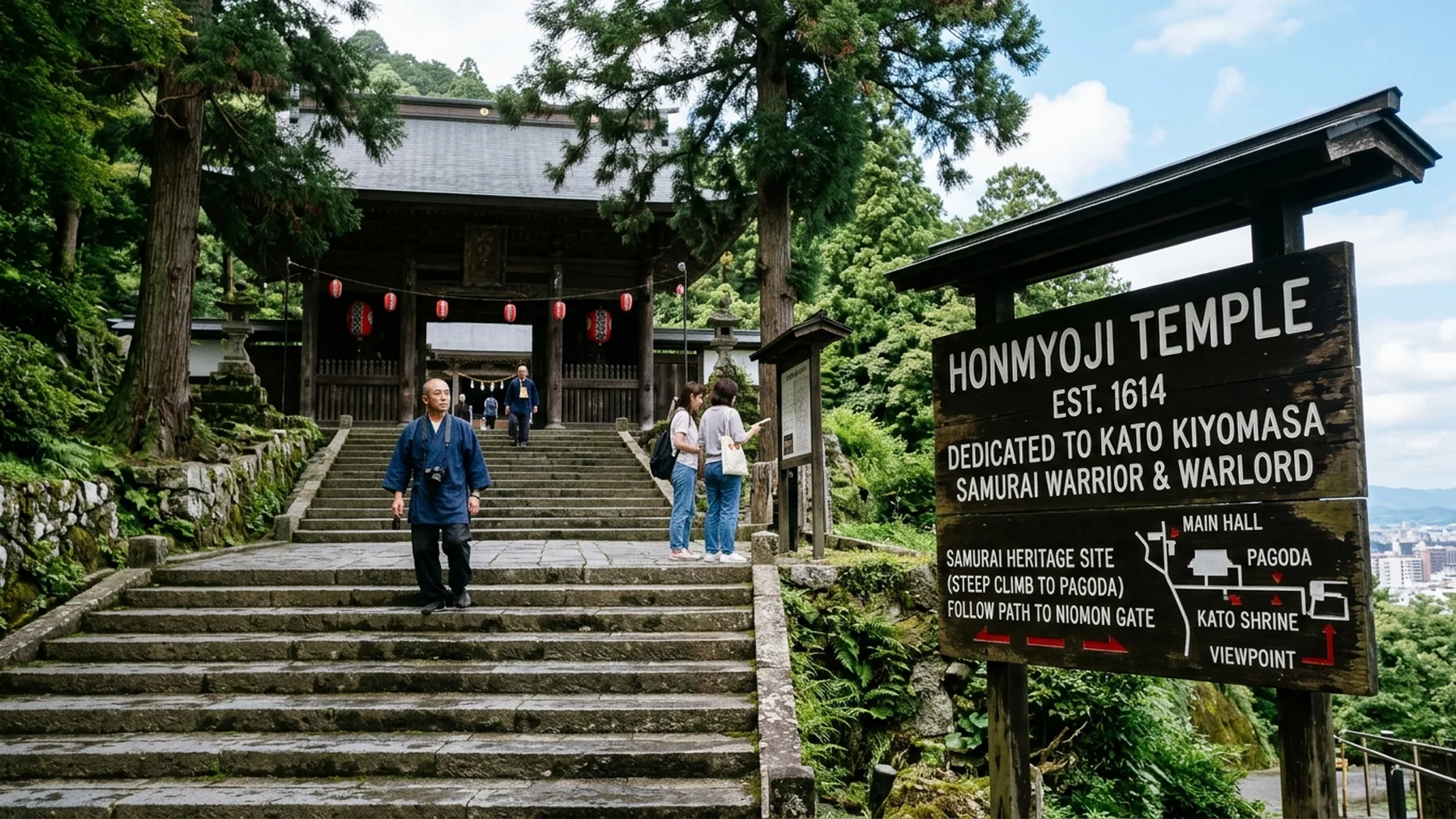
Stepping beyond conventional itineraries reveals the beating spiritual heart of Kumamoto at Honmyoji Temple, the sacred resting place of Kato Kiyomasa, the visionary daimyo who forged this storied city. Here, away from the urban bustle, lies an atmosphere of unhurried contemplation, where history unfolds along moss-draped stone paths and ancient lantern-lit stairways.
As morning mists cling to the pine-clad slopes, Honmyoji Temple emerges not merely as a historic Nichiren Buddhist sanctuary, but as an open-air archive of samurai devotion, honor, and architectural mastery. Passing beneath historic gates invites discerning travelers on a timeless journey through centuries of regional identity, offering rare moments of stillness and profound cultural resonance.
The Legacy of Kato Kiyomasa: Architecture and Samurai Spirit
Kato Kiyomasa was far more than the master architect who fortified Kumamoto Castle into one of Japan’s three most magnificent fortresses; he was also the foundational pillar of regional spirituality and daily life. Upon his passing, in accordance with his wishes, his remains were enshrined at the Jokoku-byo mausoleum within Honmyoji, positioned to eternally gaze toward Kumamoto Castle and watch over his domain and people. The temple’s architecture reflects the exquisite craftsmanship of the Momoyama to early Edo periods, showcasing intricate woodwork and landscape designs that merge seamlessly with the surrounding natural topography.
The Enchantment of Munatsuki Gangi and the Stone Lantern Path
The ascent to the upper sacred precinct begins at the 176 stone steps known locally as Munatsuki Gangi. Designed with a deliberate, steep incline, the pathway is lined with centuries-old stone lanterns softened by emerald mosses that bear silent witness to the passing eras. With each measured step, the clamor of the modern world fades, replaced by the whispering wind through pine boughs and the rhythmic cadence of footsteps. At the summit rests the solemn Jokoku-byo mausoleum, enveloped in a dignified serenity that offers visitors an intensely private space to pay homage to a legendary military commander.
Elevated Vistas: Framing the Castle and Moat from a New Vantage
Rising above the mausoleum precinct stands a grand bronze statue of Kato Kiyomasa in full samurai regalia. This elevated plateau serves as one of Kumamoto’s most rewarding vantage points, granting unobstructed panoramic views across the city. On clear days, the horizon stretches toward the magnificent keep of Kumamoto Castle, bridging past and present in a single breathtaking sweep. It is an exclusive insider’s perspective that traditional sightseeing itineraries frequently overlook.