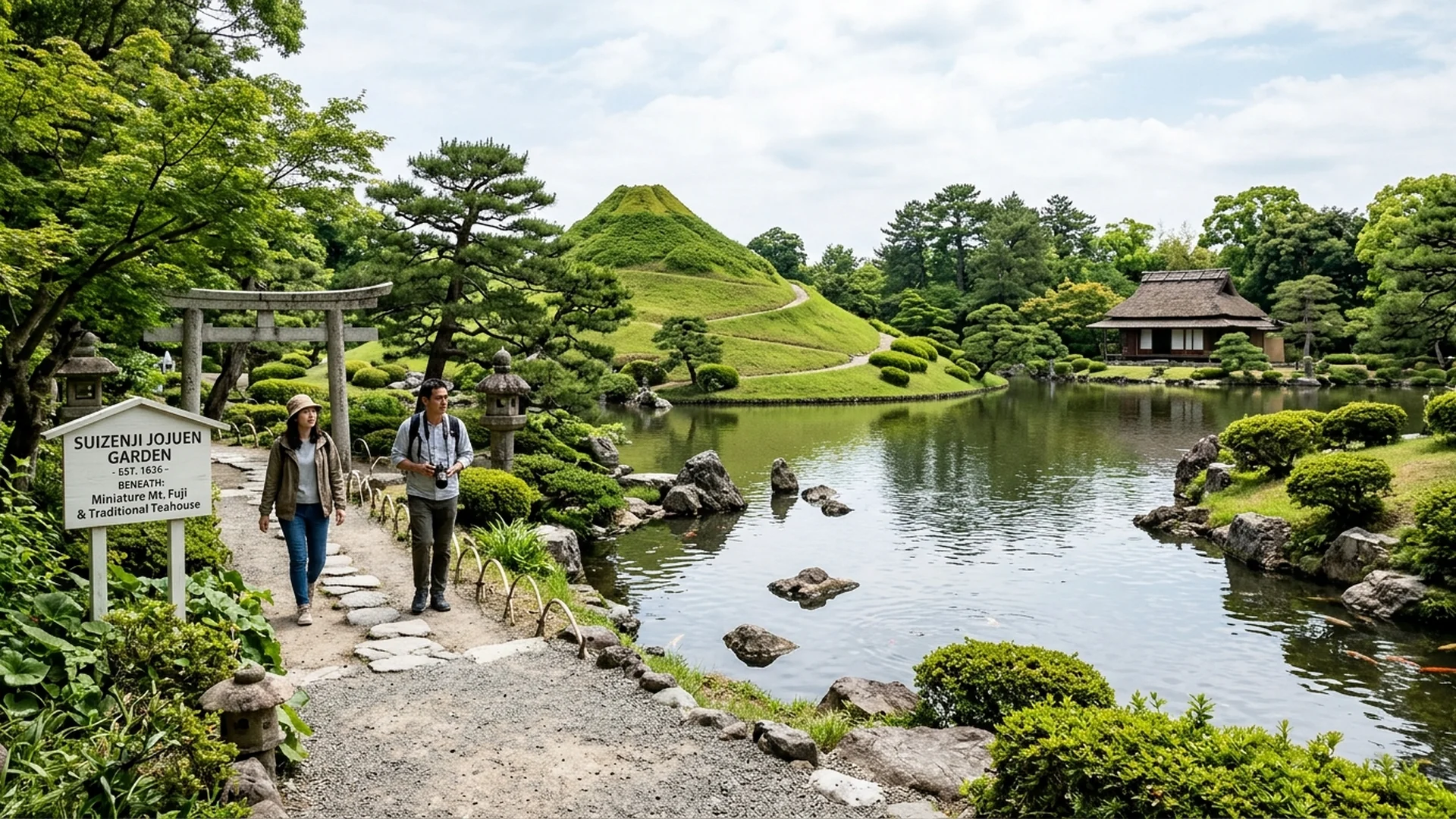
As the morning mist lifts from water as clear as polished glass, every footsteps within Suizenji Jojuen reveals a living canvas of poetic design. This is no ordinary municipal park, but a masterwork of daimyo landscape architecture meticulously crafted by the Hosokawa clan, rulers of Higo province, beginning in the seventeenth century.
Visiting this sacred enclosure offers a profound retreat from the velocity of the modern world into timeless serenity at the heart of Kumamoto. Here, manicured pine trees, natural springs fed by the pristine snowmelt of Mount Aso, and the ingenious miniaturization of the legendary Tokaido highway converge within an intimate yet boundless space.
The Philosophy of Kaiyushiki: Journeying Through Time Along the Tokaido
At the soul of Suizenji Jojuen lies the Kaiyushiki Teien design—a circuit style intended to evoke the fifty-three stations of the historic Tokaido Road, the legendary samurai-era highway connecting Edo and Kyoto. As travelers meander along the shores of the expansive central pond, they encounter miniature interpretations of iconic vistas, weathered stones, arched wooden bridges, and impeccably tended flora passed down through generations.
The undeniable focal point is the miniature Mount Fuji, a conical green hill rising sharply beside the pond. In the early morning hours, when vapor drifts over the water and gentle light catches the slope, the resemblance to the sacred volcano is striking, reflecting the profound genius of classical landscape designers who sought to encapsulate the entire breadth of Japanese beauty within a single sanctuary.
The Art of Matcha at Kokindenju no Ma Teahouse
Another invaluable cultural heritage tucked within the verdant grounds is the Kokindenju no Ma teahouse, an architectural marvel steeped in history. Originally constructed within the Kyoto Imperial Palace before finding its permanent home here, the pavilion derives its name from its association with the study of classical Japanese imperial poetry, the Kokin Wakashu.
Sitting quietly upon traditional tatami mats, gazing outward through ancient wooden lattices toward the pond and surrounding foliage, while savoring delicate wagashi confections paired with frothy, vibrant green matcha, offers an unhurried, transcendent immersion into Chado, the way of tea.
Historical Echoes and Izumi Shrine
Just a short distance from the tranquil waters stands Izumi Shrine, a Shinto sanctuary dedicated to the ancestors of the Hosokawa clan, who championed arts, culture, and scholarship throughout Higo province. The shrine grounds exude quiet dignity beneath a canopy of venerable trees, where vermilion torii gates strike a vivid contrast against the deep emerald surroundings, heightening the sacred atmosphere.
At the approach to the shrine stands a bronze statue of daimyo Hosokawa Tadatoshi, the visionary who initiated the garden’s creation, gazing perpetually over the modern prosperity of Kumamoto as a silent guardian bridging a glorious feudal past with the contemporary world.