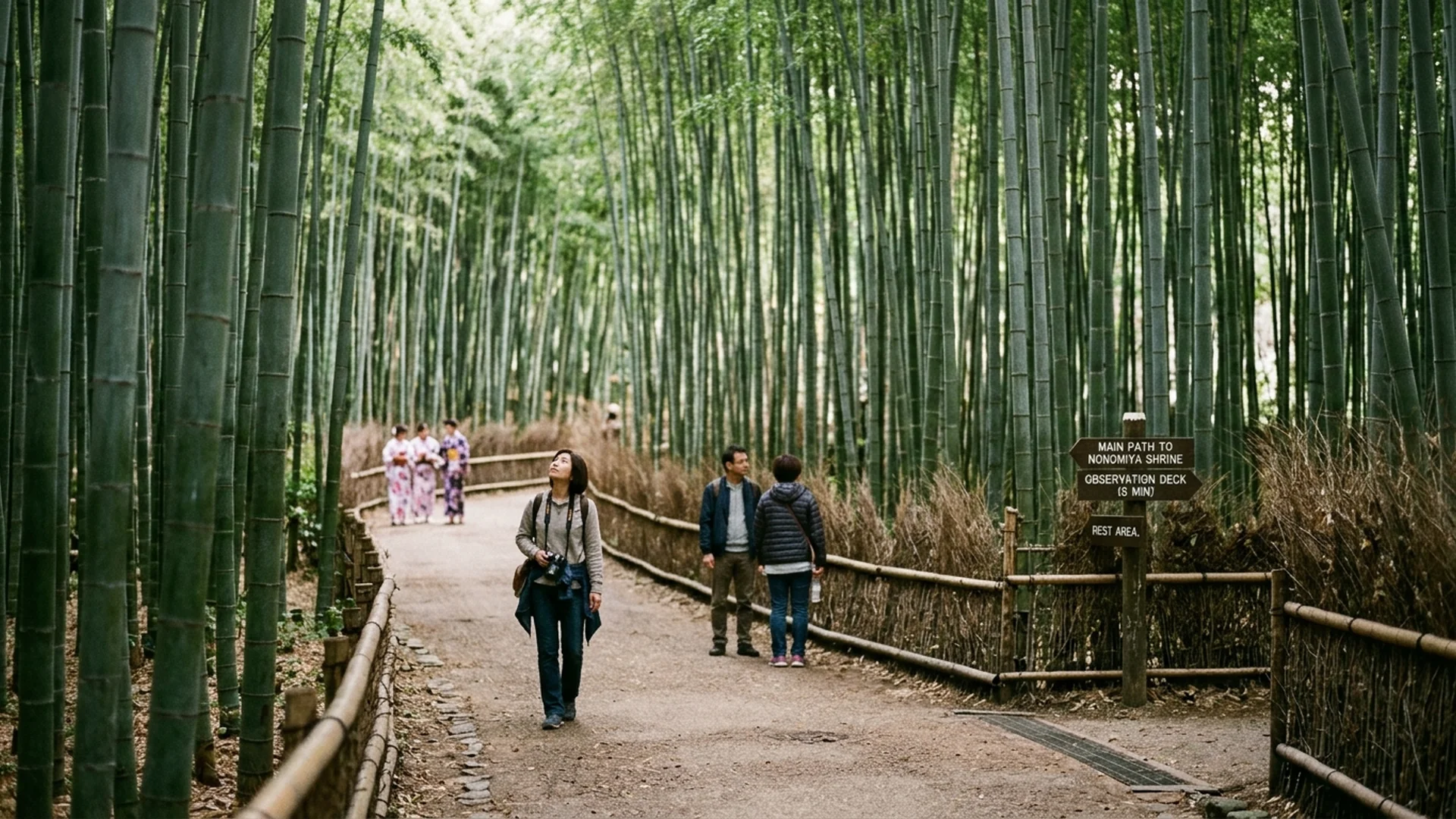
When the first golden light begins to caress the emerald canopy, a profound and sacred quietude blankets the forest floor. The Arashiyama Bamboo Grove on the western fringes of Kyoto is far more than a mere corridor of towering stalks flanking a popular pathway; it is a natural antechamber where nature and the spiritual soul of Japan converge in silent harmony.
Visiting Arashiyama in the modern era without mindful timing risks missing the very essence of tranquility that its ancient custodians intended to preserve. Understanding its layered dimensions—ranging from aesthetic natural rhythms and historical pathways to optimal scheduling—is the ultimate key to transforming a routine sightseeing excursion into a genuine dialogue between self and nature.
A Natural Symphony: Decoding the Soundscapes of Arashiyama
The moment you step onto the path enveloped by soaring Mosō bamboo, the immediate sensation is one of absolute detachment from the clamor of the outside world. Towering stalks stretch toward the heavens, acting as a natural veil that filters harsh sunlight into a soft, dappled luminescence. Discerning global travelers seek far more than a flawless photograph; they seek the whispered voice of the wilderness. Japan’s Ministry of the Environment has designated the wind whispering through Arashiyama as one of the ‘100 Soundscapes of Japan.’ The gentle friction of emerald leaves catching the morning breeze generates a low-frequency resonance that instantly calms the mind, melts tension, and ushers the listener into a meditative Zen stillness.
A Convergence of Eras: From Emerald Canopies to the Zen Realm of Tenryu-ji
To truly appreciate Arashiyama, your journey must extend effortlessly into Tenryu-ji, the premier temple of the Rinzai Zen sect located at the threshold of the grove. Designed in the 14th century by the legendary master Musō Soseki, the temple’s garden employs the genius of shakkei, or borrowed scenery, integrating the distant slopes of Arashiyama and the bamboo thicket into its composition without artificial intrusion. Stroll quietly along the edge of Sogenchi Pond, where the mirror-like water reflects the open sky and surrounding foliage, and you will intimately grasp the philosophy of wabi-sabi—the beauty found in impermanence and profound simplicity.
Refined Aesthetics: Discovering New Perspectives Through Jinrikisha and Zen Cuisine
For an exceptionally curated perspective, engaging a professional jinrikisha (traditional pull-rickshaw) driver offers an insider’s lens into the district. These knowledgeable guides navigate hidden alleyways inaccessible to automobiles while sharing local folklore and positioning you for optimal photographic angles. Conclude your day with a traditional Shojin Ryori meal—plant-based Zen Buddhist cuisine prepared with meticulous reverence for seasonal ingredients and served in heirloom vessels that honor the earth.