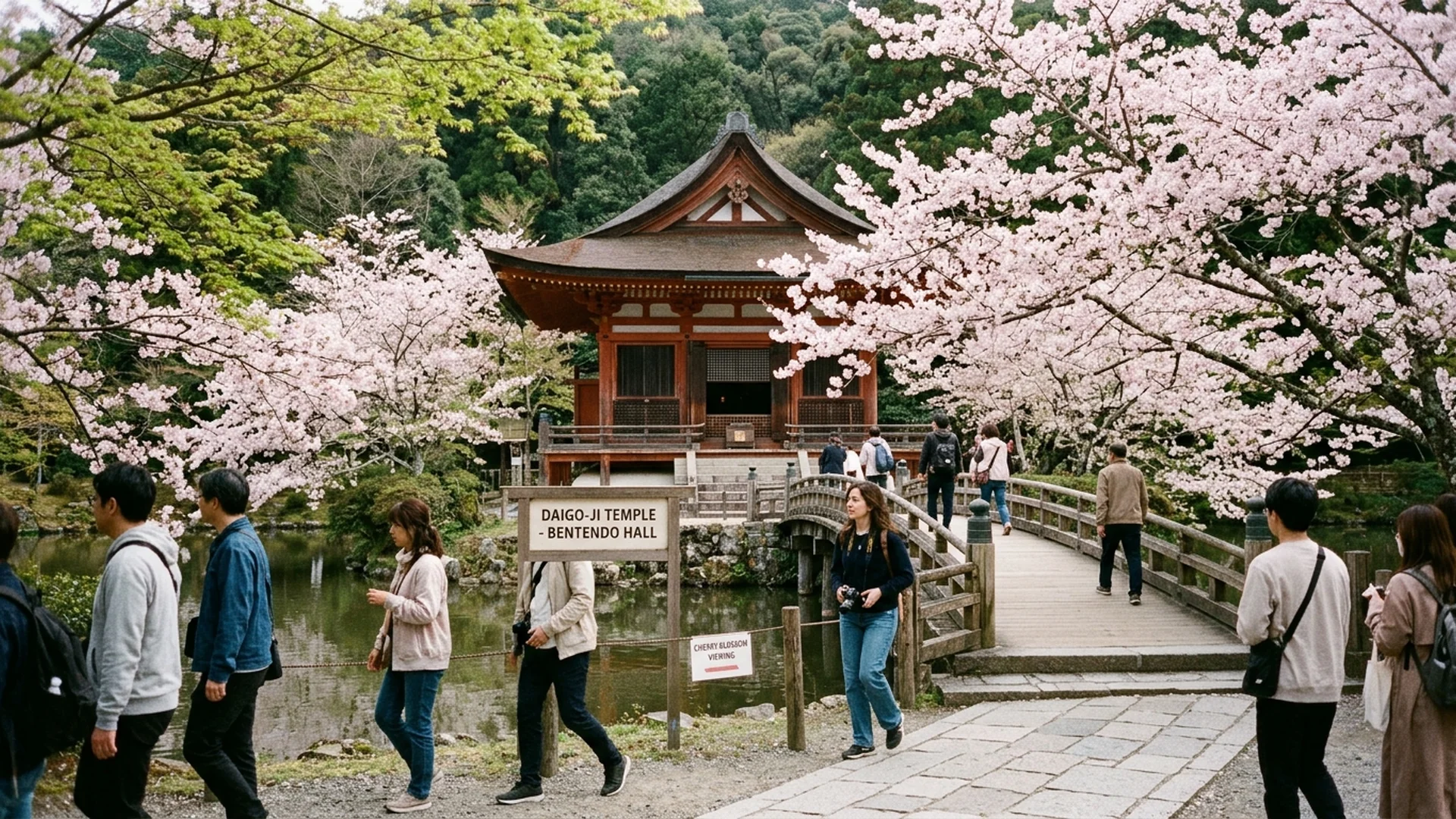
Amidst the ceaseless currents of travelers flooding Kyoto’s ancient imperial grid, a sacred forest upon Mount Daigo holds fast to a timeless, profound serenity. Daigo-ji Temple is far more than a Shingon Buddhist sanctuary or a celebrated UNESCO World Heritage site; it is an open-air library etched into nature, preserving the deepest currents of Japanese art, spirituality, and imperial history.
More than a millennium ago, when the monk Shobo first established sacred retreats upon these forested slopes, his inspiration was born not from political ambition, but from the discovery of a pure, potent spring—the “Daigo” or spring of supreme awakening. This pristine source became the bedrock for a vast monastic realm where unbridled nature and refined Buddhist devotion fused into an unbroken, harmonious whole.
The Tripartite Realm of Shingon: Architecture and Sacred Geometry
Daigo-ji cascades gracefully from the foot of Mount Daigo up into its mist-shrouded peaks, delineated into three distinct zones. At the base lies Sanbo-in, established later as the abbot’s residence and anchored by a legendary stroll garden personally conceptualized by the hegemon Toyotomi Hideyoshi. This masterpiece of Momoyama aesthetics employs meticulously placed stones, weathered boulders, and arched bridges to capture the vastness of the natural world in microcosm. Moving deeper into the complex reveals the Garan, the original ground-level compound dominated by the Five-Story Pagoda (Gojuto). Erected in 951 AD, this architectural marvel miraculously survived the catastrophic fires of the Onin War, standing today as the oldest extant wooden building in Kyoto Prefecture. Its deep vermilion pillars and impeccably balanced proportions against a backdrop of deep green timber form an unforgettable icon of sacred architecture. Finally, the Reihokan Museum safeguards over 100,000 ancient statues, paintings, and national treasures, opening its vaults annually to reveal Japan’s profound artistic lineage.
Daigo no Hanami: The Legendary Blossom Banquet That Shook the Realm
When spring graces Kyoto, Daigo-ji claims an unrivaled prominence, not merely for its canopy of over 700 cherry trees bursting into synchronized bloom, but because these grounds played host to ‘Daigo no Hanami’. In the spring of 1598, the powerful ruler Toyotomi Hideyoshi orchestrated this monumental cherry blossom viewing party to cement his cultural dominance and celebrate an era of hard-won peace. Hideyoshi commanded that over 700 diverse cherry saplings be transported from across the realm to the temple slopes, hosting historic tea ceremonies and welcoming some 1,300 esteemed guests and court ladies. Though over four centuries have elapsed, the tradition of gathering beneath the blossoming boughs for ceremonial tea every April endures, keeping alive a spirit of transcendent celebration intertwined with the fragile beauty of fleeting petals.
Bentendo Hall and Autumn’s Crimson Tides: A Meditation on Impermanence
As crisp autumn breezes sweep down through the valleys, Daigo-ji transforms into a living canvas of fiery pigments. Nowhere is this more striking than around the tranquil pond framing Bentendo Hall, a brilliant crimson pavilion rising gracefully beside the water. Framed by brilliant maples shifting from amber to vermilion, the pavilion and fiery foliage cast flawless reflections upon the glassy, motionless surface. This sublime stillness evokes the fundamental Buddhist doctrine of Anicca—the impermanence of all worldly phenomena. Beyond the lower grounds, a pilgrimage further upward to Kami-Daigo unveils an ethereal realm of mist-draped pines and profound mountain quietude unattainable within the bustling urban core.