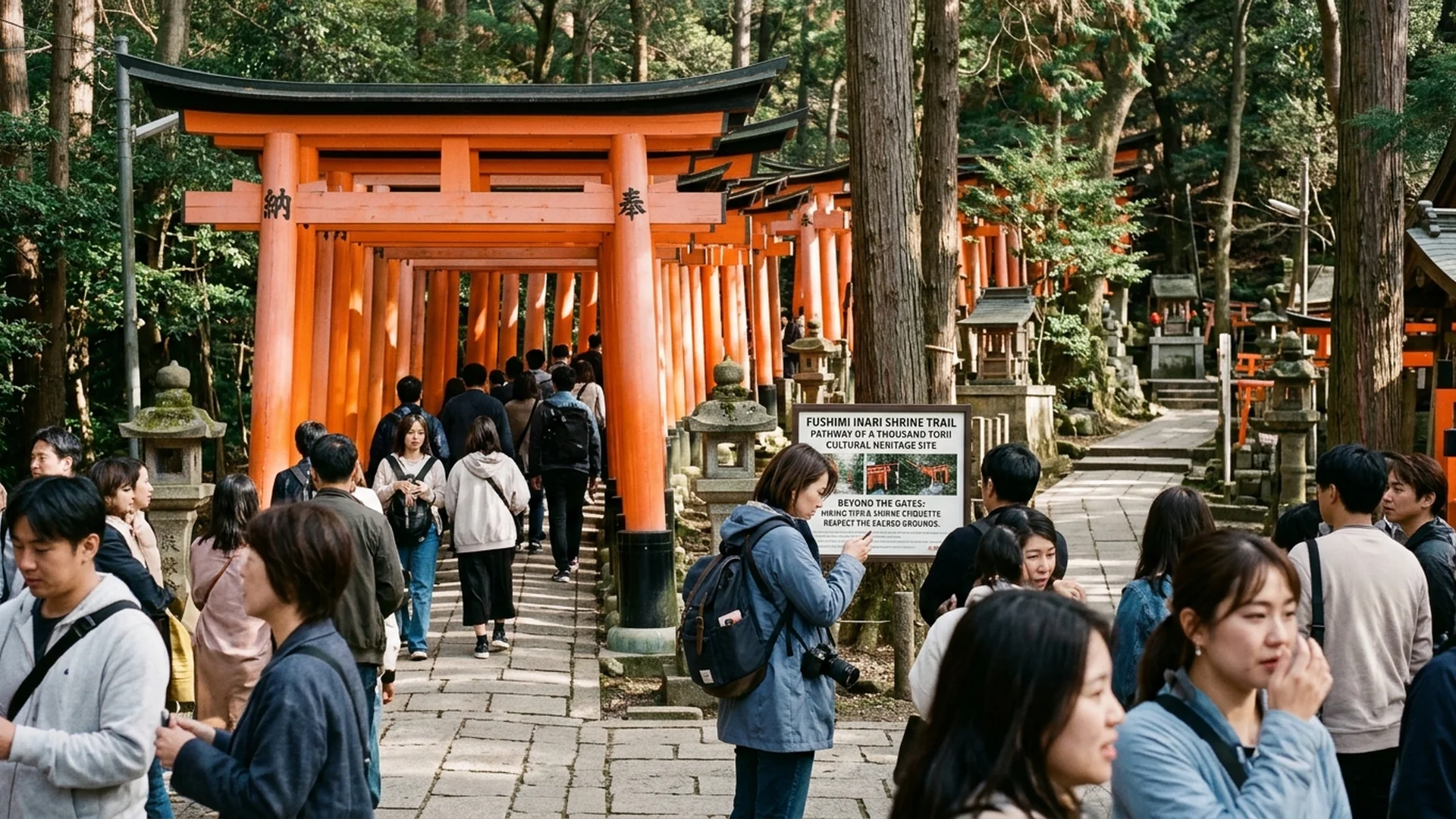
When the first morning light begins to bathe the tranquil forest below the Inari range, a hushed footfall carries us into a sacred realm painted in ten thousand shades of vermilion. The familiar imagery of travelers thronging the grand entrance of Fushimi Inari Shrine often obscures the profound spirit pulsing beneath these fiery tunnels. Yet, as one moves beyond the bustling outer courtyards, the serene dimension and ancient soul of historical Kyoto gradually reveal themselves, accompanied by the gentle whispering of wind through pine and emerald bamboo.
This sanctuary is far more than a celebrated photograph stop for visitors to Kyoto; it is a millennium-old center of devotion dedicated to Inari Okami, the deity of agriculture, commerce, and bountiful harvest. A pilgrimage here unfolds as a journey across time through vermilion corridors winding upward toward a sacred peak—every single step steeped in narrative, faith, and an austere aesthetic of quietude matched by few places on earth.
Legends and Covenants of Faith: The Deity and the White Foxes
The roots of Fushimi Inari stretch back to 711 AD, long before Kyoto became the imperial capital. Inari Okami was initially venerated as the deity of rice and agrarian harvests before evolving alongside Japanese urban life into a patron of business prosperity and mercantile success. Across the expansive grounds, the most prevalent motifs are not architectural alone, but the stone statues of ‘kitsune’ (foxes) posed in varied contemplation. According to ancient lore, these creatures are not ordinary beasts but celestial attendants and messengers of the deity. Some hold the keys to granaries, others sacred scrolls or stalks of rice, collectively embodying abundance and the inviolable protection of this sacred geography.
Senbon Torii: Vermilion Tunnels and the Architecture of Devotion
The defining visual phenomenon drawing travelers worldwide is the ‘Senbon Torii’, or the double-file tunnel of thousands of vermilion gates ascending the forested slopes. The arresting beauty of these timbers lies not only in their striking hue against the dark canopy, but in a centuries-old tradition of dedication. Since the Edo period, merchants, guilds, and enterprises have sponsored the erection of torii gates as expressions of gratitude or prayers for commercial prosperity. Each pillar bears the finely carved name of its donor and the date of dedication, transforming every footstep into a living archive of human faith interwoven with the divine.
Beyond the Threshold: The Secluded Trail to Mount Inari’s Summit
Roughly ninety percent of visitors halt their journey near the lower torii tunnels and retrace their steps. For the discerning traveler seeking depth, however, ascending Mount Inari to its 233-meter summit offers an incomparable reward. The roughly four-kilometer forested loop is punctuated by ‘otsuka’—smaller, hidden shrines embraced by moss and shadow. The atmosphere along this path yields only to the calls of woodland birds and shafts of sunlight piercing ancient cedar boughs. At the summit clearing of Yotsutsuji, travelers are rewarded with sweeping, uninterrupted vistas of Kyoto spread out in profound serenity.