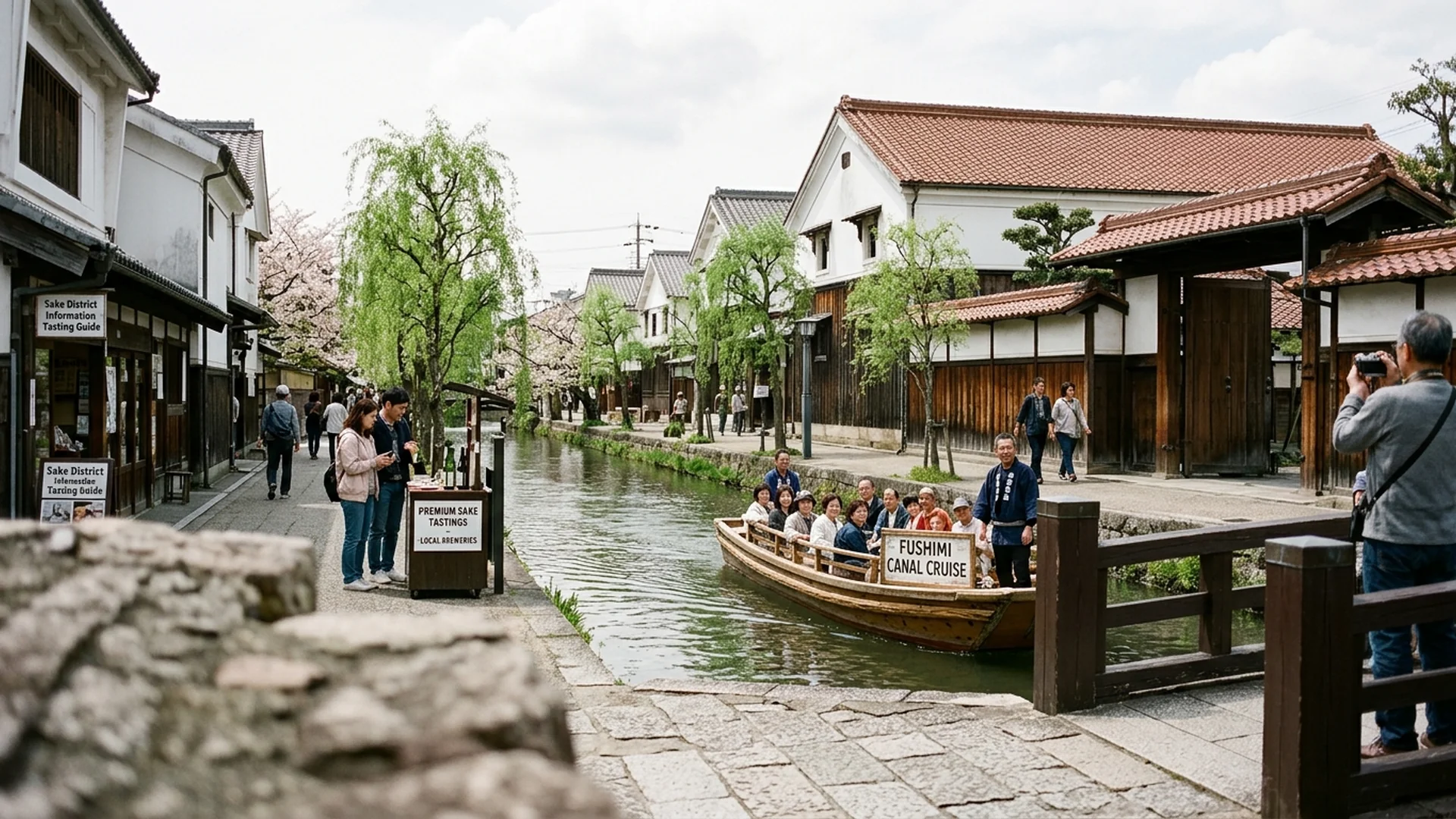
When conjuring Kyoto, the traveler’s mind is invariably painted with dark timber temples and vermilion torii gates piercing through ancient mountain mist. Yet, journeying southward to where tranquil waters meet fertile earth, the city unveils another profound, deeply spiritual visage: the Fushimi Sake District. This historic port town breathes with the gentle pulse of the Edo period, whispering ancient secrets carried by subterranean springs—the sacred lifeblood behind the divine elixirs born here.
Fushimi is far more than one of Japan’s premier brewing centers; it is a living museum suspended in time. Pristine white-plastered storehouses, known as kura, line historic canals, casting immaculate reflections upon glass-like waters. It is an enchanting sanctuary for the discerning traveler seeking refuge from bustling urban corridors, inviting them to indulge in the quiet poetry of flavor and centuries-old craftsmanship passed down through generations.
The Philosophy of Water: The Genesis of Fushimi’s Velvet Brews
At the heart of Fushimi’s extraordinary brewing distinction lies water—specifically, Fushimizu, translating poetically to ‘hidden subterranean water.’ The surrounding Momoyama hills serve as an immaculate natural filtration system, nurturing an underground aquifer characterized by moderate hardness and a meticulous balance of potassium and calcium. This precise mineral harmony allows brewing yeasts to flourish with supreme efficiency, imparting a signature softness unique to the region. Unlike the robust, assertive brews of other prefectures, Fushimi sake caresses the palate with seamless fluidity, leaving a lingering, delicate echo of rice and subtle orchard fruits in its wake.
Navigating the Jikkokubune: Canals and Edo-Era Architecture
To truly comprehend the soul of Fushimi, one must step aboard a traditional wooden vessel known as the Jikkokubune, or ‘ten-koku cargo boat.’ Historically, these modest vessels served as vital arteries transporting rice, sake, and merchants between Fushimi, Kyoto, and Osaka. Today, the gentle craft guides travelers along tranquil waterways flanked by striking storehouses featuring namako-kabe—white-plastered walls marked by distinctive black grid patterns. Overhead, weeping willows sway in rhythm with the gentle current, echoing a timeless symbiosis between human endeavor and the aquatic landscape that has endured for centuries.
Living Heritage and Contemporary Connoisseurship
Within the hallowed halls of the Gekkeikan Okura Sake Museum—a former brewing complex converted into an interactive archive—visitors encounter ancient implements, the rich, earthy fragrance of fermenting mash, and a profound appreciation for the master brewers, or Toji. Beyond historical exhibitions, the district embraces contemporary appreciation at venues like ‘Fushimi Yumehyakushu,’ a stately Taisho-era architectural gem where guests can sample flights from numerous local independent breweries, paired with artisanal confections designed to elevate the nuanced profiles of the pours.