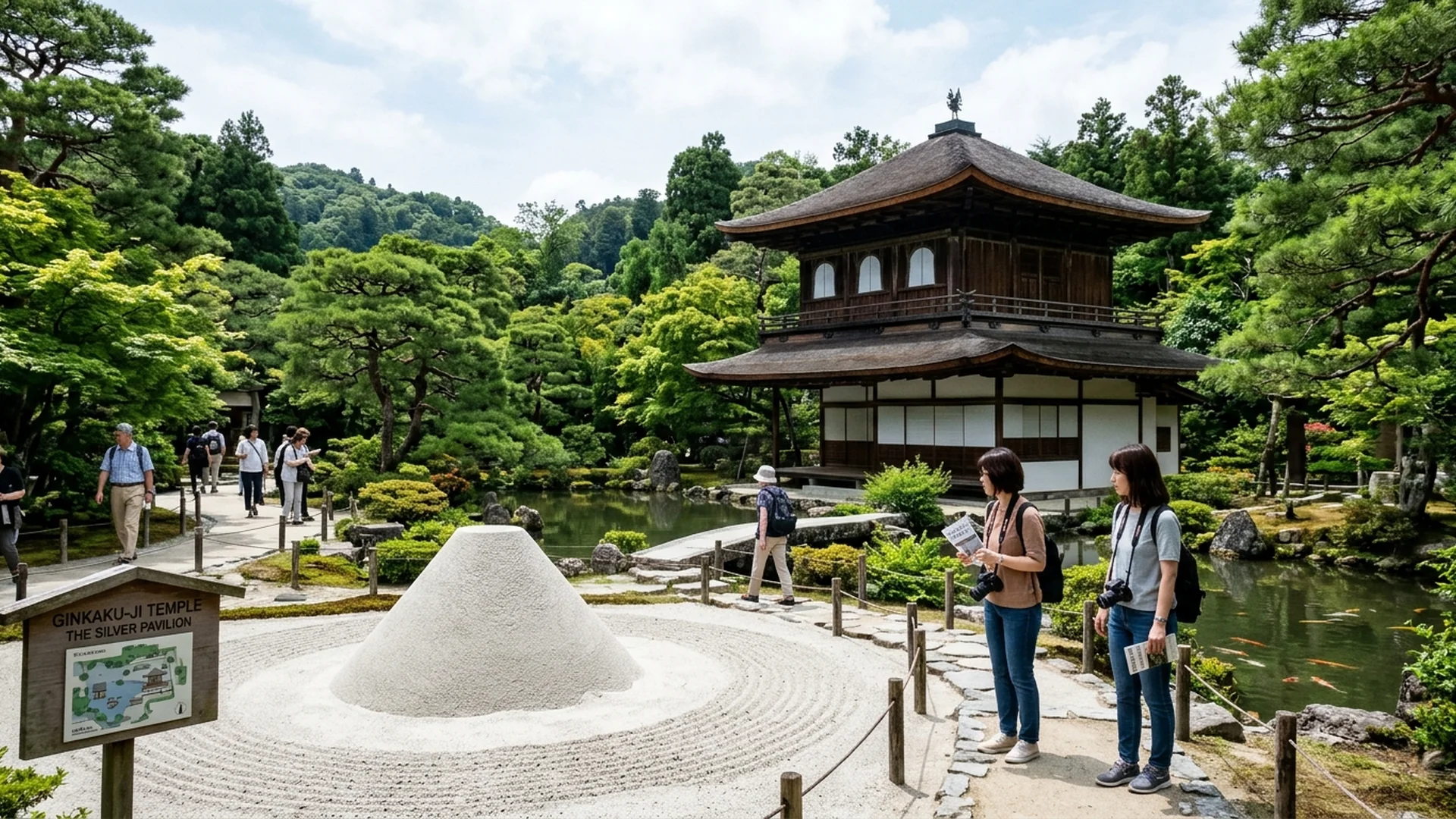
Crossing the threshold of Ginkaku-ji, traditionally known as the Silver Pavilion, one is not greeted by the dazzling opulence of its golden counterpart, Kinkaku-ji. Instead, an understated, profound stillness gently commands every sense, inviting deep contemplation. Never actually coated in silver as originally envisioned by Shogun Ashikaga Yoshimasa, the pavilion’s weathered grace and embracing of imperfection became a pristine canvas shaped jointly by nature and time—transforming it into one of the world’s most influential sanctuaries of Wabi-Sabi aesthetics.
Journeying to Ginkaku-ji transcends a mere architectural site visit; it is stepping backward into the Kansho era, an epoch where domestic political turmoil drove the elite to turn away from superficial extravagance, seeking instead spiritual sanctuary through art, flora, the tea ceremony, and landscape design. These fused disciplines ultimately formed the bedrock of Higashiyama culture, which continues to nourish the soul of Kyoto today.
From Turmoil to Quiet Grace: The Birth of Wabi-Sabi and Higashiyama Culture
In the fifteenth century, amidst the raging fires of the Onin War that reduced the capital to ash, Shogun Ashikaga Yoshimasa retreated from political chaos to construct his retirement villa upon the wooded slopes of Higashiyama. Though the original blueprint grandly intended to sheath the Buddha hall in shimmering silver leaf to rival his grandfather’s Golden Pavilion, shifting economic realities and tumultuous times meant this ambition was never realized. Yet, this very ‘incompleteness’ and unadorned simplicity birthed a revolutionary aesthetic framework known as Wabi-Sabi. Yoshimasa cultivated this sanctuary as a creative nexus for artists, poets, Zen masters, and garden designers, refining the arts of tea (Chanoyu), flower arrangement (Ikebana), and Noh drama. This convergence birthed Higashiyama culture, forever transforming the Japanese perception of beauty from ostentatious displays of wealth toward profound, unpretentious elegance.
Zen Architecture and Visual Art: The Sea of Silver Sand and the Moon-Viewing Cone
The arresting centerpiece that captivates visitors upon entering the temple grounds is the Ginshadan, or Sea of Silver Sand, impeccably raked into precise ridges that evoke vast, serene waters. Standing resolutely beside it is the Kogetsudai, a truncated conical mound of sand. These landscaping masterworks were not designed merely for transient visual pleasure; they are ingenious natural light reflectors. On nights of the full moon, the immaculate white granules catch and diffuse the lunar radiance, casting a gentle, ethereal glow across the courtyard as if moonlight itself were pooling upon the earth. Meanwhile, the main Kannondo—affectionately called the Silver Pavilion—has endured for over five centuries. Its austere dark-wood timberwork and Shoin-zukuri architectural lineage continue to project a humble elegance, merging seamlessly with the surrounding wilderness.
A Dialogue Among Moss, Woodlands, and Mountain Vistas: The Zen Strolling Garden
Beyond the geometric precision of the lower sand courtyards, the pathway ascends into the hillside behind the pavilions, transforming into an expansive strolling garden. Here, over a hundred varieties of emerald-green moss thrive in the moisture of mountain mists alongside ancient trees. The soothing trickle of the Sengetsusen, or Moon-Washing Stream, provides a gentle auditory backdrop that deepens the enveloping serenity. Reaching the highest viewing vantage point along the trail, travelers are rewarded with a secluded perspective overlooking the Silver Pavilion nestled amid dense foliage, with the sprawling expanse of Kyoto stretching toward the horizon. It is an elevated sanctuary designed to quiet the restless mind amidst the grounding scents of damp earth and pine.