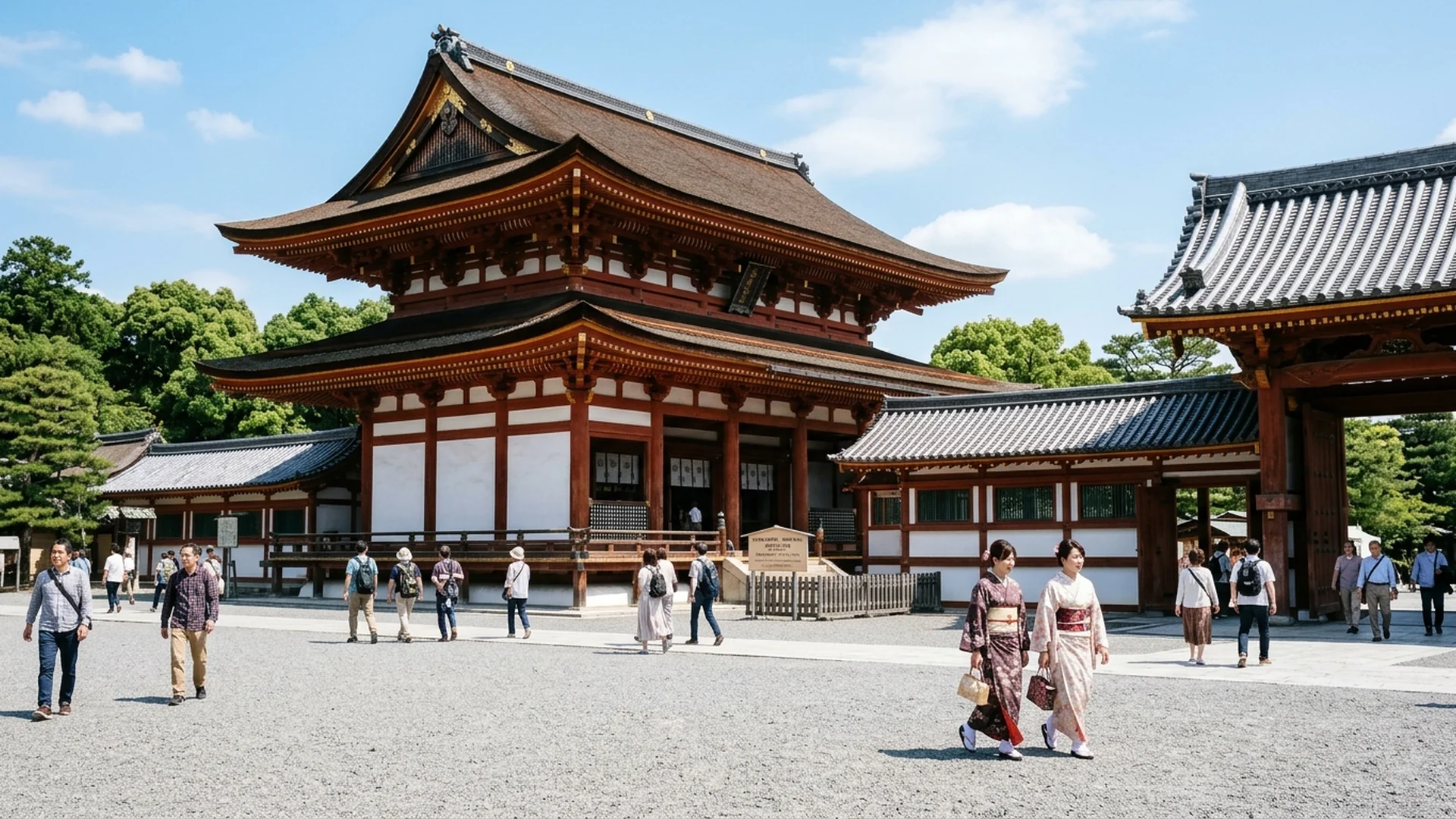
Passing beneath the shadow of the colossal vermilion torii gate standing sentinel over the Okazaki district, the murmurs of the modern world dissolve entirely. In their place arises the resonant echo of a pivotal historical chapter, artfully rewoven at Heian Shrine—an architectural monument of imperial grandeur that transcends the ordinary boundaries of a landmark. It serves, rather, as a temporal bridge, transporting the discerning traveler back to an era when Japanese arts and court culture flourished at their absolute zenith.
Here stands a three-quarters scale replica of the original Heian Imperial Palace, erected in 1895 to commemorate the 1,100th anniversary of the capital’s relocation to Kyoto and to honor the first and last emperors who reigned from this ancient seat. Yet, the true enchantment extends far beyond the striking symmetry and powerful palette of traditional Sino-Japanese architecture. It lies concealed behind courtyard walls, amidst the expansive waters of the Shin-en Garden—a kaiyushiki stroll garden and a masterwork by Ogawa Jihei, who forever transformed modern Japanese landscape architecture into a living poem that shifts its poetic grace across all four seasons.
Architectural Legacy: Decoding the Grandeur of the Heian Era
Upon stepping into the pristine white gravel courtyard of Heian Shrine, the immediate focal point is the Goten, a master replica of the Daigokuden, the principal state hall of the ancient imperial court. Towering timber columns lacquered in brilliant vermilion contrast sharply with immaculate white plaster walls and emerald-green tiled roofs, embodying the refined aesthetics born from Tang Dynasty influence harmonized gracefully with native Japanese sensibilities.
A visit here is akin to turning the pages of an illuminated manuscript from an era when Kyoto commanded supreme cultural and political authority. The expansive scale of the ceremonial plaza and the exacting symmetry of the surrounding pavilions were deliberately conceived to instill a sense of reverence and aristocratic grace, framed perfectly against the verdant, rolling hills of eastern Kyoto.
Shin-en Garden: A Poetic Masterwork of Nature and Landscape Art
If the forward-facing architecture represents formal imperial majesty, the Shin-en Garden wrapping around the rear sanctuaries offers an inner sanctuary of contemplative stillness. Conceived during the late Meiji period by Ogawa Jihei—a visionary landscape architect who redefined the idiom of the Japanese garden—this sprawling sanctuary draws life-giving waters from the Lake Biwa Canal, forming expansive reflective ponds, secluded stone pathways, and lush botanical sanctuaries.
The gardens unfold across distinct eastern, central, and western zones, each possessing a distinct botanical rhythm. The crowning jewel is the Taiheikaku, a covered wooden pavilion bridge spanning the waters, offering mesmerizing reflections of arching eaves and swaying foliage. When spring arrives, the gardens transform as countless weeping Benishidare Sakura trees drape cascades of deep pink blossoms down toward the glassy waters, creating an ethereal tableau that captivates travelers from across the globe.
Cultural Resonance and the Rhythm of Okazaki
Heian Shrine exists far beyond the confines of a preserved relic; it remains the beating cultural heart of the Okazaki Cultural District. Flanked by contemporary art museums, libraries, and performing arts centers, the neighborhood hums with a sophisticated dialogue between historical reverence and modern creative expression.
Moreover, on the 22nd of October each year, the shrine transforms into the ceremonial nexus for the Jidai Matsuri, or Festival of the Ages, one of Japan’s most monumental historical pageants. Thousands of participants don meticulous period attire, tracing an unbroken chronological procession through the centuries and manifesting the living pride of Kyoto’s enduring heritage.