Deep within the tranquil northern mountains of Kyoto, the soft, rushing murmur of mountain torrents acts as an eternal prelude, announcing your arrival at Kibune—a sacred realm where time itself moves with deliberate unhurried grace. Here stands Kifune Shrine, an invaluable historic sanctuary intrinsically bound to the pure waters and spiritual consciousness of Japan for millennia.
Emerging from the vibrant pulse of Kyoto into the deep, mist-veiled forests, an arresting stone staircase unfurls before you. Lined with brilliant vermillion lanterns that contrast sharply against summer’s lush emerald canopy or winter’s pristine blankets of snow, the scene resembles a living masterwork of classical artistry. This revered sanctuary is far more than a mere cultural stopover; it is an immersive space for spiritual purification, navigated through refined rituals and the quiet aesthetic of sophisticated travel.
Ancient Legends of the Water Deity and Sacred Origins
The roots of Kifune Shrine reach far back into antiquity, predating the founding of the ancient capital of Kyoto itself. Legends recount a celestial goddess who sailed up the Yodo and Kamo rivers in a yellow boat until she reached this pristine headwater, commanding that a sanctuary be established to honor Takaokami no Kami, the master spirit of rain and subterranean waterways. Historically, Japanese emperors dispatched imperial envoys to these sacred grounds to beseech the heavens for rain during prolonged droughts or to quell torrential floods. The original kanji characters used for Kifune translate poetically to ‘Root of the Waters,’ underscoring the ancient belief that this secluded gorge serves as the metaphysical source of all hydrological life nourishing the Kansai region. This deep sanctity has long drawn farmers, mariners, and contemplative seekers alike in search of profound inner quietude.
The Aesthetic of the Four Seasons and the Iconic Lantern Stairway
The most enduring visual masterpiece of Kifune Shrine is its sweeping stone approach, flanked by rows of glowing red lanterns that cast a warm, welcoming luminescence as twilight settles over the valley. In every season, this pathway undergoes a breathtaking metamorphosis: spring drapes the surroundings in tender maple greens; summer offers deep, cooling shade beneath towering boughs; autumn ignites the landscape in brilliant amber and crimson; and winter blankets the vermillion frames in immaculate white drifts. The complex itself is thoughtfully divided into three distinct sanctuaries—the Main Shrine (Hongu), the Central Shrine (Yui-no-yashiro) dedicated to matrimonial harmony, and the Remote Inner Sanctuary (Okunomiya). Each sacred station offers its own contemplative atmosphere and spiritual gravity.
The Water Oracle Ritual and Kawadoko Stream Dining
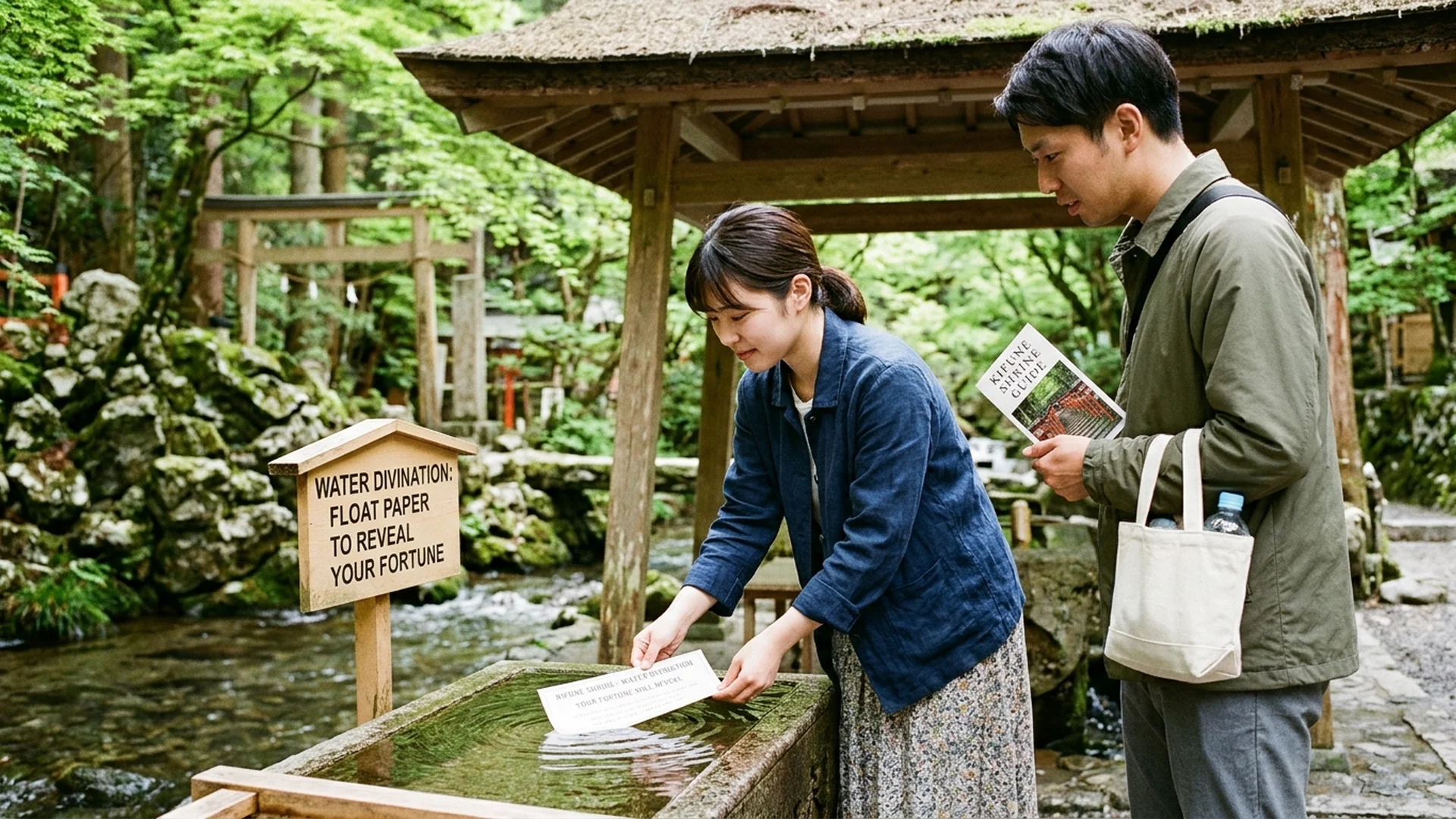
A defining ritual that elevates a journey to Kifune Shrine is the Mizu-ura Mikuji, or water-oracle divination. Travelers select a blank slip of parchment before gently resting it upon the surface of the sacred pool within the courtyard. As if by quiet enchantment, prophetic kanji characters slowly emerge across the paper upon contact with the water, complete with multilingual QR codes for international guests—offering a moment of tactile wonder and quiet revelation.
Furthermore, for those visiting during the height of summer from June through September, the Kibune Gorge plays host to the rarefied culinary tradition known as Kawadoko. Local ryokans and dining pavilions construct elegant wooden platforms extending directly over the rushing, ice-cold waters of the Kibune River. Guests savor exquisite seasonal kaiseki fare, delicate chilled somen noodles, or freshly grilled river trout, accompanied exclusively by the acoustic symphony of rushing water and cool mountain breezes—a sublime synthesis of gastronomy and nature.